Fifteen years ago, McDonald’s delivered Burger King a gut punch in the form of a commercial. It featured a little boy frustrated by his school chums stealing his McDonald’s fries, so he comes up with an ingenious solution: Hide the fries in a Burger King bag. Nobody touched them.
Though it was a McDonald’s affiliate in Germany that created the spot, anyone could watch it on Vimeo—and Burger King was pissed. “McDonald’s has broken the rules of comparative advertising by degrading the Burger King brand,” it fumed. A chastened McDonald’s took the ad down.
How quickly the tables turn.
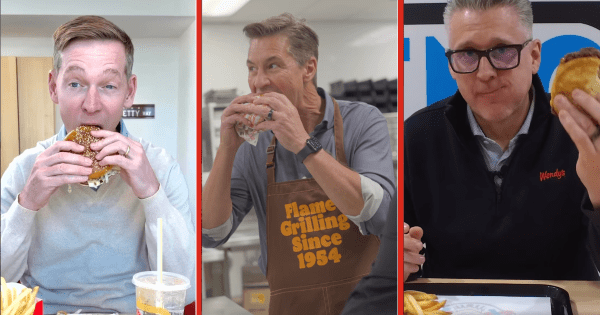
After last month’s social video featuring McDonald’s CEO Chris Kempczinski looking very uncomfortable as he tried the new Big Arch burger, the first brand to taunt him was Burger King, whose president Tom Curtis proved a natural on camera, chowing down on an “improved” Whopper—which BK recently revamped—and asking for a napkin.
That was earlier this week. Then on March 4, Wendy’s U.S. president Pete Suerken piled on by starring in his own video posted to LinkedIn. Standing at the grill, Suerken cooks up a Baconator and adds a jab at McDonald’s often out-of-commission soft-serve machines as he makes himself a Frosty: “Oh wait, our machines are always working!”
Marketing becomes a contact sport
Brands taking pokes at their competition isn’t new, of course. A generation ago, Audi famously roasted all of its competitors in its “Four Key Rings” ad, and Samsung’s Galaxy S6 Edge slammed Apple’s iPhone 6 in 2015. But the recent proliferation of brands dissing and dismissing their rivals suggests there’s a bigger socioeconomic shift underway.
“We’re in an attention economy—playing it safe is often the riskiest move you can make,” said Mike Harris, COO and partner at PR firm Uproar by Moburst. “Brands have watched challengers punch up at category leaders forever. What’s changed is that even the big guys are realizing a well-aimed jab gets you more coverage than a campaign you spent a year and a fortune building. Social media turned competitive trash talk into a spectator sport. And brands are finally showing up to play.”
Yes, they are. The Super Bowl witnessed some notable burns. Anthropic ran two ads (one of them pregame) where grinning-idiot actors represent chatbots that incorporate sales pitches into their advice, to the dismay of people asking for help. The slogan—“Ads are coming to AI. But not to Claude”—was clearly aimed at ChatGPT, though OpenAI’s chatbot wasn’t called out by name.
Then, during the second quarter, Pepsi dissed rival Coke even harder by having a polar bear—one of Coke’s mascots—take the Pepsi Challenge, a blind taste test that first hit TV in 1975. With the two cans of soda right on the table, labels facing out, the bear chose Pepsi.
“The creative isn’t just Pepsi ‘poking the bear,’” PepsiCo said in a release at the time. “It’s a defining moment that brings that brand’s proven taste superiority to center stage.” (PepsiCo did not respond to ADWEEK’s request for comment.)
Bringing back the Pepsi Challenge was one thing. But co-opting a competitor’s own mascot in the effort? That was the move that turned a jab into a right hook.
“What we’re seeing now is a shift in boldness, and it’s worth paying attention to,” said communications and media veteran Eric Yaverbaum. “When Pepsi used the bear in a Super Bowl ad, it became a calculated swipe that turned Coke’s own mascot against them in front of hundreds of millions of viewers.”
In the view of advertising veteran Michael Priem, CEO and president of ad agency ModernImpact, that calculated swipe has become an integral part of marketing strategy for three reasons. First, it “shows up as modern” in an increasingly in-your-face culture. Second, it “squeezes the juice out of the [advertising] investment” by creating a conversation tailor made for social-media. Finally, he said, combat is often what the social crowd is looking for anyway.
“If you have this rivalry effect and your advertising is migrating into social channels, that rage bait creates this huge degree of engagement,” Priem said.
Brands in glass houses
It’s worth pointing out that, with the exception of Pepsi, these brands maligned their competitors by implication, not by name. Anthropic’s ad didn’t call out ChatGPT, and neither Burger King or Wendy’s mentioned McDonald’s or its CEO, affording plausible deniability to all three.
Anthropic and Wendy’s did not respond to ADWEEK’s request for comment, but Burger King sent a statement. “The video of Tom trying the updated Whopper was planned content and the timing of the broader online conversation was coincidental,” the company said. “Our focus is on continuing to build momentum around listening to guest feedback, our Whopper updates, and delivering experiences our guests love.”
Name check or no, it’s still aggressive marketing—and it’s not without its risks. Not every CEO is a natural on camera. Will all the ridicule of Kempczinski start to look like trolling at some point?
“This type of marketing can work in very specific occasions,” said retail analyst Bruce Winder. “The hamburger example is just a bit of fun. However, brands need to be careful not to look too desperate or opportunistic—or like a bully.”
“Throwing shade invites scrutiny, and if your own house isn’t in order, you’ve just handed the press a magnifying glass,” Yaverbaum added. “There’s also the risk of elevating the very brand you’re trying to diminish.”
That may be what Anthropic accomplished with its Super Bowl ads, which helped shine a spotlight on OpenAI CEO Sam Altman’s riposte via X:
“The good part of the Anthropic ads: they are funny, and I laughed,” Altman wrote. “But I wonder why Anthropic would go for something so clearly dishonest. Our most important principle for ads says that we won’t do exactly this; we would obviously never run ads in the way Anthropic depicts them. We are not stupid.”



Comments (0)