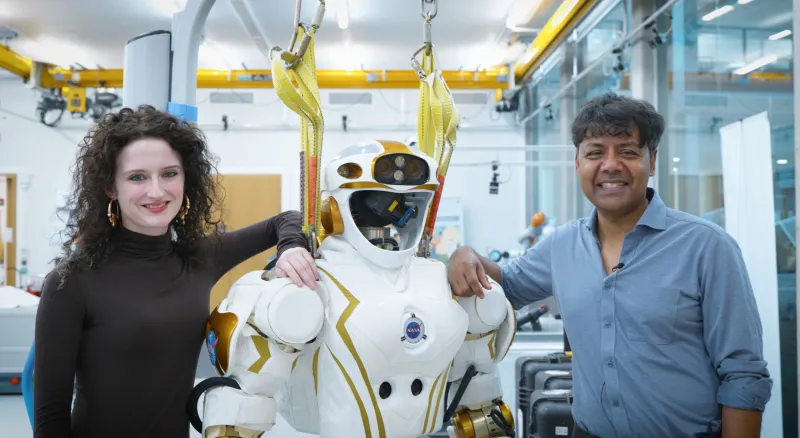
Valkyrie, a humanoid robot that was previously trained to assist NASA with Mars mission preparations, will soon return to the United States after spending nearly ten years in Edinburgh working with researchers to help improve robotic locomotion.
Valkyrie is approximately 1.8 meters tall (6-foot, 2-inches) and weighs around 125 kilograms (300-pounds). For 10 years, it was used at the University of Edinburgh by researchers who wanted to see how humanoids could walk, balance, and recognize their environment.
Only three Valkyrie units have been manufactured. The Valkyrie at the University of Edinburgh was the only one outside of the United States.
The robot will return to NASA's Johnson Space Center in Houston, Texas, after completing a ten-year lease at the University of Edinburgh, where the research program was hosted.
Val — short for Valkyrie — is a 6-foot, 2-inch, 300-pound mass of metal, wires and plastic. (CREDIT: Wikimedia / CC BY-SA 4.0) NASA's Vision for a Humanoid Robot
NASA built Valkyrie to do dangerous work that could not otherwise be done by humans.
The future applications for Valkyrie involved missions to Mars. NASA anticipated that robotic technologies like Valkyrie could be sent to the planet to prepare and maintain infrastructure and conduct hazardous operations before human astronauts arrive.
NASA was deliberate in the design of Valkyrie's humanoid form. The agency wanted to create a robot that could work with equipment designed for the human hand and move through areas built for humans.
Additionally, Valkyrie contains special hardware designed specifically for the safe collaboration of humans and robots. One example is its Series Elastic Actuators, which allow joints to move flexibly and safely instead of with rigid force. The robot also has a network of sensors that allows it to sense and respond to objects and people within its vicinity.
Robotic Research in Edinburgh
In 2016, when Valkyrie was launched in Edinburgh, it had basic functionalities such as being able to walk on flat surfaces and handle objects.
Researchers wanted to develop those capabilities into more advanced forms of functioning.
NASA was deliberate in the design of Valkyrie's humanoid form. (CREDIT: Wikimedia / CC BY-SA 4.0)
Through artificial intelligence and machine learning methods developed at the Edinburgh Centre for Robotics, scientists worked to give Valkyrie the ability to move around different environments. This included real-time navigation of the robot rather than restricting it to laboratory testing.
As the project evolved, so did the development of Valkyrie's walking and manipulation abilities. Researchers collected data from sensors and modified movements based on that data.
Learning to Navigate Complex Terrain
Many of the projects focused on robotic platforms operating in extreme terrain. This included rough ground and unpredictable conditions.
Scientists sought to establish a link between the robot's sensory data and the actions it would take. For example, if the robot detected an obstacle with its camera, it could stop or change direction before running into it.
The enhancements made to Valkyrie improved its flexibility and adaptability when responding to rapid environmental changes.
The Edinburgh Centre for Robotics is a joint initiative between the University of Edinburgh and Heriot-Watt University. This was where the research was conducted.
As the project evolved, so did the development of Valkyrie's walking and manipulation abilities. (CREDIT: MARK RALSTON / Getty Images) Training the Next Generation of Roboticists
Over many years, numerous doctoral students and researchers worked with Valkyrie on a range of projects. These included developing control algorithms that influence robot movement, planning algorithms that determine how robots move through space, and systems that help robots interpret their interactions with the world.
In addition to humanoid robotics research, these projects received support from the Engineering and Physical Sciences Research Council within UK Research and Innovation.
For many young roboticists, access to the NASA Valkyrie humanoid robot was an uncommon opportunity.
“Hosting NASA Valkyrie at the University of Edinburgh provided an incredibly unique opportunity to develop advanced research on mobility and stability, as well as develop a generation of robotics researchers and develop Edinburgh into an emerging hub for robotics innovation,” states Dr. Vladimir Ivan, who was a student at the University of Edinburgh. Dr. Ivan has since graduated, and is now Chief Technical Officer for the Edinburgh robotics startup Touchlab. He continues: “Using Valkyrie as a research platform also led to the development of mobility and stability as a primary focus area of study for many young researchers.”
The Future of Humanoid Robotics at Edinburgh
While Valkyrie will leave the University of Edinburgh, humanoid robot research at the university will continue.
The university purchased another humanoid robot called Talos in 2020. Talos is approximately 1.75 meters tall.
A close-up of the Valkyrie robot being dismantled. (CREDIT: University of Edinburgh)
Researchers are using Talos to examine how humanoid robots walk, maintain balance, and manipulate their surroundings. They are also studying human–robot collaboration, including dyadic human interaction, which refers to direct cooperative interaction between a human and a robot.
Much of this work relies on artificial intelligence systems that allow robots to learn how to adapt to changing and unknown environments.
Ten years ago, the decision to invest in humanoid robotics was uncertain.
"When we originally proposed the use of adaptive learning methods to improve scalability and performance in robot planning and control, people were sceptical about their viability," states Professor Sethu Vijayakumar, Director of the Edinburgh Centre for Robotics and Personal Chair in Robotics at the University of Edinburgh.
Reflecting on that decision, he says the investment helped support the growth of data-driven humanoid robotics.
“NASA was truly a pioneer of the humanoid robotics industry when we started out with Valkyrie, and the hardware they provided us was exceptional,” states Vijayakumar. "We will miss the Valkyrie humanoid robot, and we are grateful for all of the incredible experiences we had with her while she was here."
Related Stories



Comments (0)