
Remember me
Guy Kawasaki:
Good morning everybody. It's Guy Kawasaki. This is the Remarkable People Podcast. There's no way for you to know this, but this is our fourth attempt at trying to do this interview. And you'd think that two old tech guys like David and Guy would be able to do a podcast recording, but it has not been working very smoothly.
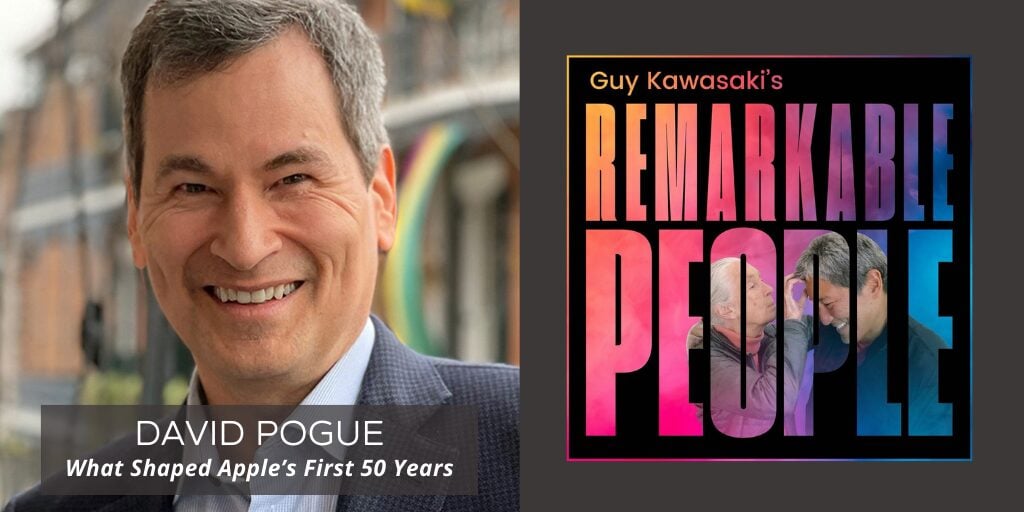
There goes our credibility. But let me introduce today's remarkable guest. His name is David Pogue. And we go back a very long way, Macworld magazine. David has won, I don't know, six or seven Emmys, and he's a bestselling author.
He's iJustine and Marques Brownlee before iJustine and Marques Brownlee were even born. He's worked for The New York Times. He founded Yahoo! Tech. He now works for CBS News Sunday Morning. He hosted twenty episodes of NOVA. Basically, he is the man in tech journalism. And now I learned something that he was trained as a Broadway conductor.
David Pogue:
Ten years. Yeah. I was a pit musician, man.
Guy Kawasaki:
Wow. So yeah, maybe that has something to do with his wonderfulness as a tech journalist.
David Pogue:
You can say it, “show off.” Yeah.
Guy Kawasaki:
Yeah. And the momentous occasion, which brings us together is the publication of this book. And let me tell you something, as a person who was inside the washing machine when the washing machine was running, I learned a shit load of stuff about the company that I was at, and I had no idea.
And listen, this is a really thick book, this is War and Peace of Apple, which War and Peace of Apple is a good description of what happened at Apple. David, first I want to go on the record.
When you first contacted me about writing this book, I had the chutzpah and the balls to suggest that I be your co-author and we write this book together and you very wisely and very diplomatically told me, “Guy, don't even fucking think about it. You're not up to my speed.”
And I have to say, David, now that I read this book, I said, “You made the absolute right decision. I would not have added a damn thing to this book. And the book is better without me.” That's a rare moment of humility on my part. You made the absolute right decision.
David Pogue:
You did give me an absolutely phenomenal interview, 600 pages is a lot, but I hope you at least read your sections because you are so funny in that interview and I used some great quotes.
Guy Kawasaki:
The first thing I did when I got the galley was I went to look for the index so I could only read about me, but there is no index for galleys.
David Pogue:
Oh, that's right. Oh, okay. We've got the hardbound copies now. I'll have to ship you one.
Guy Kawasaki:
The cover should say Apple: The First Fifty Years, David Pogue without Guy Kawasaki. Okay, so first of all, I got to bring up some of your checkered pass. I just learned that you're in the Epstein files. So, I’d like you to explain that for us first.
David Pogue:
I'm in the Epstein files four times. My wife said, “Are you in the Epstein files?” And there's a public website where you can search it. And I popped up four times, all four are people forwarding to Jeffrey Epstein my articles like, “Hey J.E., just thought you should look into this new Sony camera.”
I never met the man. I'm not sure I'd even heard of the guy, but apparently he knew who I was because people kept sending him my articles.
Guy Kawasaki:
Wow. If we had known that earlier, we would've never scheduled you on this interview.
David Pogue:
Exactly.
Guy Kawasaki:
All right. I got to get a little dark right now. So how close did you come to boarding an OceanGate submarine and taking that tour?
David Pogue:
I was on it.
Guy Kawasaki:
In the water?
David Pogue:
Yeah, I was, we were in the water. CBS Sunday Morning did a story about OceanGate and that guy, Stockton Rush, and that was to involve going down to the Titanic on his thing. And so we got up at four o’clock in the morning and we got in and we got bolted shut from the outside and we only got down forty feet when they had some kind of really stupid malfunction.
I can tell you how stupid it was, but I was really pissed because it was a twelve day commitment. And so they canceled the dive and brought us back to the surface. And that was it for our time on the OceanGate. I was very annoyed until I learned that three dives later, that thing imploded and killed everybody.
So it was like a Russian roulette moment. Everyone's always like, “Well, didn't you know it was a janky operation?” And the answer is no. I don't know if it was theater or what, but they were so apparently safety obsessed. There were checklists and countdowns and mandatory countdown stops.
And like they had this rule of three, that if three even little things were amiss, they would cancel the dive. Like the batteries in the flashlight aren't fully charged or the label on the gauge is peeling off, whatever. So what happened with us was we were forty feet down and the sub is mounted to a big horizontal floating sinkable platform.
So you sink to forty feet and then scuba divers come and unbolt the sub, and off you go. They do that so that the launch happens underwater where it's calm.
And while they were unbolting us, one of these four little black buoys on the corner of the platform came untied and popped up, like I said to the guy, “Who cares? The job of the platform is over. No one gives a crap about this stupid buoy.” But it was like this strike three thing. So that was the end of my journey.
Guy Kawasaki:
Wow. This book could have been Apple: The First Fifty Years by Guy Kawasaki without David Pogue.
David Pogue:
It could have.
Guy Kawasaki:
Okay, so I have to tell you that I'm surprised by your reaction because in my mind it was all about this kind of billionaire bro arrogance that we got so much money, we can send everybody up into space for a few minutes.
We can send people to the Titanic, because we're billionaires and we can do anything we want. But that's not exactly the impression I just got from you. They were very careful.
David Pogue:
I know that the narrative is now that Stockton Rush was a crook and a conman and a killer, and he didn't care. I did four interviews with him during those twelve days, and he knew the science, he knew the materials. He had studied all the four previous submersibles that had gone to the Titanic, and he had on staff Paul-Henri Nargeolet, the most experienced Titanic diver in the world.
He'd been to the Titanic twenty-seven times, and he supervised the building of this submersible. And I'm like, “You have no qualms about it's being made of carbon fiber.” And he's said, “Absolutely not. I wouldn't get in it if I would.”
What we saw was much more buttoned down and safety conscious than what we now think of from the documentaries and so on where Stockton was ignoring whistleblowers and all that.
Guy Kawasaki:
Wow. That is 180 degrees of what most people's impression is of what happened there. Wow. But David, I got to ask you a question like, what kind of person would name his company with the word “gate” at the end? There's Watergate, there's all the gates are considered bad, right? Why would you name your company with “gate” at the end?
David Pogue:
Maybe he was thinking that nobody could ever call it a scandal because it would have to be OceanGate gate, and that was too silly.
Guy Kawasaki:
That is almost as dumb as naming an AI company Perplexity. But anyway, that's a different discussion. So now I really want to know, how does one win an Emmy? Because I've never won an Emmy. I don't know how to win an Emmy. How does this happen?
David Pogue:
There are these academies, television, arts and science academies. There's one on the East coast, one on the West coast, and Emmys are for television, right? So television production companies and networks can submit stories for consideration in the various categories. There's news, there's sports, there's children.
It's a big honor, but I will also say it's also a big business because the trophy costs me 400 dollars. You buy those trophies, right? And there are many, many categories.
There's documentary, there's sports, and multiple things within each of these categories. Best, one-off, special, best series, best limited series, best supporting actor, best main actor, best main actress, best supporting actor, and so on.
And times two, because there's an East coast academy and a West coast academy, and they all give out duplicate trophies. So for example, for fourteen years I've been the host of the technical Emmys. And at the tech Emmys we give out awards to like the steady cam and the first four-K camera and things like that.
But meanwhile, I know in the back of my head that a similar event is simultaneously going on the West coast with another host, with another set of winners. So it's a business.
Guy Kawasaki:
Wait, there's East coast, West coast for the exact same award, so you could win an Emmy for the best USB-C cable East coast, USB-C Cable West coast, there's two winners?
David Pogue:
You could, that's absolutely happened.
Guy Kawasaki:
Yeah, and does winning an Emmy change your life? All of a sudden you don't have to make reservations anywhere on the East coast and like Tavern On the Green is begging you to come eat there. Trump Tower gives you free rooms.
David Pogue:
Well, just suddenly, podcast hosts are interested in you.
Guy Kawasaki:
Everybody wants to co-author a book with you.
David Pogue:
I'm a former musician, so we put them on the piano, and I will say there's an instantaneous credibility thing that happens when somebody enters the house, they treat you better. They, the movers, are more careful, things like that.
Guy Kawasaki:
So David, how many do you have?
David Pogue:
Seven.
Guy Kawasaki:
If I give you 400 dollars, will you give me one? And then I can say, have an Emmy, right?
David Pogue:
What kind of public figure idiot thinks that taking a trophy from a genuine winner, Nobel Prize, counts as having earned it?
Guy Kawasaki:
Oh, you mean somebody did that before me? Yeah. Oh.
David Pogue:
I don't know what you're talking about.
Guy Kawasaki:
I thought I was the most clever person to come up with that. I'd rather give you 400 dollars and get an Emmy than have to invade a country. But that's a different discussion.
Okay, so now we covered the Emmy. I'm going down this checklist of my fantasy questions for David Pogue here. Okay, so you've done a lot of interviews with a lot of famous people. I want to know who the nicest person ever was that you interviewed.
David Pogue:
Yeah, I can tell you that. When I was a teenager, my favorite band was Electric Light Orchestra, ELO.
Guy Kawasaki:
ELO?
David Pogue:
It was ELO, “Mr. Blue Sky,” and all that. And it was run by a guy named Jeff Lynne. He wrote all the songs. He was the singer, and then the band broke up.
And so for thirty years, there was no ELO. And then about three years ago, the guy's like seventy now, and he put the band back together and was going to do a U.S. tour of ELO. And they were coming to Madison Square Garden.
I told my wife, “Oh my God, we have to go. This is my inner child healed,” and she said, “Dude, you work for a national news show. Why don't you propose doing a story about him? And then instead of just seeing them from the seats, you get to meet him.”
And if you can believe it, my bosses said, “Yes.” And I went and I got to spend the day with Jeff Lynne at his house in California. And it's always risky meeting your heroes as I knew from the day I met you.
Guy Kawasaki:
I was just about to say the same thing about you, but okay.
David Pogue:
Oh, your intro was wrong about one thing. In 1983, 84 when you were changing the world at Apple. I was in college and all I knew of you was reading about you and your evangelist newsletter would come out during the darker times. And man, I dropped everything to read that email to give myself hope, to tell me that I wasn't diluted being an Apple fan.
So we were not friends in 1983. You were a hero and I was your reader in 1984, so let's make that clear.
Guy Kawasaki:
You seem a lot older than you are.
David Pogue:
Anyway, so yeah, so I got to meet Jeff Lynne of ELO and didn't know if he would be a jerk or what, but he was so nice and so funny and so vulnerable. It was unbelievable.
Guy Kawasaki:
Oh, that's great to hear. Okay, so now I got to ask you the flip side, which is, which of these people gave you the most bullshit? Which was the most difficult?
David Pogue:
I interviewed Elon Musk in June.
Guy Kawasaki:
Yeah, and? This is for CBS, right?
David Pogue:
Yes, that's right. And it was a terrifying interview for a bunch of reasons. One is that every damn person had their own agenda and hopes for this interview, right? Like all these liberal people in Westchester County where I live were all like, “You go there and you cut his balls off on camera,” and then, CBS was being sued by the Trump administration for the Sixty Minutes thing.
And they're like, “You have to be clear. You have to be patient. You can't edit him.” And, meanwhile, Musk's people obviously wanted a glowing thing about SpaceX. So everybody had their own agenda. And I had been told by his people that any subject was open. So I could ask him about politics, I could ask him about Tesla, anything.
So he came onto the set to meet me, and they take a couple minutes to adjust your mics and the lighting. And so during that time, I generally tried to disarm my interview subject by making some small jokes or chitchat. He was wearing a t-shirt that said, “Occupy Mars.” And this interview was taking place at SpaceX on the factory floor where they're building the rockets.
And so I'm like, “Oh, I love that t-shirt. Can I get that in the gift shop?” And he just turned his eyes toward me, dead and cold like a shark. He had come into this interview angry, and I don't know why. He had no clue what I had in mind to ask him. Somebody must have told him like, “This is likely to be a hostile interview.”
I don't know. And then I started asking him a couple space questions, and then I asked him, “You came over to the United States on this program that lets foreign students,” he was from South Africa, “study in American universities, and now your boss is trying to shut down that program. How does that make you feel?”
And he's like, “No, we're not talking about that. We're just talking about space today.” And I'm like, “But your people told me anything goes.” And he is like, “Uh, no.” And so it just made my blood ran cold because I had prepared for a whole thing and I had one vision of how this would go.
And then I kid you not unasked, I didn't bring up Trump, unasked. He starts going, “But I got to tell you something. This Big, Beautiful Bill is a disaster. I don't like it. It's going to erase everything I've tried to do with DOGE in like three months.” And he said, “I think a bill can be big or it can be beautiful, but it can't be both.”
So immediately CBS takes that line and releases it to the internet as a promo for the Sunday where this is going to air and it goes super viral, top left corner of The New York Times. Musk turns on Trump, this whole thing. Trump is asked about it in the White House. We saw a clip from a CBS interview, and the next day, Elon Musk is out of the White House.
I've heard a couple of people say that he intended to use this interview as a way to get himself out, because like he volunteered that stuff. I had not asked him.
Guy Kawasaki:
Wow. I told you to take some ketamine for him when you did that interview. What were you thinking, David? Oh my God, and have you had any interaction with him afterwards?
David Pogue:
No. It was suggested that I contact them after he announced that he was leaving the White House, it was suggested that I seek a follow-up comment, which I did, and there was no response. Yeah, I think that bridge is burned.
Guy Kawasaki:
Yeah, but meanwhile, do you still drive a Model Three?
David Pogue:
I do. I love those cars. Have you tried the self-driving recently?
Guy Kawasaki:
I know that you did it, you loved it. If Lyft shows up and it's a Tesla, I'll get in, but I will not voluntarily get in a Tesla or do anything with a Tesla.
David Pogue:
Just because of the association? Yeah. I know. We do have the sticker on the car, “We bought this before Elon went crazy.”
Guy Kawasaki:
Are you telling me that you would absolutely trust your life to the Full Self-Driving of Tesla right now?
David Pogue:
I do every day. I have not driven manually in like three months. It is extraordinary like you're in your garage, right? You put in the address. You hit start self-driving.
At this point, you can just cross your arms. The garage door opens, the car backs out, does a three point turn to get out the driveway, puts on the signal, turns onto the road, gets to the highway, merges onto the ramp beautifully.
If there's somebody slow in front of you, it puts on the turn signal and passes him and then gets back into the non-passing lane. It knows what exits to take. And when you get to the destination, the mall or the store, it goes up and down the rows of the parking lot looking for the closest space and then parks itself all by itself.
It is so obviously safer and better than a person, like way better. I keep having these incidents like I was showing my dad the self-driving in Manhattan. He's ninety-seven. It was the night before Thanksgiving. It was raining, it was dark, it was horrible, chaotic traffic. And we're at a light, a red light.
And my dad says, “But how's it going to know when to go?” And I'm like, “Dad, it has cameras all around. It can see the light.” And at that moment, the light turned green and the car didn't move.
And I had already come up with some compensatory excuse when this crazy grungy screaming high guy runs from behind, from the back left of the car, diagonally across the front fender, screaming in the rain.
And the car had seen it from behind and projected the trajectory of this guy. And if it hadn't, I would've plowed him over. There's no question the car saw him before I did.
Guy Kawasaki:
Madisun, I'm in a big moral dilemma. Should we edit out that whole section where David Pogue is testifying to how great Tesla is? Ah, man, of course. You got to put this into context. This is the same guy who got in OceanGate and was ready to go. So, okay, you're one of the few people in the world who have interactions with Steve Jobs and Elon Musk.
Which of these two people do you think has altered the universe more? Elon or Steve?
David Pogue:
Wow. I think it's impossible to answer because both of them hugely and in different ways.
Guy Kawasaki:
Don’t be chicken shit, David. I need a good answer.
David Pogue:
I guess Steve, because in 1976 when Apple was founded, no one had ever seen a computer like in person, right? Corporations and governments had computers. They did not have keyboards.
They did not have screens. You operated them with flippy switches on the front, and they gave you your answers with punch cards or lights that light up. And it was Woz who first thought of attaching a TV screen and a keyboard, and then it was Jobs who said, “We should market this and bring this to the masses.”
So those two guys with the Apple One, especially the Apple Two, brought computers into homes like to make it something that everybody could own, which was something no one thought coming. And that led to everything else.
And that led to the phone, which led to social media, which led to Airbnb, Tinder, Grubhub, all the social media sites, which has changed the world politically, culturally, environmentally.
All because of that central mission of putting advanced technology into the hands of everybody.
Guy Kawasaki:
All right. We might as well tackle the Apple question now. After all, that's why you're here. How much more can I endorse your book without talking about your book. But anyway, as I was reading your book, I said to myself over and over, “I didn't know that was true.”
Like the first time was I didn't know that Apple was the fourth thing that they did together. So correct the record. Two guys in a garage start Apple. Can you just give us the full story? Because I didn't know the full story.
David Pogue:
Yeah. No, Apple didn't start in a garage. That's another myth. I will tell you, so I interviewed 150 people for this book, you among them, that was an unbelievably great interview.
And, like 40 percent of these guys, the first thing out of their mouths was, “Please get it right this time.” Because all these previous books, first of all, they tend to be written by business writers, so they have a sort of executive boardroom focus.
I'm a technology dude, so I wanted it to be more about the origin stories of the products and the technologies and stuff like that. So I really tried to fix the game of author telephone that's been going on for fifty years, where the first Apple book cited a story that wasn't true. But then the next Apple book author refers to the first book as source material.
And the story keeps getting propagated on and on, like there's the story that everybody tells about the iPod. Jobs wanted it as small as possible. And so they brought him a prototype and they're like, “Here you go. See, this is as small as it's going to get.” And he drops it in the aquarium, in the fish tank and air bubbles come out.
And he's like, “See those air bubbles? That means there's still room in there. Make it smaller.” What a wonderful story. Absolutely not true. Not a single person remembers or could say that. Yeah. It turns out that this was the fourth business of the two Steves. They had gone into business locally trying to sell the Apple One, of course, which wasn't called the Apple One.
It was just Woz's Circuit Board. That was the first one. The second one was they were hired by a local timeshare company. These are companies who would own a minicomputer, and let poor non-corporate slobs connect to the online military network remotely by dialing in.
They wanted the two Steves to build a little 200 dollar terminal that this guy could sell to clients who wanted to use his minicomputer remotely.
And then there was the “blue box.” That was a huge one. When Woz was in college, he built this little device that could mimic the touch tones of telephones, dialing the bell phone system and make free phone calls. And once again, as with the Apple One, Jobs was like, “Dude, that's amazing. We should sell this.”
And so he began marketing this thing to college kids who would make free phone calls and save a lot of money. So Apple was actually the fourth one. And you probably know this, Guy, but a lot of people don't realize that there was a third founder who was cut in for 10 percent. This guy, Ron Wayne, that Jobs knew from his work at Atari.
And Ron was an entrepreneur. He was a jack of all trades. He was an engineer. He was a draftsman. So he made Apple's first logo. He designed a case for the Apple One. And more to the point he got Steve Jobs and Woz over the hump of some disagreement stuff. And he said, “Look, let's found you as a company.”
And on April First, 1976, the three of them signed the founding documents. Ron Wayne, if he had held onto his stock, today would have 400 billion dollars, but instead twelve days later, the two boys, the two Steves who were by the way young, long-haired, grungy. Jobs was barefoot and smelly. He did not use deodorant.
He did not do good hygiene. He was a very counterculture kid. They got a loan for 15,000 dollars’ worth of parts to build these Apple Ones. And Ron Wayne was on the hook for some of that because he was one of the founders. And he had just gone through some really nasty startup entrepreneurial disasters where he was on the hook for loans that he couldn't pay back.
And he was like, “Dude, I'm forty. This is crazy. What am I doing messing with these two twenty-year-old hippies with a 15,000 dollar loan? I'm out.”
So he went back to the Santa Clara registrar's office and took his name off the agreement twelve days later. So they paid him 800 dollars. And then Apple's lawyers said, “We'll give you another 1,500 dollars if you'll agree that this is really it.”
So that was it for Ron Wayne. He's never done an interview. I tried to reach him for the book, couldn't find him. He wrote a little memoir, which is really sweet. He's like, “Everybody wants me to say I regret backing out. And honestly, I did what I had to do at the time, and I've never starved, so I'm okay,” which is really moving and mature and sweet.
And so on March Eleventh, I don't know if that's before or after this is aired, but March Eleventh, I'm launching the book at the Computer History Museum in Mountain View with special guests on stage, we’re having John Sculley and Chris Espinosa and Avi Tevanian and so on.
Woz is going to make a video appearance, we hope. Who emails the museum from nowhere? But Ron Wayne, he's like, “Do you think I could say a few words?” And I'm like, “Hell yeah. No one's ever seen you.” So he's going to stand up and I'm going to ask him a couple questions at this thing. Somebody should make a movie about that.
Guy Kawasaki:
Wow. By the way, David, thanks for the invite.
David Pogue:
We'll drag a folding chair on stage for you, Guy.
Guy Kawasaki:
No, I'll be in Hawaii.
David Pogue:
We didn't want to bother you.
Guy Kawasaki:
Yeah, I can tell you something though, I have very strong feelings about John Sculley these days after his Christmas vacation. We can get into that later.
David Pogue:
Why? I didn't know about this.
Guy Kawasaki:
Oh, so on his social media for Christmas, he's posting pictures like, “Here we are at the White House at the Christmas celebration. Here we are at Mar-a-Lago with the Trumps for Christmas celebration.”
David Pogue:
Sculley?
Guy Kawasaki:
John Sculley. Absolutely.
David Pogue:
Wow.
Guy Kawasaki:
I’ll send you pictures. John Sculley is now Donald Trump's BFF.
David Pogue:
I did not know that.
Guy Kawasaki:
Yeah, disinvite his ass and I'll take his place.
David Pogue:
That's so weird because in the ten years he was the CEO of Apple, he was sort of Independent, but he campaigned for Clinton and was up for Secretary of Commerce under Clinton. What happened?
Guy Kawasaki:
That's why you should have had me as a co-author, I would've prevented things like this happening, but okay, you can only lead an author to the water. You can't make them drink. What can I say there?
David Pogue:
I've heard that.
Guy Kawasaki:
All right, so now I love Woz. Woz has been on this podcast. I think Woz is the purest form of engineering that I have ever met, and he deserves a lot more credit than he gets, but I want you to, with all the stories that Chris Espinoza has told you and all that, give us one Woz story that best captures that character.
David Pogue:
I have to say, I am so moved by this man's generosity. He is the opposite of the modern tech bro CEO. He gave away all his Apple money like years ago. He founded the San Jose Ballet, a children's museum, the tech museum in Silicon Valley.
He funded a music festival. He lost millions of dollars, but he got U-Two and Sting and all these great bands to perform. And then he repeated it the next year, even though it was a money loser. It was so much fun.
He's just so generous and you know this, Guy, but when Apple went public, the single meanest thing Steve Jobs ever did was to give stock options to every executive and every full-time staff member, except the guys who had been with Apple from before it was Apple who helped build the Apple One circuit boards in the garage.
The guys who were, they were technically contractors, not full-timers when Apple was underway. And that was his argument. You guys aren't full-time, so you get no stock. These were some of his best friends, so it was the most vicious cutout like all around them.
These guys buddies were now millionaires and they got nothing. So Woz said, “Don't worry, I'll give you some of my stock.” And he did. He gave about a million dollars’ worth of stock to each of these guys just to make them whole. And Apple's lawyers flipped out. They're like, “You can't do that. The paperwork, the 1099,” whatever.
And he's like, “I don't care. I'm giving them money.” So they nicknamed this the Woz Plan and he made a bunch of people whole for no reason other than he thought it was the nice thing to do. And he's generous of time, he sat down for an interview for this book, another interview for this CBS Sunday Morning story I'm doing.
And between these two interviews, he made himself available by email for historical questions and technical questions anytime of the day or night. He would answer me within hours. The man is genuinely a gift, a legend. I can say that fully.
Guy Kawasaki:
Yeah. I think David, I would also add some data there that if Woz is generous with his time and effort for you. It really means that Janet likes you because if Janet doesn't like you, your ass is grass, David, and you would not get the time of day from Woz if Janet doesn't like you.
David Pogue:
I agree. She's a very good gatekeeper because everyone wants a piece of Woz. Especially at the Fiftieth anniversary, like everybody wants a little bit of Woz and so she guards his time judiciously.
Guy Kawasaki:
As I look back, the way I got on the good side of Janet was I once helped them figure out how to get a visa to Russia because getting a visa into Russia was a non-trivial task before we knew Stephen Miller and stuff, but yeah, it was very hard to get a Russian visa. And I figured out the most expeditious way was, and I helped them and that’s why Woz was on my podcast.
David Pogue:
Wow. Well done.
Guy Kawasaki:
Yeah. No, nothing illegal or anything like that. It was just, you got to know the tricks of the trade here.
Let us make a stipulation that Steve Jobs was an asshole. Would you say he was a mission-driven asshole or an ego-driven asshole? Because there are different kinds of assholes. I've been in Silicon Valley for forty years. I'm kind of an expert in assholes and, not in the proctological sense, the billionaire bro sense. So what kind of asshole was Steve Jobs?
David Pogue:
I didn't know him in the eighties. You did. And in your interview you told me, “Listen, I've been in Silicon Valley a long time. I know my assholes,” and I quoted you in the book, and you said, “The difference is that Jobs was a mission-driven asshole.”
So I get my answer from you, and which means like they're very much two different philosophies on his cruelty. And there are some who say, “He just had a mean streak, and he just got off on ripping people apart.” But then there are other people who said, “No, it was all a means to an end of getting you to rise above your self-imposed limitations and do better work.”
And many people told me this, and they would give examples, “I was in this engineering corner, and I just couldn't figure it out. So I said, ‘We're not going to be able to get this feature in.’ And then Jobs ripped me apart. And over the weekend I went back to it, and I found a way,” I kept hearing that and Jobs said that himself.
He said, “This is a way to motivate people to brilliance levels that they didn't think they had.” And also we should say, there are two Steve Jobs, right? There was the young Steve Jobs in his twenties who founded Apple and hired Guy Kawasaki, and then he left for eleven years, did next in Pixar and then he came back in 1997, older, wiser.
He'd had much more experience managing people and he was supposedly much more chill upon his return.
Guy Kawasaki:
Suppose is a very strong word there.
David Pogue:
Yeah. Was he not?
Guy Kawasaki:
I don’t know because I wasn't there the second time. My last interaction with Steve, I believe is when he wanted to offer me the job of running Apple University and I turned him down. I figured that decision cost me maybe seventy-five million dollars.
But then I quit two times before, so I think all in all, by quitting twice and turning Steve Jobs down, probably 350, 400 million dollars. But, David, I know you're the big mocker of tech journalism, but for most people, David, 400 million dollars here or 400 million dollars there, it adds up to real money after a while.
David Pogue:
That's real money. Yeah, exactly. But Guy, what is it worth to have your integrity? You maintained your integrity.
Guy Kawasaki:
About 395 million dollars. I have thought about this. Hearing the Ron Wayne story makes me feel a lot better because he lost 400 billion dollars. I only lost 400 million dollars, right? But I got to tell you, if I had stayed at Apple, I would not have tried to start companies. I would not have become a writer.
I would not have become a podcaster because Apple cannot tolerate anybody inside of Apple getting more attention than the CEO or whoever.
So Mark Rober was at Apple, and he started getting twenty-five million YouTube subscribers, and Apple PR couldn't handle that Mark Rober had more subscribers than Apple.
Anyway, if I had stayed at Apple, I would be just an insufferable asshole, which maybe I am already, but I would be a richer insufferable asshole. So now where do you come down on this argument?
This is a very existential argument that I have not resolved in my mind. So was being an asshole made him be successful or was he a success so that people tolerated his assholeness like this is chicken versus egg here. Is there a causative relationship there?
David Pogue:
Yeah, I really, really hate to say this, but I think having zero social skills and being an asshole, like him and Elon Musk, plays a part in their changing the world because life is filled with red tape and naysayers and regulation and the way things, we've always done it.
Both of these guys were knives. They just cut through the tradition, the pushback. They just had no patience. They had a vision and they wanted to get there, and they both want to get there soon. And I got to say the way they treated people was an element in how much they got done.
Guy Kawasaki:
But my counter to that, David, is I would say that Elon and Steve are or were assholes, but they also had vision and I mean, they had a lot of stuff and my greatest fear when people study Elon and Steve is that they only understand the asshole part.
The asshole part is easy. Anybody can be an asshole, right? You just buy a Porsche. You drive alone in the carpool lane. You park in the handicap slot. That's not hard. The asshole part is easy.
It's the visionary part that's hard. And otherwise everybody would just wear a black mock turtleneck, and they'd all be in prison for selling a magic machine that takes one drop of your blood and diagnose everything. Anyway, don't get me started on that.
David Pogue:
No, you're exactly right that people take the wrong lesson from the success of these guys. What's that phrase about necessary, but insufficient? Like yes, you do have to have a vision, and you have to be driven, and you have to be singularly focused, but you can't just be singularly focused.
Guy Kawasaki:
An asshole.
David Pogue:
An asshole, yeah, exactly. That has been proven not to work over and over.
Guy Kawasaki:
I studied Latin in high school, and the phrase is “Post hoc ergo propter hoc,” which means, “Just because it's after this doesn't mean it's because of this.” You can use that for your next book there. “Post hoc ergo propter hoc.” Yeah.
David Pogue:
That's good, Mr. Latin.
Guy Kawasaki:
More value from a co-author. So now in today's Apple, I am fully cognizant of this kind of retroactive, flattering yourself, “When I was back at Apple, we really innovated, or, when I was your age, I was really working hard and blah, blah blah.”
So taking that off the table, I have to say that in my greatest dreams for Apple is they create a product that is to iPhone and Macintosh what Macintosh was to the Apple Two, which mean Macintosh made me forget the Apple Two. So what is going to make me forget iPhone and Macintosh?
And it's not the goggles that you put on your head. It's not the Apple Watch, maybe Apple glasses, but do you have any insights? David, seriously, when is the last time you were willing to go to midnight to Manhattan to camp out in front of the Apple store, so the next morning you could get the first one?
David Pogue:
The iPhone was it. Yeah, I know. In the Tim Cook era, we no longer have that Steve Jobs thing of every three years there's another world changing platform. That is demonstrably true. Tim Cook has tripled the revenue, the profit, and the headcount of Apple in his time. So he is spectacularly successful.
And by the way, all the while adding a layer of civic responsibility, sustainability, accessibility, really, charity, you know, Jobs never gave any money to charity.
Tim Cook instituted an employee thing where they'll match any money that any employee gives, they'll make donations of twenty-five dollars an hour to your favorite charity based on how many hours you volunteer for anybody.
Things like that don't even get a lot of play. So the question, is Tim Cook incapable of doing another major platform, or has that era just passed? There was the Vision Pro, there was the car. Not many people talk about the Titan Project that the Apple Car, beautiful, self-driving, most advanced electric car in the world.
They spent ten years on it, ten billion dollars, 1,200 engineers, and ultimately canceled it because they weren't quite getting there. And meanwhile, margins on cars are not good. The world had changed, so one argument is Tim Cook is just not a hardware product visionary like Jobs would, so that era of Apple is over.
The other way to look at it is, Steve Jobs came along at an incredible time, a time of miniaturization and memory getting cheaper and material science advances that nobody since that time, even Steve Jobs, could have kept it up. We haven't seen any iPhone level inventions from any company since he died.
So there's that argument that we all knew Jobs during the key years of invention and innovation, and all the low hanging fruit was plucked. And Tim Cook and nobody can repeat it.
Guy Kawasaki:
But David, I could make the case that of all companies in the world, the company that can most integrate artificial intelligence is Apple because Apple owns your phone. Apple owns your computer, Apple owns your glasses, Apple owns your watch.
You don't have to add Gemini, you don't have to add Open AI, you don't have to add any, everything is built in. But freaking Siri, you cannot tell Siri to tell you the time, and it get it right. I do not understand that.
And now, I don't know if it's to their credit or to their fault that they're going to use Gemini. But like why can't they be the world shattering patent pending, curve jumping, revolutionary integration of AI into all their systems?
David Pogue:
Yeah, I know. They kind of blew it. I love what they showed in 2004 at the developer's conference where you say to Siri, “What time do I need to pick up my mom?” And behind the scenes it goes through your email to learn that your mother's coming to visit. Then it checks your messages to find out what the flight number is.
Then it goes to flightaware.com and learns if the flight is late, then it goes to Google Maps and learns what the traffic is like, and in a blink of an eye it says, “You need to leave at twenty past one o-clock in the afternoon.” That was so cool. And here we are speaking a year and a half later and there's still no sign of that feature, but that would be amazing.
That would be a leap ahead of Open AI. That can't do that.
Guy Kawasaki:
David, I obviously use all Macintosh and iPhone products and I'm on my iPhone and I'm texting, and I want to send a message to my wife. “What time should I be home for dinner?” And when I input “for,” it comes out “fir,” F-I-R. And with a modicum of intelligence, you would think that Apple knows that I'm not into trees.
I never ever text about fir or oak or eucalyptus. AI can write entire books based on the statistics of the probability of the following syllable. But Apple Messages thinks that when I type in “for,” I am typing in “fir,” because somehow I'm going to ask my wife, what kind of tree are we going to have for dinner?
I do not understand that. Anyway, I digress. So now let us talk about this. I have never met Tim Cook. It's not clear to me Tim Cook even knows who the hell I am or cares. But what I do not understand, David, and this is one of the greatest mysteries in my life is of all people, of all companies, why is Apple doing this thing with the Trump administration?
Now, I realize you work for CBS News, so we can just end it right here because I don't want Bari Weiss's head to explode, but I do not understand. Okay, so you give a million dollars to the inauguration, all right. So you had to pay your dues, you appear on the stage, okay.
But all of this, like giving him a trophy and donating to the East Wing destruction, and then on the date that Alex Pretti is killed, you're taking selfies at the Melania unveiling.
I do not understand this. David, please explain this to me. The slogan or sort of the phrase for Apple was, “We're about to make the world a better place,” and now it seems like, “We're about to avoid tariffs.” That's the mantra of Apple. “We avoid tariffs.”
David Pogue:
I think very clearly that, they won't explain Tim Cook's behavior, but I think it was very clearly along with the universities and the law firms and the news networks and all these other people who are afraid, they know that with some very simple appeals to the president's ego, they can avoid business disaster.
A 3,500 dollar iPhone, which is what it would cost for it made in the United States, would be a disaster. That wouldn't serve anyone, right? Not Apple, not the shareholders, not the customers. So my guess is that they were shrewd enough to say, “Give the guy a trophy and he'll leave us alone.”
And it worked. Depending on your politics, this was just a shameless, disgusting, spineless suck up, or an incredibly shrewd, one time, low cost, strategic move that worked.
Guy Kawasaki:
And pray tell, where are you on this argument?
David Pogue:
Oh my God. If I were in that position, I would just implode. I don't know. It was a no win, right? If I were the university or the law firm, I think they would've survived without capitulating the way they did.
The tech companies, the hardware companies like Apple, I think we're in a harder spot because a 3,500 dollar iPhone, that's doomsday.
Guy Kawasaki:
Yeah. That's why I'm not CEO of Apple. I could not have done that. So David, I think that you are damn lucky that Apple started in 1976 because if it started in 1977, you in the first fifty years, you would've had to cover this whole issue of tariffs and Trump.
David Pogue:
Oh, it's in there. It's in the book. Yeah. I was updating as late as December.
Guy Kawasaki:
Yeah, but December is a long time ago.
David Pogue:
That's true.
Guy Kawasaki:
That was before Minneapolis and all that, right?
David Pogue:
That is true.
Guy Kawasaki:
Yeah, so you're lucky.
David Pogue:
The trophy incident is in there, but not Minneapolis.
And that's exactly what I said is that, depending on your lens it was either super shrewd or super sycophantic and disgusting.
Guy Kawasaki:
Yeah. So I got to ask you this because, and I bet you asked Chris Espinosa and other people like this, and I don't know the answer, and people ask me this all the time. I wasn't exactly Steve's BFF, and I wasn't in his inner circle like Chris Espinoza and stuff. But if Steve were alive today, how would've this played out with the Trump administration?
David Pogue:
Oh man. Dude, that's an impossible question. I have no idea.
Guy Kawasaki:
I want to win an Emmy for podcasting. So I got to ask you the tough questions, David. I got 400 dollars. I pay for the Emmy. No problem.
David Pogue:
Do we even know Jobs’ politics? Was he a Republican? Was he a Democrat?
Guy Kawasaki:
We kind of know Laurene's politics, right?
David Pogue:
Yeah, that's right. We know Jobs was very pro education. So in that way, he was an empathetic, charismatic person, but he was also virulently against teachers unions who said they were destroying education. So who is he? Everybody wants to know about Jobs, right?
You can read a 600 page book on Steve Jobs and still not feel like you know him. And the reason is, first of all, there were multiple Steve Jobs eras, like we talked about. Second of all, there were multiple Steve Jobs personalities.
Sculley said, “No question. The guy was bipolar, he would cry really easily and he was hilarious. He was like screamingly funny. He could eviscerate you. He could put you on a pedestal.”
And so I interviewed Andy Hertzfeld, one of the key engineers on the first Macintosh, and he said, “Any adjective you could use to describe a person you could describe him with, like he was all the adjectives, which makes him impossible to pin down.”
Guy Kawasaki:
Yeah. Oh, as I look back, man, I think what a privilege and honor it was to work for him. To use a sports analogy, I bet it's like saying, “I played for Bobby Knight or Vince Lombardi.” Really, I would not be where I am were it not for Steve Jobs. I freely admit that. It was amazing.
David Pogue:
Have you ever told people on this podcast about the Macintosh unveiling? You had the greatest description when you talked to me, so everybody knew that Apple was about to revolutionize computers by releasing a relatively low cost machine with a graphic interface, right?
It could do fonts and graphics and animations. And everything before that had been text commands, memorized commands, and you told me that you were in the Flint Auditorium.
Guy Kawasaki:
Wait, I told you this story?
David Pogue:
It was amazing. You said, “It was like a revival meeting.”
Guy Kawasaki:
Okay. The emotional side of this.
David Pogue:
The emotional side. Yeah.
Guy Kawasaki:
Yeah. This was like, we're witnessing the birth of Christ. It's hard. I get all choked up just thinking about it. It was fricking amazing that we were completely and utterly convinced that we were saving the world ironically, from a totalitarian government and a totalitarian world like 1984 won't be like 1984.
Come to find out 2024 is like 1984, but that's a different discussion. And it was the most moving, amazing thing. I would say it's second only to witnessing the birth of my children. Yeah, it's truly amazing. Yeah. And anybody who was there who tells you different either wasn't there or was asleep, or I don't know, something's wrong with them.
David Pogue:
Yeah. People's tears were streaming down people's faces. It was just, yeah, like you said.
Guy Kawasaki:
Yeah. We who were in the Macintosh division at that time, after that, they took us to the parking lot and there was this big truck and we all got Macintosh 128Ks that in the back said, “In appreciation,” and it said, “To Guy Kawasaki,” or “To Mike Boich,” or “To Andy Herzfeld,” or whatever.
Did you know that we all got one?
David Pogue:
Yeah, I did. That's in the book. Yeah.
Guy Kawasaki:
Yeah.
David Pogue:
Do you have yours? Do you still have it, or do you put that on eBay?
Guy Kawasaki:
I don't know where the hell that computer is.
David Pogue:
Oh, no.
Guy Kawasaki:
Because 1984 to now, I moved about five times, and I think we were living in Palo Alto just after we got married and there was this condominium and there was an attic.
And I think we put some stuff in that attic and then we moved out and forgot to empty the attic. So one of these days I'm going to knock on that door and say, “You don't realize, but in that closet there's an attic, and in that attic there might be a Macintosh with my name on it,” but I'm afraid of getting arrested by doing that.
And like this crazy Asian guy, like wax on, wax off, attic on, attic off. And he came to my house, and he said he wanted to get the Macintosh out of my attic. And I had him arrested and that would be a great story.
David Pogue:
No, you could be like, “Knock, knock, doc. Don't you know who I am?” They let you in.
Guy Kawasaki:
Yeah. And you know what they'll say, “Oh, didn't you write Rich Dad Poor Dad? And I go, “Ah,” so David, I'm going to let you off the hook now before CBS News fires you.
And I just telling you who uses an Apple product and cares about Apple in an emotional sense, you absolutely should read the War and Peace, the definitive history of Apple by David Pogue and only David Pogue, and it's called Apple: The First Fifty Years.
Thank God it's not the first fifty-one years. You got to read this. You just got to read this book. And David, thank you so much for being on this and I want you to tell people to buy Madisun and I’s Signal book.
David Pogue:
All right. We'll do a little co-blurbing opportunity here. We'll log roll.
Guy Kawasaki:
You should start using Signal, David. Okay.
David Pogue:
I've heard. You're really into Signal, man.
Guy Kawasaki:
Yes I am. I'm a Signal evangelist now.
David Pogue:
Do you think Apple is listening into your iMessages messages?
Guy Kawasaki:
If they are, all they know is when I'm going surfing. They also know that I love fir trees.
David Pogue:
And you're reading this really great book about Apple.
Guy Kawasaki:
Yeah. Written by only David Pogue.
David Pogue:
But you're not bitter.
Guy Kawasaki:
David, it's been a pleasure. Sometime when you come out here please let me know. I would love to see you. I'll get some Apple friends to sneak us in, and we'll go have lunch at the Apple cafeteria.
David Pogue:
Oh man, I'm in.
Guy Kawasaki:
I know you're about to go on the roll to do all the book tour for this book, but you are not going to have an interview that's better than this interview for this book.
David Pogue:
Probably not, honestly.
Guy Kawasaki:
I don't care what Terry Gross tells you.
David Pogue:
The fallacy of all of this is you're very kind to have me on your show, but you are the guy who was there. I'm just reporting on it from the outside.
Guy Kawasaki:
Yeah. But sometimes, as you very well know, when you're inside the reality distortion field, it's very difficult to understand the distortion you're in. Yeah.
David Pogue:
Yeah.
Guy Kawasaki:
David, I'm going to let you go because I'm sure you need to talk to more important people than me. I got to thank Madisun Nuismer, co-producer, Jeff Sieh, co-producer, Shannon Hernandez, sound design engineer, Tessa Nuismer, researcher.
We're not like CBS News here. We just have a few people behind me, but they are remarkable. They make this podcast so successful. And, if you pay me enough, I will not put the outtakes where you could not make your technology work.
David Pogue:
That was the hardest one podcast in history.
Guy Kawasaki:
Yeah, what can I say? All right. David,
David Pogue:
Thanks man.
Guy Kawasaki:
Just how many weeks you'll be on the top of The New York Times Bestseller List. I hope it's permanent.
David Pogue:
I hope at all, that would be nice.
Guy Kawasaki:
I can tell you how to game that system if you want.
David Pogue:
Oh, let me know.
Guy Kawasaki:
Alrighty, thank you very much.
David Pogue:
Thank you.
Comments (0)