
Remember me

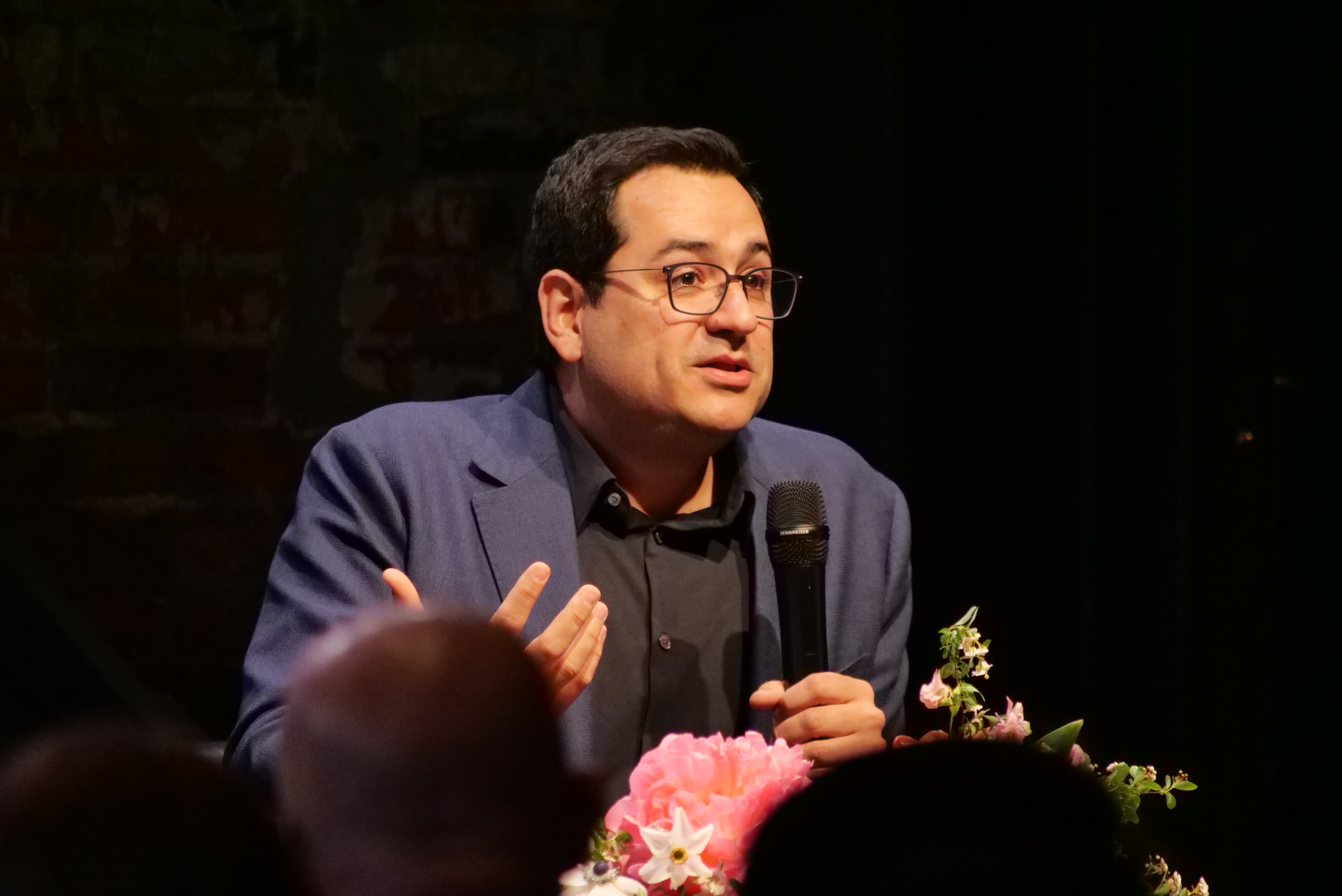




 Ali Farhadi speaks at the Tech Alliance State of Technology annual luncheon in Seattle, May 2024. (GeekWire File Photo / Todd Bishop)
Microsoft is hiring a group of top AI researchers from the Seattle-based Allen Institute for AI and the University of Washington, including former Ai2 CEO Ali Farhadi, GeekWire has learned.
Farhadi, Hanna Hajishirzi, and Ranjay Krishna are expected to join Mustafa Suleyman’s organization at Microsoft while retaining their faculty positions at the UW’s Allen School of Computer Science and Engineering. Also joining is Sophie Lebrecht, the former Ai2 chief operating officer.
The move follows Farhadi’s departure from Ai2, announced March 12. Farhadi had led the Seattle-based nonprofit research institute for more than two and a half years.
Suleyman, the CEO of Microsoft AI, narrowed his focus last week from overseeing consumer-oriented Copilot products to leading Microsoft’s Superintelligence team.
The hires come as Microsoft works to reduce its dependence on OpenAI for frontier AI models, competing against Amazon, Google, and others. Suleyman’s Superintelligence team, formed in November, is part of a broader push to further develop advanced foundation models.
Microsoft has already hired researchers from Google DeepMind, Meta, OpenAI, and Anthropic, and the addition of the Ai2 and UW group would bring deep expertise in open-source model development and training efficiency — where Ai2 has punched well above its weight.
Backing from NSF and NvidiaThe exits represent a notable collective loss for Ai2, which was founded in 2014 by the late Microsoft co-founder Paul Allen. Hajishirzi is a co-lead of the OLMo open-source language model project and a co-principal investigator on a $152 million, five-year initiative backed by the National Science Foundation and Nvidia to build open AI models for scientific research.
She represented Ai2 in multiple sessions last week at Nvidia’s GTC conference in San Jose, including a panel on the future of open models alongside Nvidia CEO Jensen Huang.
Krishna has led the development of Ai2’s Molmo multimodal models, among other projects. He also presented at the Nvidia conference last week on behalf of the institute.
Farhadi, a computer vision specialist, co-founded Ai2 spinout Xnor.ai, which Apple acquired in 2020 for an estimated $200 million. He led machine learning efforts at Apple before returning to lead Ai2 as CEO in July 2023.
Ai2 interim CEO Peter Clark acknowledged the departures in a statement, saying the institute remains committed to its mission and its partnerships with the NSF and Nvidia, including the OMAI initiative.
“These initiatives are backed by a broad, experienced team with the expertise and continuity needed to carry this work forward,” Clark said. “We’re confident in our ability to build on the strong foundation already in place and to expand the impact of these efforts in the months ahead.”
He added that the institute is “grateful for the leadership and contributions of Ali, Hanna, Ranjay, and others” in advancing Ai2’s work, and wished them well.
In a post about the hires on LinkedIn, Suleyman praised Farhadi for leading Ai2 in releasing more than 100 models in a single year and called Hajishirzi “one of the most cited researchers of natural language processing in the world, full stop.”
Suleyman described Lebrecht as having scaled Ai2’s operations and open-source efforts, noting that she also co-founded the AI company Neon Labs and holds a PhD in cognitive neuroscience from Brown University.
He said they will help pursue Microsoft’s mission of “humanist superintelligence: safer, controllable, more capable AI systems in service of humanity and our toughest problems.”
When news broke earlier this month that Farhadi was leaving, Ai2 board chair Bill Hilf told GeekWire that Farhadi wanted to pursue research at the extreme frontier of AI, where for-profit companies are spending billions on training the most advanced models.
At the time, Hilf said the board had to weigh whether a nonprofit’s philanthropic dollars were best spent trying to keep pace, acknowledging that competing against tech giants at the largest scale of model development had become extraordinarily difficult.
Changes in Ai2’s funding realitiesBehind the scenes, the changing nature of Ai2’s funding environment has also been playing a role in the exits, according to people with knowledge of the situation.
Ai2 was originally funded by Allen’s Vulcan Inc. and later by his estate. Its primary backer is now the Fund for Science and Technology, a $3.1 billion foundation created under Allen’s instructions and publicly launched in August, with a focus on applying science and technology to problems in areas aligned with Allen’s passions, including AI, bioscience, and the environment.
FFST, led by CEO Dr. Lynda Stuart, a physician-scientist who previously led the Institute for Protein Design at the UW, favors applied uses of AI over the costly work of frontier models.
In addition, while all Ai2 programs for 2026 are fully funded, these people said, FFST is moving from providing Ai2 with overall annual funding to a proposal-based process, with future support expected to favor real-world applications of AI over building open-source foundation models. The shift helps explain the departures of researchers focused on model development.
A spokesperson for the Fund for Science and Technology said Ai2’s “work and mission remain the same” and that FFST’s broader program strategies are still under development.
Farhadi, Hajishirzi, and Krishna are researchers whose work centers on building and advancing AI models. Microsoft’s Superintelligence team, backed by billions in compute investment, offers the resources and mandate to pursue that work at a much larger scale.