
Remember me









The icon indicates free access to the linked research on JSTOR.
An unbothered gray cat eats while resting on a kitchen mat, not having yet noticed the still cucumber behind his tail. In less than a second, he will turn around to discover the dark green cylinder. His fur will then stand up as if the cucumber were a predator, and he will meow loudly, jumping high and afraid. For those who were online in the fall of 2015, this scene will bring to mind a cultural phenomenon: ten years ago, “Cats Scared by Cucumbers Compilation” was first uploaded to YouTube. Since then, 13 million people have watched this viral video.

On the internet, many speculated that cats fear cucumbers because they remind them of snakes. And although feline specialists subsequently disproved the rumor, those who saw the resemblance were not alone: they were in the company of Virgil.
The cucumber coils and it climbs; it circulates, and it spreads. It is, undoubtedly, a highly mobile plant.
In the Georgics, a lyrical guide to agriculture published in 29 BCE, the Roman poet noted that “the cucumber, coiling through the grass, swells into a paunch.” His words evoke the image of an animal slithering on the ground before growing—an allusion that was likely intended as a gardening pun about reptiles, argues classics scholar Rebecca Armstrong. “For an instant reminding us of the sinister snakes lurking in the grass elsewhere in the Georgics,” she writes, “the cucumber emerges as a harmless, and welcome, vegetable.” It is, be thankful, an innocuous creature. It won’t jump at your pets and eat them.
But don’t let its stillness in the videos fool you. To think of this gourd as an object devoid of action would be a fatal mistake. Making sense of the cucumber demands an inquiry into movement. The plant that produces cucumbers is, after all, a creeping vine, and its history is shaped by different kinds of motion. The cucumber coils and it climbs; it circulates, and it spreads. It is, undoubtedly, a highly mobile plant.
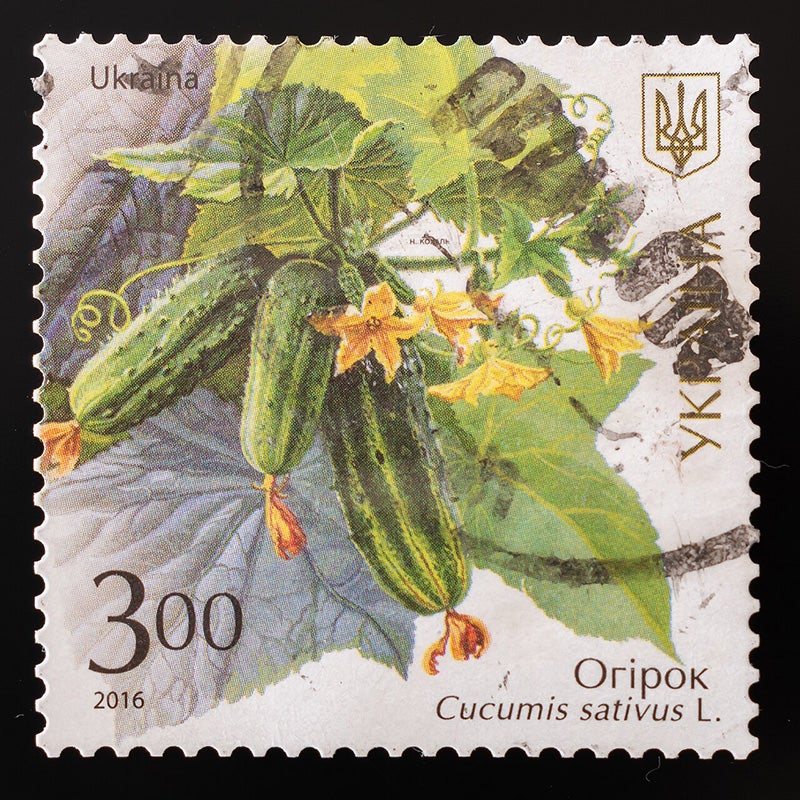 Cucumis sativus stamp from Ukraine, via Wikimedia Commons
A History of Cucumber Science
Cucumis sativus stamp from Ukraine, via Wikimedia Commons
A History of Cucumber Science
Known in Linnaean nomenclature as Cucumis sativus, the cucumber for many of us is a familiar culinary staple: a light and watery, mild-flavored though versatile food. First cultivated over 3000 years ago, cucumbers are eaten alongside a diverse array of ingredients: mixed with yogurt and cumin as raita; marinated with soy sauce and garlic in the form of pai huang gua; or sprinkled with chili lime seasoning as pepinos con chile. Yet this widely available gourd—harvested and eaten while still immature, in fact, for ripe cucumbers are yellow and bitter—is not the entirety of the plant. It only tells one part of the story.
Cucumis sativus is a complex organism, boasting multiple notable morphological features. Its leaves are large and shaped like hearts, with a thin, hair-covered dark surface and finely serrated edges. Its flowers, in contrast, are bright and yellow, each made of five petals, which, fused at the base, form a structure resembling a star. And its tendrils, perhaps the most peculiar part of the plant, are light-colored and shaped like thin wires. Both literally and figuratively, these appendages are the hook of the cucumber. Whenever they touch a physical surface, they coil and wrap themselves around it, thereby allowing the plant to climb surfaces. They also grab, and have grabbed, the attention of curious scientists across disciplines, with both naturalists in the 19th century and physicists in the 21st taking interest in the study of tendrils.
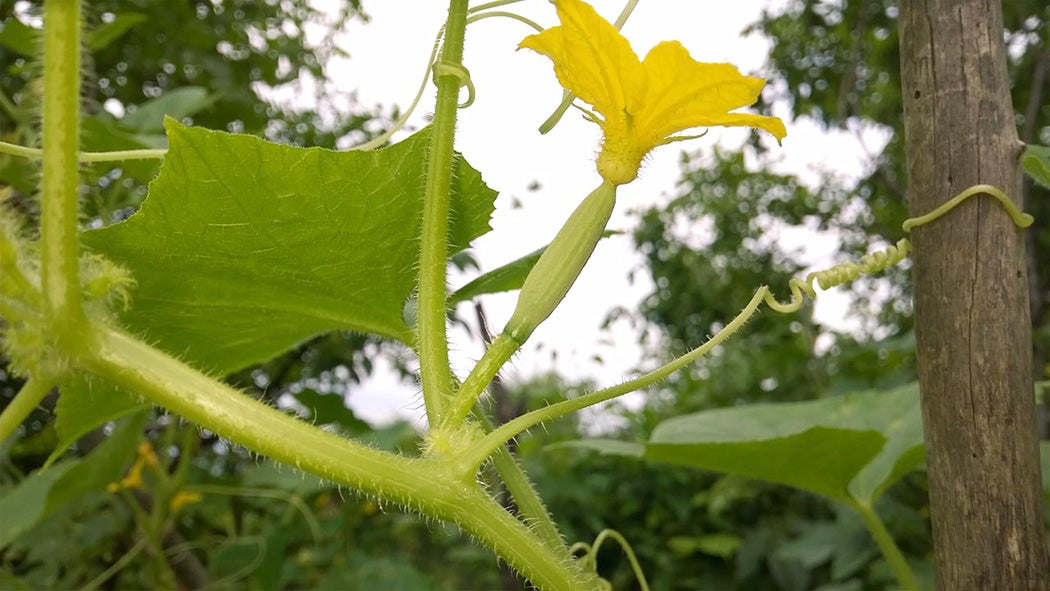 Cucumis sativus flower, via Wikimedia Commons.
The most famous contributor to this scientific history is Charles Darwin, best known for his theory of evolution by means of natural selection, less known for his work on the climbing abilities of plants. Following the publication of an 1858 essay on the coiling of cucumber tendrils by Harvard botanist Asa Gray, Darwin became fascinated by the subject of plant movement. He wrote a letter to Gray, who then replied with a set of suggestions for Darwin—ideas for a possible scientific experiment. Alongside his recommendations, Gray also sent Darwin the seeds of two kinds of cucumber all the way from Massachusetts. “Upon these, especially upon the first, I made my observations of tendrils coiling to the touch,” he explained. “Put the seeds directly into the ground; they will come up in the spring, in moist garden soil.” Across the Atlantic, in Kent, Darwin proceeded to follow the instructions carefully. He planted the seeds and waited for the cucumbers to grow.
Seven months later, he reported back to Gray: “I am observing the plant in another respect, namely the incessant rotatory movement of the leading shoots, which bring the tendrils into contact with any body within a circle of a foot or 20 inches in diameter.” Intrigued by this behavior, Darwin began tracing the slow, circular movements of such plants, which he would record via meticulous sketches recording their spatial trajectories. His observations became the basis of On the Movements and Habits of Climbing Plants, a best-selling book, in which he described the movements of tendril-bearing plants like cucumbers. Missing, however, was a mechanical explanation. The tendrils could coil, yes, but how exactly were they able to do so?
 Juneberry: A Summer Sweet for People, Pollinators, and Birds
 June 27, 2025
For millennia, Indigenous peoples in North America derived sustenance from the juneberry, known also as the misâskwatômin, serviceberry, shadbush, or saskatoon.
The mystery wouldn’t be unwound until more than a century and a half later, when a team of soft matter physicists embarked on finding an answer. In a 2012 scientific paper published in the journal Science, the group shared their findings. Cucumber tendrils, they discovered, bear “an internal fiber ribbon of specialized cells,” which, when contracted, makes the appendage coil. Such a mechanism is what enables thigmotropism: a plant’s ability to grow in a certain direction in response to stimuli like touch. It is this kind of growth that allows plants like cucumbers to climb for sunlight, and, as Darwin speculated in On the Movements and Habits of Climbing Plants, it also entails increased reproductive fitness: “Plants become climbers, in order, it may be presumed, to reach the light, and to expose a large surface of leaves to its action and to that of the free air.” Yet to understand the movement of cucumbers solely in terms of thigmotropism would be to ignore part of what makes this plant so captivating.
Besides physically climbing over surfaces, cucumbers have moved globally—not by means of their coiling tendrils, but rather by becoming a commodity known for its refreshing and beautifying uses. Appreciative of these qualities, humans have domesticated Cucumis sativus and traded it throughout the world, with the fruit’s coolness becoming another, if metaphorical, tendril. The fruit’s desirability explains why the plant has spread across continents. And that, too, is a form of movement.
 Cucumber Harvest, via JSTOR
Promises of Immortality and Rejuvenation
Cucumber Harvest, via JSTOR
Promises of Immortality and Rejuvenation
Cucumbers were first cultivated in the Himalayan foothills of the Indian peninsula over 3000 years ago. In a manner that feels prototypical of the plant’s subsequent valorization across other cultures, the cucumber makes an appearance in the Rigveda, an ancient collection of Sanskrit hymns belonging to the canonical Hindu tradition. Dating back to approximately 1500 BCE, the Rigveda presents the cucumber as a fruit associated with immortality—and, less explicitly, a commodity associated with healing, peace, and rejuvenation. The fruit is featured most prominently in the Mahamrityunjaya mantra: “Like a cucumber from its stem, might I be freed from death, not from deathlessness.” The mantra presents the image of a ripe cucumber becoming untethered from its vine, evoking a deep desire for liberation from the physical world—a strong yearning for an unbounded, eternal, and therefore immortal condition.
Perhaps promising to bring such benefits into fruition, the cucumber grew in popularity and appeal over time, both within the Indian peninsula and, eventually, beyond it. Over the next seventeen centuries, the plant would be introduced to other world regions: first to East Asia, then to Europe and Africa, and finally, in the fifteenth century, to the Americas. Thus began the cultivation of the cucumber in widely different environments—and, as a consequence, its consumption across different culinary traditions and cultures.
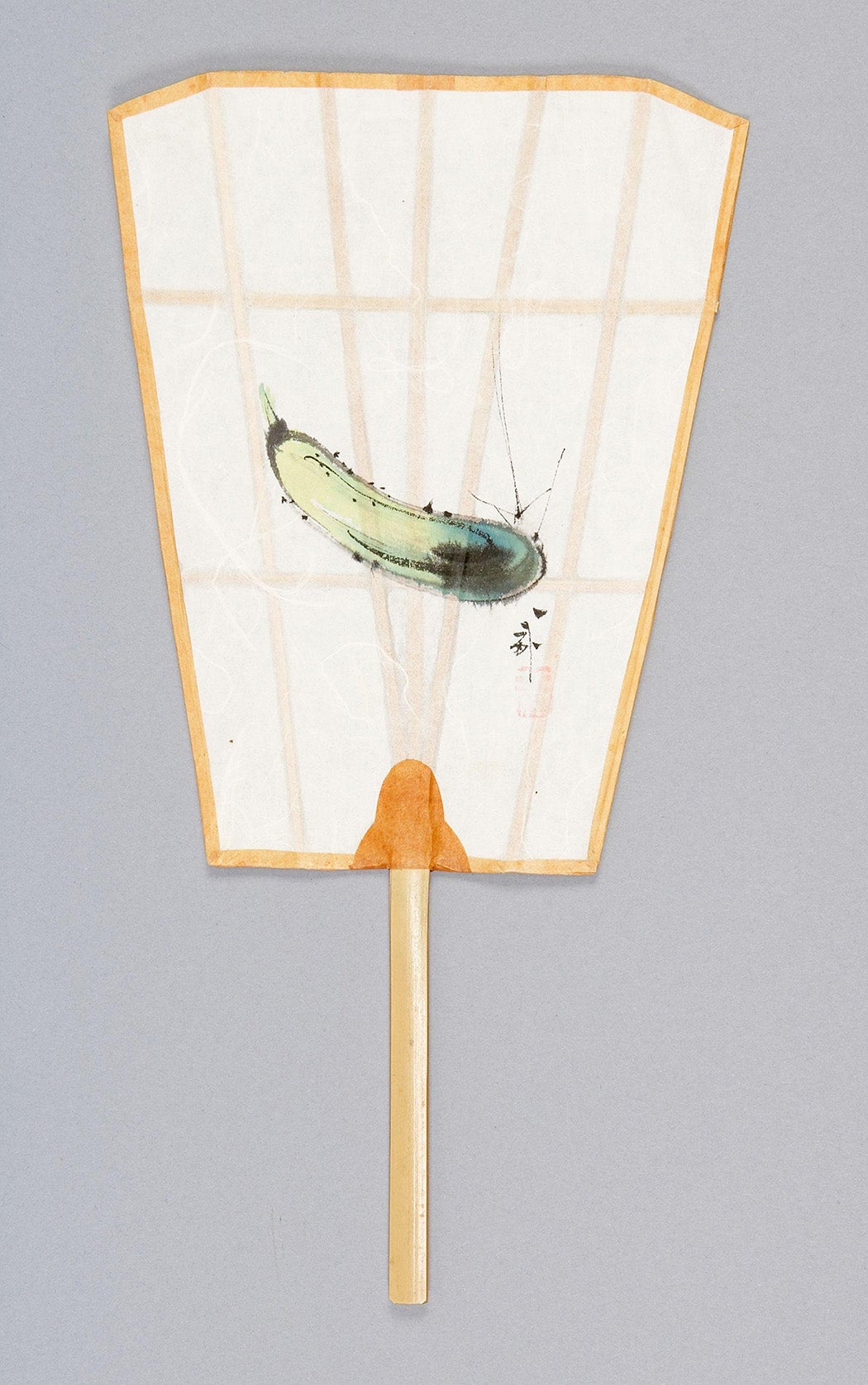 Paper hand fan with a bamboo handle, made in Japan. via JSTOR
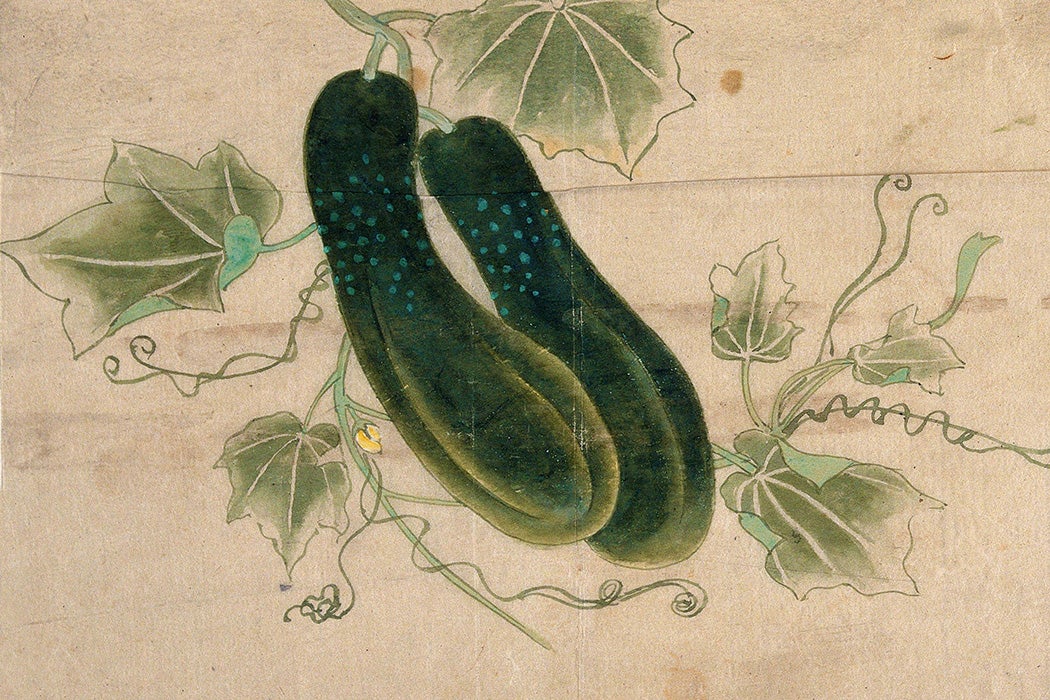
However disparate these contexts may have been, the cucumber’s identity as a cultural product remained connected with ideals of personal preservation. For instance, the New London Toilette, a printed collection of recipes for personal beautification, set forward the instructions for a cucumber-based cooling body wash in 1778. “Take the juice of six large cucumbers, and add to it half a pint of the juice of ground ivy,” it read. “Rub this over the face in the morning, and it will prevent sweating.” Likely seeking to achieve the same cooling effect but through a different strategy, a twentieth-century Japanese paper hand fan with a bamboo handle prominently features the image of a hand-painted green cucumber. So strong is the association between the fruit and coolness that its visual depiction seeks to enhance the fan’s function. Just looking at a cucumber, it so seems, provides the fanner with a refreshing moment.
Writing a botanical treatise not unlike the Georgics, Aristotle famously said that “plants have no movement” because “they are fixed in the earth and the earth does not move.” Yet by cooling down people and promising to satiate the inquisitiveness of curious scientists, the cucumber managed to spread to all continents. Both its physical abilities and global history actively subvert the philosopher’s aphorism. The cucumber is, quite simply, a moving, dynamic plant. The Plant Humanities Initiative at Dumbarton Oaks draws from the arts, sciences, and humanities to explore how plants like the cucumber relate to human culture and society.



Comments (0)