
Remember me
Honest, paywall-free news is rare. Please support our boldly independent journalism with a donation of any size.
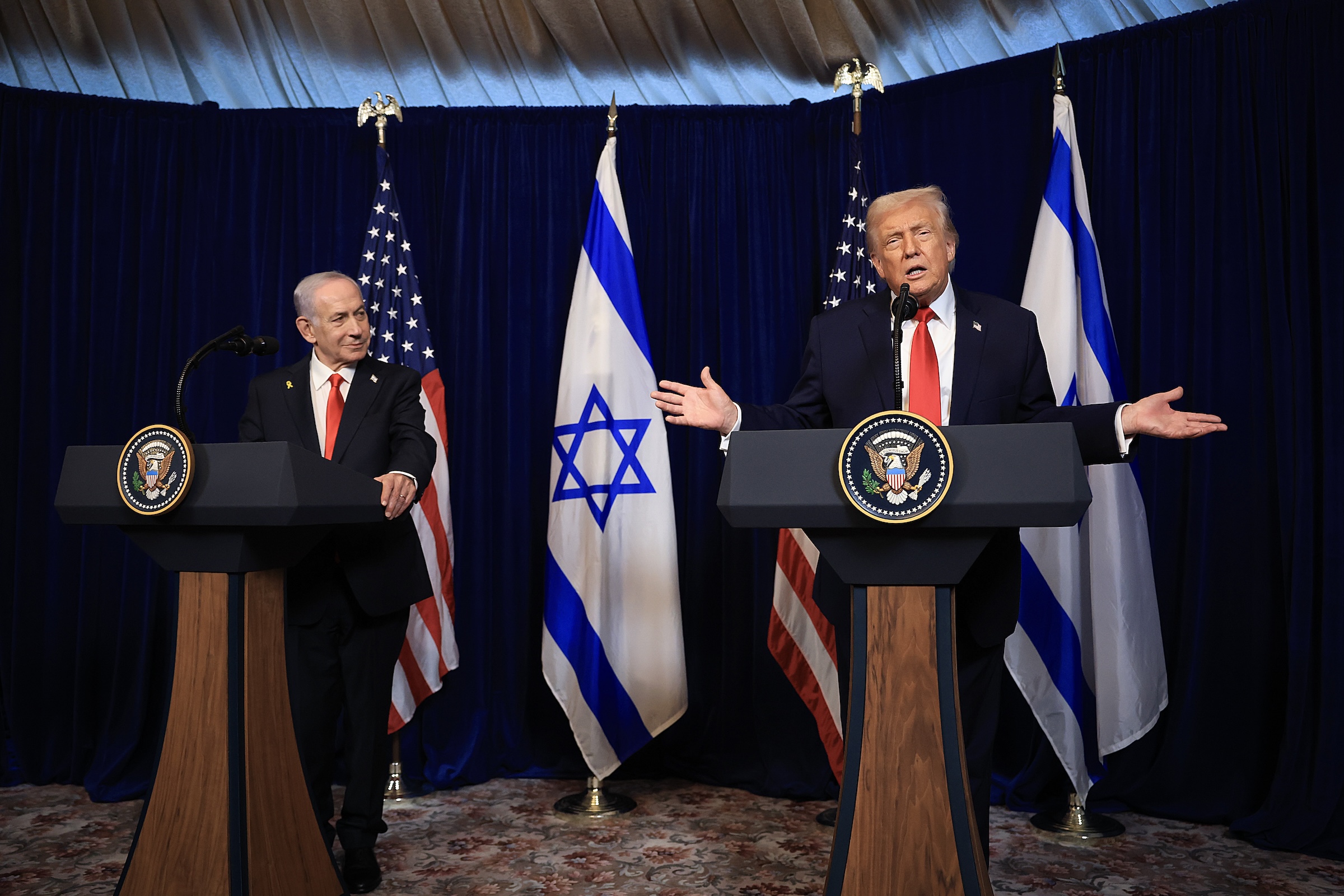
Speaking before a Friends of Ireland luncheon while wearing a lucky green tie for St. Patrick’s Day, President Donald Trump announced, “the war is proceeding very, very strongly. We’re doing very, very well in Iran, knocking the hell out of ‘em and you have to do that. We can’t let them have a nuclear weapon. They were two weeks away in my opinion, two weeks away from having a nuclear weapon.”
But members of Trump’s own administration, nuclear experts, and scientists have disputed Trump’s claim, suggesting the president’s timeline was based on misinterpreted information from the International Atomic Energy Agency (IAEA). A March 2025 Annual Threat Assessment of the U.S. Intelligence Community stated: “We continue to assess Iran is not building a nuclear weapon and that [then Supreme Leader] Khamenei has not reauthorized the nuclear weapons program he suspended in 2003…”
One day before Israel and the U.S. began bombing Iran on February 28, CBS News reported that Oman’s foreign minister, Sayyid Badr Albusaidi said a peace deal was “within our reach if we just allow diplomacy the space it needs to get there.” Further technical meetings, which had been scheduled for the following Monday, never took place because the war was launched two days prior.
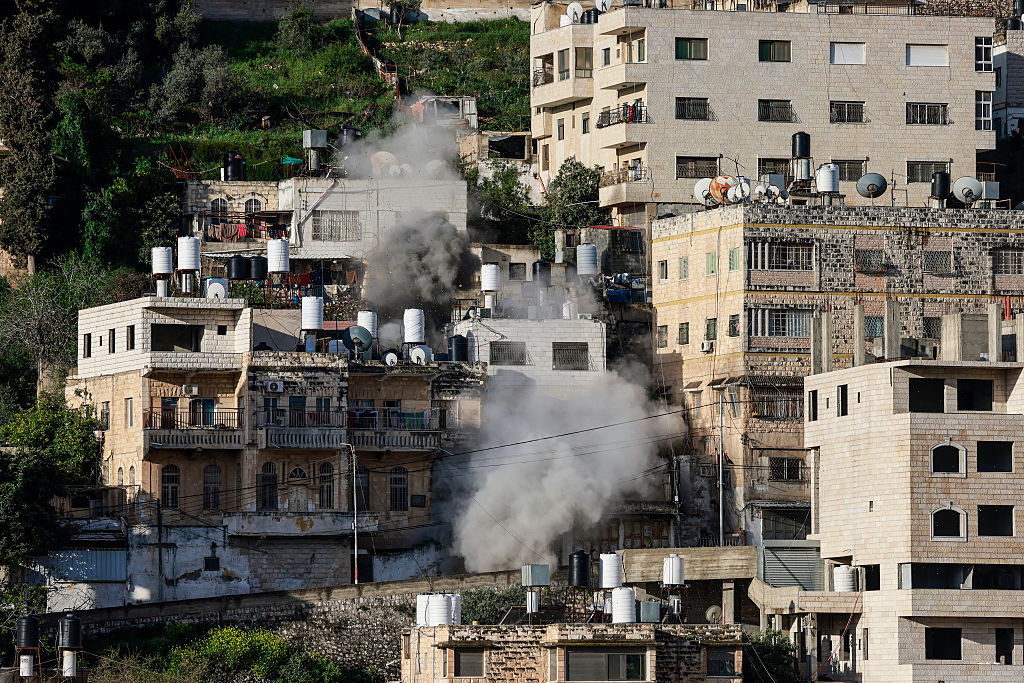
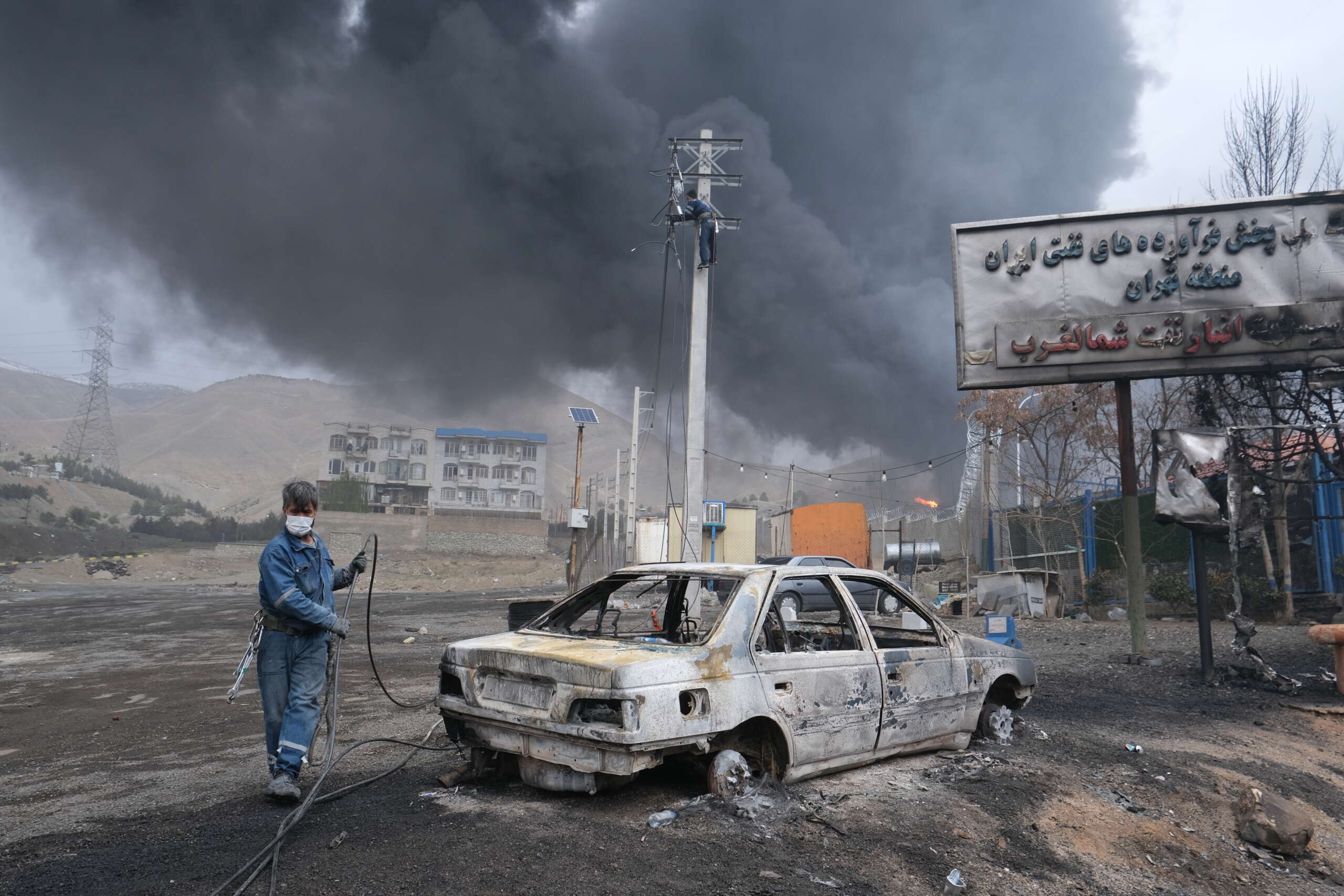
For the second time in less than nine months, the U.S. and Israel attacked Iran in the middle of negotiations. More than 2,700 people have been killed in Iran, Lebanon, and multiple other countries as the war rapidly engulfs the region, causing what the International Energy Agency has called the “largest supply disruption in the history of the global oil market.”
The Trump administration’s justification for the war has been inconsistent and ill-defined, but at its heart has always been Trump’s insistence that Iran never develop a nuclear weapon. One month into a war in which two nuclear armed states attacked a non-nuclear armed state to prevent it from doing as they have done, serious questions are being raised about the future of nuclear proliferation.
Related Story
The US controls nuclear weapons in five NATO countries, but Europe may choose a new path amid strained relations.
How Did We Get Here?In a debate hosted by Foreign Policy Magazine, Trita Parsi, co-founder and executive vice president of the Quincy Institute for Responsible Statecraft, summarized the Trump administration’s failure to reach a deal with Iran: “Diplomacy and other ways of actually being able to resolve the many tensions and problems that exist with Iran were never exhausted.” Had those negotiations been successfully concluded, Parsi said, “Trump would have gotten zero enrichment from Iran in this deal if he had declared victory which he easily could have. Instead, he chose to declare war.”
Parsi pointed out that the Trump State Dept. had twice certified the Joint Comprehensive Plan of Action (better known as the Iran nuclear deal) as serving U.S. interests and the IAEA certified 14 reports in a row that Iran was living up to its end of the bargain. He added that this diplomatic opening would have been far more effective than blowing up the entire region.
Abruptly abandoning talks to launch a bombing campaign against Iran sends the message that the U.S. is not an honest broker and unless you have a nuclear deterrent, you are subject to its attacks.
In an email, Parsi told Truthout that he suspects that Iranians will no longer agree to a bilateral negotiation with the U.S. and are likely to seek the participation of China, Russia, and possibly its Gulf Cooperation Council neighboring states in any new negotiations in order to increase the cost of future U.S. betrayals.
Parsi says the debate on nuclear weapons in Iran has shifted significantly. “Israel and the United States have given Tehran all the incentives to pursue such a weapon.” More broadly, he sees a clear trend toward a positive reconsideration of nuclear weapons. Given the conduct of the U.S., Israel, and Russia, European nations including Sweden have indicated a potential review of their nuclear posture.
Sending the Wrong MessageDaryl Kimball, executive director of the Arms Control Association, believes that any future negotiations between the U.S. and Iran are likely to be predicated on very strong assurances that there will be no further attacks. New talks will also require a different negotiating team and additional parties equipped with the technical knowledge that Trump’s previous negotiators lacked.
After widespread bombing of Iran’s enrichment facilities, there is even greater uncertainty about Iran’s residual nuclear capabilities and, Kimball said, it will be crucial for IAEA inspectors to assess where Iran’s enriched nuclear material is and the status of its facilities.
Kimball told Truthout, “I think it’s very likely that hardliners inside of Iran may have a more powerful argument to pursue nuclear weapons as a means of deterrence against attack by nuclear armed countries.” He added that abruptly abandoning talks to launch a bombing campaign against Iran sends
the message that the U.S., especially under Trump, is not an honest broker and unless you have a nuclear deterrent, you are subject to its attacks. For North Korea, it may also reinforce Kim Jong-un’s paranoia about a decapitation strike and encourage him, while he’s under reduced international pressure, to build up his nuclear arsenal.
Regarding the possibility of proliferation by other states, Kimball says each potential proliferator is operating in a different security environment, and the Iran war may or may not influence their outlook on nuclear weapons. He describes the impact of Russia’s war on Ukraine and the U.S.-Israeli war on Iran as a setback to long-term efforts to halt the spread of nuclear weapons and another severe blow to international law.
Difficult ConversationsThe war on Iran comes just weeks before the world’s diplomats and nuclear negotiators will convene at UN headquarters in April for the Treaty on the Non-Proliferation of Nuclear Weapons (NPT) Review Conference. Held every five years, the review conference provides a forum to assess progress on the compliance and implementation of the treaty’s provisions. Currently, there are 191 states parties to the NPT. India, Israel, Pakistan, and South Sudan never joined the treaty. North Korea announced it was withdrawing from the NPT in 2003 and tested its first nuclear weapon in 2006.
Kimball says the Iran war will severely complicate what is already expected to be a very difficult review conference. Because the U.S. has attacked another country in contravention to the UN charter and has attacked nuclear facilities which is a violation of international law, he thinks it will bring debate about a Middle East WMD-free zone back to the fore.
A trust deficit over U.S. extended deterrence could prove to be an even greater impetus for countries in Europe and East Asia to reconsider their position on nuclear weapons.
Scott Roecker, vice president for Nuclear Materials Security with the Nuclear Threat Initiative, told Truthout that if Iran was going to announce changes to its NPT status, it might choose to do so at the review conference, but he doesn’t see any indication of that now.
Even as questions about Iran’s nuclear program remain, Roecker says a trust deficit over U.S. extended deterrence could prove to be an even greater impetus for countries in Europe and East Asia to reconsider their position on nuclear weapons. He asks if current nonproliferation policies are fit for purpose in the world we face today.
Other questions about safeguards to prevent nuclear proliferation swirl around the Trump administration’s pursuit of a civilian nuclear program in Saudi Arabia, examined closely in a recent Arms Control Association issue brief.
In a 2023 interview with Fox News, Saudi Arabia’s Crown Prince Mohammed bin Salman said that if Iran developed a nuclear weapon, Saudi Arabia would do the same. “If they get one, we have to get one, for security reasons, for balancing power in the Middle East. But we don’t want to see that.”
More recently, speaking in a CBC interview, Saudi political analyst Salman Al-Ansari said that if Saudi Arabia entered the war with Iran, it would activate its mutual defense agreement with Pakistan. “There is a Pakistani nuclear umbrella over Saudi Arabia,” Al-Ansari said.
As talk of nuclear proliferation grows, Roecker said, “I personally think that nuclear weapons states need to make very clear, tangible progress toward reducing the amount of nuclear weapons in the world. That’s a very unpopular thing to say right now and not very plausible, but that needs to happen.”
“This war on Iran could not come at a worse time,” said Roecker. “It’s just going to make things even more difficult,”
Security? What Security?Gaukhar Mukhatzhanova, program director with the Vienna Center for Disarmament and Non-Proliferation, told Truthout that if Iran were to withdraw from the NPT, it would give the U.S. more political ammunition and potentially rally Western countries to support the war. “I believe it’s not in their interest right now, still, to get out of the NPT.”
Mukhatzhanova says that some elements in the Iranian government may conclude it is time to build a bomb, even as others believe it is too risky and it’s better for Iran to keep its options open as a non-nuclear armed state with advanced capabilities.
“The danger of this moment and this action is of course that you hand the win basically internally to whoever argued the case that without nuclear weapons Iran is vulnerable,” Mukhatzhanova added.
Since Russia’s 2014 annexation of Crimea and full-scale invasion of Ukraine in 2022, Mukhatzhanova says there has been a return of the salience of nuclear weapons and a recommitment to them as a guarantee of security. Furthermore, Trump’s dismissive stance toward U.S. alliances comes as more countries are talking about going nuclear.
At the same time, Mukhatzhanova says it’s important to remember that many small and mid-sized countries do not see nuclear weapons as a source of security, but view them with abhorrence and take the perspective that “we don’t want anyone to have nuclear weapons because their use causes horrendous consequences.”
Kourosh Ziabari, an independent Iranian journalist and contributor to New Lines Magazine, thinks it is unlikely that Iran will take the drastic step of withdrawing from the NPT, knowing it would likely invite further aggression.
“We’re living in a new world altogether … Proliferation issues that seemed settled are all unsettled at this moment.”
Ziabari says there is a common denominator in conflicts around the world, whether in Iran, Ukraine, or elsewhere. “There is a precedent being set that whenever nuclear armed countries start a military escalation or take action against smaller or weaker states, the international community fails to come up with a response, which means that we are already giving lots of unspoken credit to nuclear weapons,” Ziabari said.
“We are setting a dangerous precedent, showing that whenever nuclear armed states decide to breach international norms, they can get away with that.”
Fueling ProliferationIn 2021, a new international agreement, the Treaty on the Prohibition of Nuclear Weapons (TPNW) entered into force. Five years later, nearly half the world’s countries have adopted or ratified the treaty, demonstrating their commitment to rid the world of nuclear weapons. TPNW states parties include not only small countries such as Sri Lanka, Ghana, and Malta and island nations like Fiji, Kiribati, and the Seychelles, but also large countries such as Indonesia, Mexico, Nigeria, South Africa, and Kazakhstan, which gave up its possession of Soviet nuclear weapons in the 1990s.
In a statement, executive director of the International Campaign to Abolish Nuclear Weapons (ICAN) Melissa Parke said, “Military action is not a viable or long-term solution to prevent nuclear proliferation.”
The double-standard of two nuclear-armed states attacking a non-nuclear armed country underscores that “the idea that some states can be trusted with nuclear weapons while others cannot is without merit and fuels the very proliferation it claims to prevent,” said Florian Eblenkamp, ICAN’s advocacy officer.
“Both countries repeatedly threaten to use nuclear weapons and claim them as essential for their national security. What is this other than incentivizing nuclear weapons?” Eblenkamp said in an email to Truthout. He calls on all countries to join the TPNW, which requires nuclear-armed states to verifiably dismantle their nuclear weapons within 10 years of joining the treaty.
A New World AltogetherManpreet Sethi, a distinguished fellow at the Centre for Air Power Studies in New Delhi and member of the Science and Security Board of the Bulletin of the Atomic Scientists, points to Ukraine, a country that relinquished control of the Soviet nuclear weapons on its territory in exchange for security assurances, but ultimately was attacked anyway.
She says we’ve entered a time when a growing number of countries are seeing nuclear weapons as a currency of power and assurance against attack. Once again we are talking about states that may be on the threshold of being able to produce nuclear weapons. Sethi says that while South Korea, Japan, Germany, and Poland currently don’t have nuclear weapons, the fact that strategic communities are beginning to discuss developing or sharing them is a matter of concern.
“Every country from now on that’s going to be a nuclear armed state is today’s non-nuclear weapon country in the NPT,” Sethi said. “It will mean having to step out of the NPT.” Any country that chooses to follow that path would then likely demonstrate that they have acquired a certain level of capability through a nuclear test. Sethi is concerned that if a country decides to go nuclear, they will make a dash for it.
“We’re living in a new world altogether … Proliferation issues that seemed settled are all unsettled at this moment.”
Hope as a StrategySethi says that the trends of geopolitical contestation, technological advancements without guardrails, and a lack of political leadership are converging, leaving humanity stumbling into disaster. She says that across the board, every leader of a major country is talking the same language: hard power and military spending. “Right now, I don’t think we have that sense of a shared risk. Everybody’s believing ‘I can get away with it’ and the other will have to succumb to what I am asking for.”
“Are we waiting for a crisis moment before we see sanity?” she asked.
Despite the difficult nuclear outlook, Sethi is hopeful that if at least two leaders emerge who are willing to recognize their shared sense of risk and re-establish confidence building measures, we may return to arms control and avert catastrophe.
“I hope something, somewhere will give and we’ll be able to pull ourselves back,” Sethi said, adding, “they always say, ‘hope is not a strategy.’ When things are as hopeless as this, hope is a strategy.
With so many complex global challenges, and a growing blatant disregard for international law in favor of a law of the jungle approach, humanity needs to hold on to hope. But if further nuclear weapons proliferation is to be avoided, we will need much more than hope and good luck.
An urgent appeal for your support: We Have Until Midnight to raise $10,000Truthout relies on individual donations to publish independent journalism, free from political and corporate influence. In fact, we’re almost entirely funded by readers like you.
Unfortunately, donations are down. At a moment when independent journalism is urgently needed, we are struggling to meet our operational costs due to increasing political censorship.
Truthout may end this month in the red without additional help, so we launched a fundraiser. We have until midnight tonight to hit our $10,000 goal. Please make a tax-deductible one-time or monthly donation if you can.
Republishing GuidelinesThis article is licensed under Creative Commons (CC BY-NC-ND 4.0), and you are free to share and republish under the following terms:
Required: Required: You must credit Truthout and retain our links, as follows: "This article was originally published by Truthout." Required: You must preserve the article exactly as it appears on our site. You cannot edit, shorten or otherwise alter the content. Required: You must clearly credit the author(s) and retain their byline. Prohibited: You cannot republish our photographs or illustrations without specific permission. Prohibited: You cannot use this work for commercial purposes. Republish HTML code for copying <h1>The US-Israeli War on Iran Is Incentivizing Nuclear Proliferation</h1> <p><strong>By Jon Letman</strong></p> <p><em>This article was originally published by </em> <a href src="https://truthout.org/articles/the-us-israeli-war-on-iran-is-incentivizing-nuclear-proliferation/">Truthout</a></p> <p><strong><p>As nuclear-armed countries violate international law, others may turn to proliferation as a form of deterrence.</p></strong></p> <p>Speaking before a Friends of Ireland luncheon while wearing a lucky green tie for St. Patrick’s Day, President Donald Trump <a href="https://youtu.be/O1jIO7w-qnE?si=xZV0f1zz43yCj1CZ&t=293">announced</a>, “the war is proceeding very, very strongly. We’re doing very, very well in Iran, knocking the hell out of ‘em and you have to do that. We can’t let them have a nuclear weapon. They were two weeks away in my opinion, two weeks away from having a nuclear weapon.”</p> <p>But members of Trump’s own <a href="https://truthout.org/articles/trumps-top-counterterrorism-official-resigns-in-protest-over-iran-war/">administration</a>, nuclear experts, and scientists have <a href="https://www.scientificamerican.com/article/iran-was-nowhere-close-to-a-nuclear-bomb-experts-say/">disputed</a> Trump’s claim, suggesting the president’s timeline was based on <a href="https://apnews.com/article/iran-nuclear-iaea-uranium-enrichment-suspend-ccf574a324504b985f4b158f9d3d6941">misinterpreted information</a> from the International Atomic Energy Agency (IAEA). A March 2025 <a href="https://www.dni.gov/files/ODNI/documents/assessments/ATA-2025-Unclassified-Report.pdf">Annual Threat Assessment of the U.S. Intelligence Community</a> stated: “We continue to assess Iran is not building a nuclear weapon and that [then Supreme Leader] Khamenei has not reauthorized the nuclear weapons program he suspended in 2003…”</p> <p>One day before Israel and the U.S. began bombing Iran on February 28, <em>CBS News</em> <a href="https://www.cbsnews.com/news/us-iran-deal-within-our-reach-oman-mediator-says/">reported</a> that Oman’s <a href="https://www.fm.gov.om/en/ministry/about-us/key-figures/">foreign minister</a>, Sayyid Badr Albusaidi said a peace deal was “within our reach if we just allow diplomacy the space it needs to get there.” Further <a href="https://www.aa.com.tr/en/world/3rd-round-of-iran-us-indirect-nuclear-talks-in-geneva-concludes/3841265">technical meetings</a>, which <a href="https://youtu.be/_e0N4N3FnnY?si=I-HRdGLluOl3GaDH&t=801">had been scheduled</a> for the following Monday, never took place because the war was launched two days prior.</p> <p>For the second time in less than nine months, the U.S. and Israel attacked Iran in the middle of negotiations. More than 2,700 people <a href="https://www.aljazeera.com/news/2026/3/1/us-israel-attacks-on-iran-death-toll-and-injuries-live-tracker">have been killed</a> in Iran, Lebanon, and multiple other countries as the war rapidly engulfs the region, causing what the International Energy Agency has <a href="https://www.iea.org/news/new-iea-report-highlights-options-to-ease-oil-price-pressures-on-consumers-in-response-to-middle-east-supply-disruptions">called</a> the “largest supply disruption in the history of the global oil market.”</p> <p>The Trump administration’s justification for the war has been inconsistent and ill-defined, but at its heart has always been Trump’s insistence that Iran never develop a nuclear weapon. One month into a war in which <a href="https://thebulletin.org/nuclear-notebook/">two nuclear armed states</a> attacked a non-nuclear armed state to prevent it from doing as they have done, serious questions are being raised about the future of nuclear proliferation.</p> <h2 class="wp-block-heading">How Did We Get Here?</h2> <p>In a <a href="https://foreignpolicy.com/live/kroenig-parsi-debate-iran-war-trump/">debate</a> hosted by Foreign Policy Magazine, Trita Parsi, co-founder and executive vice president of the <a href="https://quincyinst.org/">Quincy Institute for Responsible Statecraft</a>, summarized the Trump administration’s failure to reach a deal with Iran: “Diplomacy and other ways of actually being able to resolve the many tensions and problems that exist with Iran were never exhausted.” Had those negotiations been successfully concluded, Parsi said, “Trump would have gotten zero enrichment from Iran in this deal if he had declared victory which he easily could have. Instead, he chose to declare war.”</p> <p>Parsi pointed out that the Trump State Dept. had twice certified the Joint Comprehensive Plan of Action (better known as the Iran nuclear deal) as serving U.S. interests and the IAEA certified 14 reports in a row that Iran was living up to its end of the bargain. He added that this diplomatic opening would have been far more effective than blowing up the entire region.</p> <p>In an email, Parsi told <em>Truthout</em> that he suspects that Iranians will no longer agree to a bilateral negotiation with the U.S. and are likely to seek the participation of China, Russia, and possibly its <a href="https://www.gcc-sg.org/en/AboutUs/MemberStates/Pages/default.aspx">Gulf Cooperation Council</a> neighboring states in any new negotiations in order to increase the cost of future U.S. betrayals.</p> <p>Parsi says the debate on nuclear weapons in Iran has shifted significantly. “Israel and the United States have given Tehran all the incentives to pursue such a weapon.” More broadly, he sees a clear trend toward a positive reconsideration of nuclear weapons. Given the conduct of the U.S., Israel, and Russia, European nations including <a href="https://breakingdefense.com/2026/01/sweden-eyes-franco-british-nuclear-weapons-cooperation/">Sweden</a> have indicated a potential review of their nuclear posture. </p> <h2 class="wp-block-heading">Sending the Wrong Message</h2> <p>Daryl Kimball, executive director of the <a href="https://www.armscontrol.org/">Arms Control Association</a>, believes that any future negotiations between the U.S. and Iran are likely to be predicated on very strong assurances that there will be no further attacks. New talks will also require a different negotiating team and additional parties equipped with the <a href="https://responsiblestatecraft.org/iran-hardliners/">technical knowledge</a> that Trump’s <a href="https://www.ms.now/news/trump-iran-nuclear-reactor-war-evidence">previous negotiators lacked</a>.</p> <p>After widespread bombing of Iran’s enrichment facilities, there is even greater uncertainty about Iran’s residual <a href="https://www.armscontrol.org/issue-briefs/2026-03/us-war-iran-new-and-lingering-nuclear-risks">nuclear capabilities</a> and, Kimball said, it will be crucial for IAEA inspectors to assess where Iran’s enriched nuclear material is and the status of its facilities.</p> <p>Kimball told <em>Truthout</em>, “I think it’s very likely that hardliners inside of Iran may have a more powerful argument to pursue nuclear weapons as a means of deterrence against attack by nuclear armed countries.” He added that abruptly abandoning talks to launch a bombing campaign against Iran sends</p> <p>the message that the U.S., especially under Trump, is not an honest broker and unless you have a nuclear deterrent, you are subject to its attacks. For North Korea, it may also reinforce Kim Jong-un’s paranoia about a decapitation strike and encourage him, while he’s under reduced international pressure, to build up his nuclear arsenal.</p> <p>Regarding the possibility of proliferation by other states, Kimball says each potential proliferator is operating in a different security environment, and the Iran war may or may not influence their outlook on nuclear weapons. He describes the impact of Russia’s war on Ukraine and the U.S.-Israeli war on Iran as a setback to long-term efforts to halt the spread of nuclear weapons and another severe blow to international law.</p> <h2 class="wp-block-heading">Difficult Conversations</h2> <p>The war on Iran comes just weeks before the world’s diplomats and nuclear negotiators will convene at UN headquarters in April for the <a href="https://armscontrolcenter.org/fact-sheet-nuclear-non-proliferation-treaty-npt/">Treaty on the Non-Proliferation of Nuclear Weapons</a> (NPT) <a href="https://meetings.unoda.org/npt-revcon/treaty-on-the-non-proliferation-of-nuclear-weapons-eleventh-review-conference-2026">Review Conference</a>. Held every five years, the review conference provides a forum to assess progress on the compliance and implementation of the treaty’s provisions. Currently, there are 191 states parties to the NPT. India, Israel, Pakistan, and South Sudan <a href="https://armscontrolcenter.org/fact-sheet-nuclear-non-proliferation-treaty-npt/">never joined the treaty</a>. <a href="https://www.nti.org/analysis/articles/north-korea-nuclear-disarmament/">North Korea</a> announced it was withdrawing from the NPT in 2003 and tested its first nuclear weapon in 2006.</p> <p>Kimball says the Iran war will severely complicate what is already expected to be a very difficult review conference. Because the U.S. has attacked another country in contravention to the <a href="https://legal.un.org/repertory/art51.shtml">UN charter</a> and has attacked nuclear facilities which is a <a href="https://vcdnp.org/wp-content/uploads/2022/09/Attacks-on-nuclear-facilities.pdf">violation of international law</a>, he thinks it will bring debate about a <a href="https://www.armscontrol.org/act/2022-07/features/middle-eastern-wmd-free-zone-and-npt">Middle East WMD-free zone</a> back to the fore.</p> <p>Scott Roecker, vice president for <a href="https://www.nti.org/about/programs-projects/program/nms/">Nuclear Materials Security</a> with the Nuclear Threat Initiative, told <em>Truthout </em>that if Iran was going to announce changes to its NPT status, it might choose to do so at the review conference, but he doesn’t see any indication of that now.</p> <p>Even as questions about Iran’s nuclear program remain, Roecker says a trust deficit over U.S. extended deterrence could prove to be an even greater impetus for countries in <a href="https://www.politico.eu/article/poland-should-begin-work-on-nuclear-defenses-president-nawrocki-russia-putin-war/">Europe</a> and <a href="https://japantoday.com/category/features/opinions/going-nuclear-why-a-growing-number-of-washington%E2%80%99s-allies-are-eyeing-an-alternative-to-us-umbrella">East Asia</a> to <a href="https://truthout.org/articles/growing-tensions-with-us-could-lead-europe-deeper-into-nuclear-proliferation/">reconsider their position</a> on nuclear weapons. He asks if current nonproliferation policies are <a href="https://www.belfercenter.org/preventing-era-nuclear-anarchy">fit for purpose</a> in the world we face today.</p> <p>Other <a href="https://www.reuters.com/world/us/us-removing-guardrails-proposed-saudi-nuclear-deal-document-says-2026-02-19/">questions about safeguards</a> to prevent nuclear proliferation swirl around the Trump administration’s pursuit of a <a href="https://thebulletin.org/2026/03/the-war-on-iran-will-speed-the-transition-away-from-fossil-fuels-and-toward-nuclear-energy-creating-strategic-challenges-for-the-united-states/#post-heading">civilian nuclear program</a> in Saudi Arabia, examined closely in a recent Arms Control Association <a href="https://www.armscontrol.org/issue-briefs/2026-02/trump-jeopardizing-nonproliferation-efforts-get-nuclear-cooperation-deal-saudi">issue brief</a>.</p> <p>In a 2023 <a href="https://youtu.be/w0NxI44yBDM?si=kcHKK7mHTAIvVgmc&t=534">interview</a> with <em>Fox News</em>, Saudi Arabia’s Crown Prince Mohammed bin Salman said that if Iran developed a nuclear weapon, Saudi Arabia would do the same. “If they get one, we have to get one, for security reasons, for balancing power in the Middle East. But we don’t want to see that.”</p> <p>More recently, speaking in a <em>CBC</em> <a href="https://youtu.be/K0zFoMiiy78?si=m6Ya7cyaOC8SIRPU&t=25">interview</a>, Saudi political analyst Salman Al-Ansari said that if Saudi Arabia entered the war with Iran, it would activate its <a href="https://www.grc.net/documents/68dd1614b17b4SaudiPakistanMutualDefenseAgreement2.pdf">mutual defense agreement</a> with Pakistan. “There is a Pakistani nuclear umbrella over Saudi Arabia,” Al-Ansari said.</p> <p>As talk of nuclear proliferation grows, Roecker said, “I personally think that nuclear weapons states need to make very clear, tangible progress toward reducing the amount of nuclear weapons in the world. That’s a very unpopular thing to say right now and not very plausible, but that needs to happen.”</p> <p>“This war on Iran could not come at a worse time,” said Roecker. “It’s just going to make things even more difficult,”</p> <h2 class="wp-block-heading"><strong>Security? What Security?</strong></h2> <p><a href="https://vcdnp.org/expert/gaukhar-mukhatzhanova/">Gaukhar Mukhatzhanova</a>, program director with the <a href="https://vcdnp.org/">Vienna Center for Disarmament and Non-Proliferation</a>, told <em>Truthout </em>that if Iran were to withdraw from the NPT, it would give the U.S. more political ammunition and potentially rally Western countries to support the war. “I believe it’s not in their interest right now, still, to get out of the NPT.”</p> <p>Mukhatzhanova says that some elements in the Iranian government may conclude it is time to build a bomb, even as others believe it is too risky and it’s better for Iran to keep its options open as a non-nuclear armed state with advanced capabilities.</p> <p>“The danger of this moment and this action is of course that you hand the win basically internally to whoever argued the case that without nuclear weapons Iran is vulnerable,” Mukhatzhanova added.</p> <p>Since Russia’s 2014 annexation of Crimea and full-scale invasion of Ukraine in 2022, Mukhatzhanova says there has been a return of the salience of nuclear weapons and a recommitment to them as a guarantee of security. Furthermore, Trump’s dismissive stance toward U.S. alliances comes as more countries are talking about going nuclear.</p> <p>At the same time, Mukhatzhanova says it’s important to remember that many small and mid-sized countries do not see nuclear weapons as a source of security, but view them with abhorrence and take the perspective that “we don’t want anyone to have nuclear weapons because their use causes horrendous consequences.”</p> <p>Kourosh Ziabari, an independent Iranian journalist and contributor to <em>New Lines</em> <em>Magazine</em>, thinks it is unlikely that Iran will take the drastic step of withdrawing from the NPT, knowing it would likely invite further aggression.</p> <p>Ziabari says there is a common denominator in conflicts around the world, whether in Iran, Ukraine, or elsewhere. “There is a precedent being set that whenever nuclear armed countries start a military escalation or take action against smaller or weaker states, the international community fails to come up with a response, which means that we are already giving lots of unspoken credit to nuclear weapons,” Ziabari said.</p> <p>“We are setting a dangerous precedent, showing that whenever nuclear armed states decide to breach international norms, they can get away with that.”</p> <h2 class="wp-block-heading">Fueling Proliferation</h2> <p>In 2021, a new international agreement, the <a href="https://disarmament.unoda.org/en/our-work/weapons-mass-destruction/nuclear-weapons/treaty-prohibition-nuclear-weapons">Treaty on the Prohibition of Nuclear Weapons</a> (TPNW) entered into force. Five years later, nearly half the world’s countries have <a href="https://www.icanw.org/signature_and_ratification_status">adopted or ratified</a> the treaty, demonstrating their commitment to rid the world of nuclear weapons. TPNW states parties include not only small countries such as Sri Lanka, Ghana, and Malta and island nations like Fiji, Kiribati, and the Seychelles, but also large countries such as Indonesia, Mexico, Nigeria, South Africa, and Kazakhstan, which <a href="https://www.unoda.org/ar/updates/hope-future-world-without-nuclear-weapons-twenty-years-ago-belarus-kazakhstan-and-ukraine-renounced-their-nuclear-arsenals">gave up its possession of Soviet nuclear weapons</a> in the 1990s.</p> <p>In a statement, executive director of the <a href="https://www.icanw.org/">International Campaign to Abolish Nuclear Weapons</a> (ICAN) Melissa Parke said, “Military action is not a viable or long-term solution to prevent nuclear proliferation.”</p> <p>The double-standard of two nuclear-armed states attacking a non-nuclear armed country underscores that “the idea that some states can be trusted with nuclear weapons while others cannot is without merit and fuels the very proliferation it claims to prevent,” said Florian Eblenkamp, ICAN’s advocacy officer.</p> <p>“Both countries repeatedly threaten to use nuclear weapons and claim them as essential for their national security. What is this other than incentivizing nuclear weapons?” Eblenkamp said in an email to <em>Truthout</em>. He calls on all countries to join the TPNW, which requires nuclear-armed states to verifiably dismantle their nuclear weapons within 10 years of joining the treaty.</p> <h2 class="wp-block-heading">A New World Altogether</h2> <p><a href="https://thebulletin.org/biography/manpreet-sethi-2/">Manpreet Sethi</a>, a distinguished fellow at the Centre for Air Power Studies in New Delhi and member of the <a href="https://thebulletin.org/about-us/science-and-security-board/">Science and Security Board</a> of the Bulletin of the Atomic Scientists, points to Ukraine, a country that relinquished control of the Soviet nuclear weapons on its territory in exchange for <a href="https://www.armscontrol.org/factsheets/ukraine-nuclear-weapons-and-security-assurances-glance">security assurances</a>, but ultimately was attacked anyway.</p> <p>She says we’ve entered a time when a growing number of countries are seeing nuclear weapons as a <a href="https://www.tandfonline.com/doi/full/10.1080/10736700903255029">currency of power</a> and assurance against attack. Once again we are talking about states that may be on the <a href="https://www.tandfonline.com/doi/full/10.1080/10736700903484660">threshold</a> of being able to produce nuclear weapons. Sethi says that while <a href="https://www.nytimes.com/2024/08/17/world/asia/south-korea-nuclear-arsenal.html">South Korea</a>, <a href="https://www.asahi.com/ajw/articles/16236962">Japan</a>, <a href="https://www.reuters.com/business/aerospace-defense/merz-says-germany-exploring-shared-nuclear-umbrella-with-european-allies-2026-01-29/">Germany</a>, and <a href="https://www.atlanticcouncil.org/blogs/new-atlanticist/why-polands-president-wants-us-nuclear-weapons/">Poland</a> currently don’t have nuclear weapons, the fact that strategic communities are beginning to discuss developing or <a href="https://www.nato.int/content/dam/nato/legacy-wcm/media_pdf/2022/2/pdf/220204-factsheet-nuclear-sharing-arrangements_en.pdf">sharing them</a> is a matter of concern. </p> <p>“Every country from now on that’s going to be a nuclear armed state is today’s non-nuclear weapon country in the NPT,” Sethi said. “It will mean having to step out of the NPT.” Any country that chooses to follow that path would then likely demonstrate that they have acquired a certain level of capability through a nuclear test. Sethi is concerned that if a country decides to go nuclear, they will make a dash for it.</p> <p>“We’re living in a new world altogether … Proliferation issues that seemed settled are all unsettled at this moment.”</p> <h2 class="wp-block-heading">Hope as a Strategy</h2> <p>Sethi says that the trends of <a href="https://politicon.co/en/analytics/194/clashing-visions-the-global-contest-of-competing-geopolitical-projects">geopolitical contestation</a>, <a href="https://thebulletin.org/disruptive-technologies/#nav_menu">technological advancements</a> without guardrails, and a <a href="https://theelders.org/news/elders-warn-failures-political-leadership-risk-collapse-international-order">lack of political leadership</a> are converging, leaving humanity stumbling into disaster. She says that across the board, every leader of a major country is talking the same language: hard power and military spending. “Right now, I don’t think we have that sense of a shared risk. Everybody’s believing ‘I can get away with it’ and the other will have to succumb to what I am asking for.”</p> <p>“Are we waiting for a crisis moment before we see sanity?” she asked.</p> <p>Despite the difficult nuclear outlook, Sethi is hopeful that if at least two leaders emerge who are willing to recognize their shared sense of risk and re-establish confidence building measures, we may return to arms control and avert catastrophe.</p> <p>“I hope something, somewhere will give and we’ll be able to pull ourselves back,” Sethi said, adding, “they always say, ‘hope is not a strategy.’ When things are as hopeless as this, hope <em>is</em> a strategy.</p> <p>With so many complex global challenges, and a growing blatant disregard for international law in favor of a law of the jungle approach, humanity needs to hold on to hope. But if further nuclear weapons proliferation is to be avoided, we will need much more than hope and good luck.</p> <hr> <p><em>This <a href="https://truthout.org/articles/the-us-israeli-war-on-iran-is-incentivizing-nuclear-proliferation/">article</a> was originally published by <a href="https://truthout.org">Truthout</a> and is licensed under <a href="https://creativecommons.org/licenses/by-nc-nd/4.0/" rel="license">Creative Commons (CC BY-NC-ND 4.0)</a>. Please maintain all links and credits in accordance with our <a href="https://truthout.org/republishing-policy">republishing guidelines</a>.</em></p>Copy this HTML code to republish the article on your website
This piece was reprinted by Truthout with permission or license. It may not be reproduced in any form without permission or license from the source.
Comments (0)