
Remember me



An asylum seeker who fled Iran has told immigration judges that life in Gateshead left him with depression.
The 20-year-old first came to the UK by small boat and claimed was an opponent of the regime in Tehran who faced violent retribution at home.
But while he was now safe from the brutal Islamist theocracy terrorising the Middle East, it appears his mental resolve struggled to withstand Tyneside.
The man claimed he fell into a depressive slump when he was settled in the North East and even converted to Christianity to try to improve his mental health.
But, despite his reservations about his new home, he is fighting against deportation back to Iran at an immigration tribunal.
The Iranian, referred to as 'FM' in the proceedings, was born in Iran in 2006 and arrived in the UK on a small boat in 2022 - the day after his 16th birthday.
He sought asylum in the UK, saying that his father had been 'extremely abusive' in Iran and he had been beaten daily. He was also forced to work long, unpaid hours.
His claim for protection was initially refused in June 2023 but because of his age the Home Office granted him a limited period of discretionary leave.
While in the UK he took part in anti-regime protests in Newcastle and featured in a video on an Iranian dissident's Instagram account which has 54,000 followers.
His initial appeal was rejected by the First-tier Tribunal.
But he appealed against the ruling and an Upper Tribunal Judge has now decided that the case needs to be reheard due to the 'significant developments' in Iran.

An Iranian asylum seeker claimed he fell into a depressive slump when he reocated to the North East and even converted to Christianity to try to improve his mental health
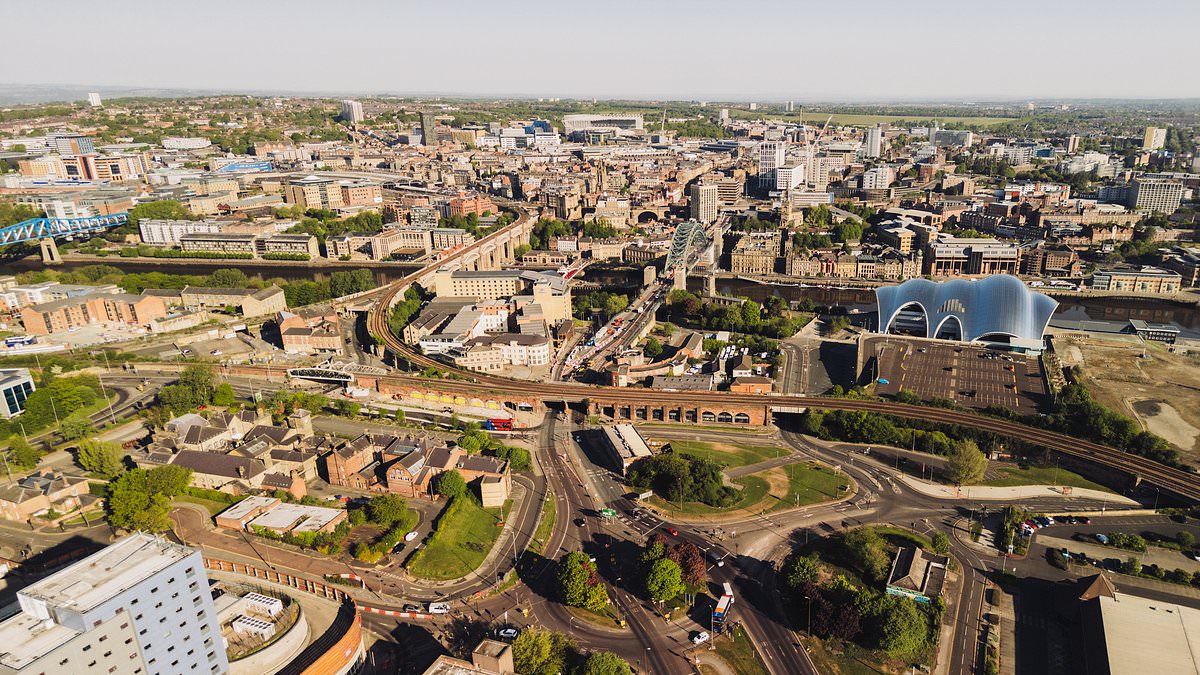
The Upper Tribunal heard that FM claimed that he moved to Gateshead, which sits across the River Tyne from Newcastle, in the summer of 2024.
'In the summer of 2024 he had been dispersed to Gateshead and was feeling depressed', the tribunal heard.
Gateshead was ranked as the 53rd most deprived of the 296 local authorities in England by the 2025 Index of Multiple Deprivation.
FM said after his move he had had contact with his family who said that his little brother had been in an accident and was in coma.
A friend suggested that he attend a Christian church with him to help his depression.
He attributed his brother's subsequent recovery to his prayers.
The man attended Farsi prayer sessions and has since been baptised.
An expert witness at the court said he believes FM to be 'genuine and heartfelt' and not trying to fake a conversion to help with his claim for protection.
Upper Tribunal Judge Gaenor Bruce says that FM had provided 'perfectly good' reasons for his conversion to Christianity and noted the camaraderie within his community.
She decided that the developments in Iran and in his life means that the case should be reheard by a new judge in the First-Tier Tribunal.
FM required a Farsi interpreter at the hearing in the Upper Tribunal Immigration and Asylum Chamber.
Judge Bruce said: '(FM) explained that one of the reasons he believes in Jesus was the fact his brother recovered after being in a coma following an accident.
'He provided no details of the accident or what injuries his brother had suffered.
'The absence of documentary evidence in respect of this and his mother's depression leading to Alzheimer's is relevant as without this, (FM) has no explanation as to why he felt drawn to a belief in Jesus.
'(FM) also claims that his attendance at church has been beneficial to his own mental health.
'He claimed to be suffering from depression which was lifted after attending the church. I note, however, that he did receive counselling and that this helped him recover too.
'The Tribunal was quite wrong to say that there was "no explanation". (FM) had given one.
'He had said that it was his brother's recovery, the compassion shown to him by fellow congregants, and the camaraderie he felt in being part of that community.
'In the hiatus between the Upper Tribunal hearing and this decision being promulgated, there have been significant developments in Iran, in that the country is currently subject to attack by the United States and Israel.
'Whether those events should result in a stay in proceedings will be a matter for the First-tier Tribunal.'
Comments (0)