
Remember me








If this Easter bunny turned up to deliver your chocolate eggs, you’d be sure to know about it.
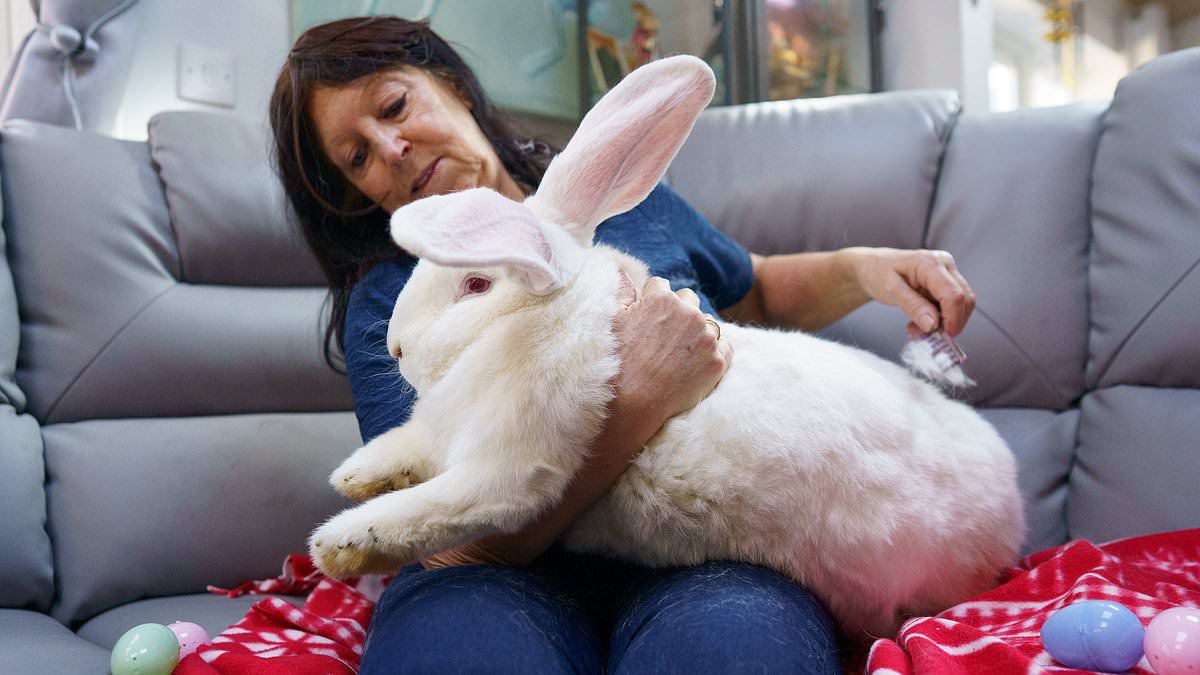
Big-eared Junior weighs an impressive 21lb and, you may not be surprised to learn, is a Continental giant rabbit.
He towers over his playmate Suzi, a Netherland dwarf rabbit who is just 1.5lb. In fact, she’s so small that she loves to snuggle up under one of Junior’s massive ears when they’re on the sofa together.
Owner Lyn Hobson, 66, admits that the pair are ‘spoiled’ and have their own room in her three-bedroom home in Hull and a sandpit outside. Those tempted to get their own bunny might want to sleep on the idea first, however.
A study found that owning a rabbit is linked to a significantly higher risk of insomnia – whereas having a dog can offer a major boost to sleep quality.
The research showed adults over 60 with a pet are significantly less likely to suffer from insomnia, with dog owners getting most protection partly thanks to increased physical activity during walkies.
But rabbits ‘are predominantly nocturnal animals requiring cage confinement and demanding care (eg, frequent cage cleaning), which may increase owners’ psychological stress and correlate with poorer sleep quality’.
The study of nearly 1,500 adults, carried out by researchers in China, was published in Frontiers of Veterinary Science.

Junior's owner Lyn Hobson, 66, admits that the giant rabbit and his playmate Suzi are ‘spoiled’ as they have their own room in her three-bedroom home in Hull - and a sandpit outside

Big-eared Junior weighs an impressive 21lb and towers over his playmate Suzi, a Netherland dwarf rabbit who is just 1.5lb
They answered questions including whether they owned pets, the type of animals and how often they interacted, such as through walks or engagement at home.
Pet ownership in general was ‘significantly associated with a reduced risk’ of insomnia - a persistent difficulty falling and staying asleep - the researchers said.
‘Specifically, dog ownership and owning healthy pets were protective factors. Conversely, rabbit ownership, ownership duration of less than one year, and daily interaction exceeding two hours were associated with an increased risk of poor sleep quality.’
The increased benefits for dog owners were linked to the increased physical activity and social benefits. Dog owners in the study typically spend around 45 minutes per day walking their pet.
‘Walking dogs provides more social opportunities, reducing loneliness and indirectly promoting sleep,’ the researchers said. ‘Moreover, dog owners experience greater daytime exposure to natural light, which helps maintain healthy circadian rhythms.’
The paper added: ‘Rabbits are predominantly nocturnal animals requiring cage confinement and demanding care (e.g., frequent cage cleaning), which may increase owners’ psychological stress and correlate with poorer sleep quality.’
A total of 717 participants had one or more animals as pets, including 487 dog owners, 270 cat owners, 61 bird owners, and 70 rabbit owners.
Nearly 61pc of rabbit owners suffered from insomnia, compared with 21pc of dog owners.
No insomnia link was observed in the cat and bird owner group.
‘For cats, calming interactions such as petting can provide emotional support and reduce stress, potentially benefiting sleep. However, cats are often most active during dawn and dusk, and their nighttime behaviors can disrupt an owner’s sleep,’ the study said.
They said the increased insomnia risk in owners who spend two hours or more per day looking after their pet could be due to ‘underlying challenges, such as behaviour issues in pets (e.g. separation anxiety) that may also cause sleep disruption at night, or owner-related anxiety and over-attachment that sustains a state of hypervigilance’.
‘Furthermore, stimulating interactions close to bedtime may directly interfere with the wind-down process necessary for sleep onset,’ they said.
Those who had their pet less than one year may have reduced sleep quality as they ‘adapt to care demands’.
The study, carried out by researchers in China, was published in Frontiers of Veterinary Science (pls keep).