Oil tanker crews stuck in Strait of Hormuz suffer mental breakdowns and refuse to sail even when it opens after six weeks stuck in the Gulf
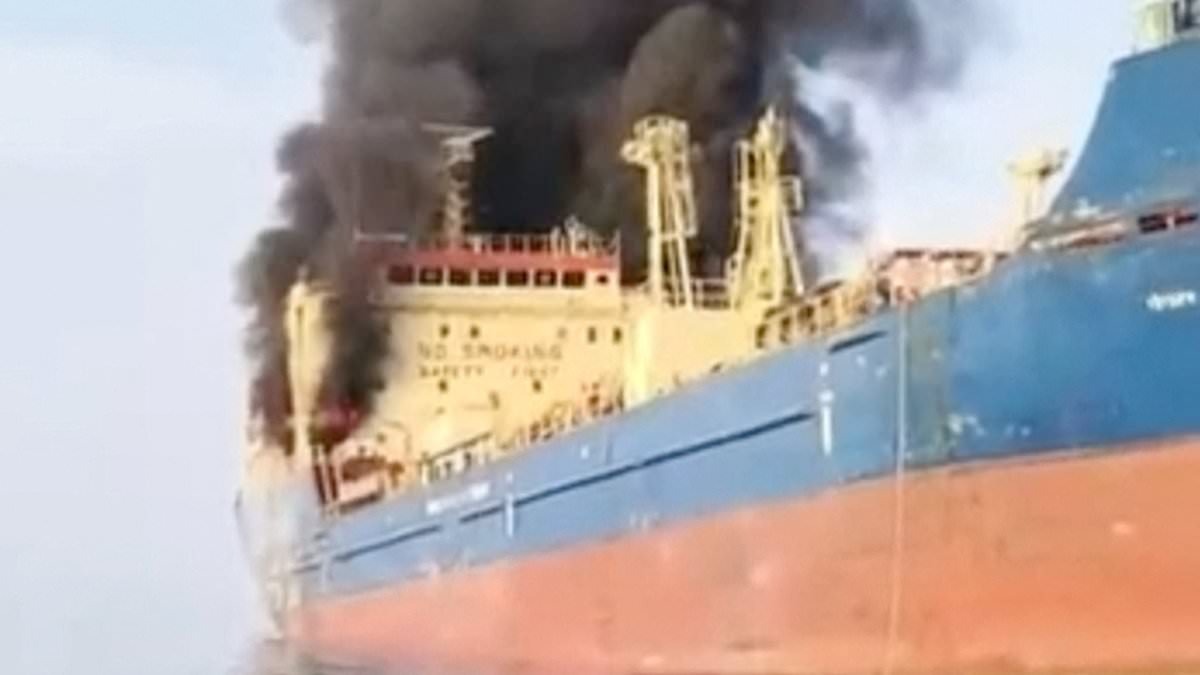
Oil tanker crews stranded in the Strait of Hormuz are suffering mental breakdowns with some refusing to sail even after it reopens.Terrified sailors fear they are 'sitting ducks' as they remain trapped in their stationary ships for a sixth week while Iran retains control over the passage.The reopening of the waterway, through which 20 per cent of global oil travels daily, is a crucial part of the two-week ceasefire agreed by Donald Trump and Iran.But the Iranian regime has continued to block oil tankers transiting through the strait and has warned vessels they will have to pay a toll of up to $2million per journey or face destruction - dashing hopes of a swift reopening. An estimated 2,000 ships and 20,000 seafarers have been trapped in the Gulf the beginning of the war, sparking an enormous surge in oil prices worldwide.Paralysed by fear after witnessing neighbouring ships set ablaze by Iranian missile attacks, some crew members say they won't sail through the strait even if it does open in a development which could spell further crisis for the global economy.One seafarer, stuck off the coast of the United Arab Emirates watched an Iranian missile strike a loaded Kuwaiti tanker, sparking a large blaze, while parked at a Dubai port last month.They claimed 90 per cent of their crew will refuse to travel through the strait when it eventually opens. Terrified sailors fear they are 'sitting ducks' as they remain trapped in their stationary ships for a sixth week while Iran retains control over the passage. Pictured: Tankers sit anchored in the strait A new map released by Iran seemed to show areas of the Strait have been mined by its paramilitary Islamic Revolutionary Guard Corps Pictured: Smoke billows from an oil tanker. Crew members on vessels are paralysed with fear and believe they are 'sitting ducks'The worker said the threats of violence have caused an 'impossible' impact on their mental health. They told The Guardian: 'I’m in no mental condition to perform any intense task after all of this.'The sailor also claimed one of their colleagues had suffered a 'mental breakdown' and is being checked on regularly. 'I’ve no doubt that this particular issue, this mental breakdown, is happening [on tankers] all around us from the stress of this situation,' they said. 'Seafarer support [phone] lines are trying to help, but from the beginning we have all known that it would not be enough.' They added: 'Any hope they may soon be free to leave had already evaporated, if it ever felt real at all.'Ship worker representatives have described the 'mental toll' the threat of violence has taken and how sailors feel as if they are 'sitting ducks'.There remains chaos and confusion over who will get long-term control of the Strait of Hormuz.The Islamist regime has kept the Strait to traffic despite the US President declaring a dramatic and decisive victory in the Middle East. Iranian officials cited the ongoing Israeli attacks on Iran's Hezbollah allies for the move to shut off the Arabian Gulf which sent oil prices soaring and stock prices falling again.Trump responded by threatening to green-light 'bigger, and better and stronger' attacks on Iran if a permanent deal isn't reached.But he had earlier suggested the US and Iran could work together on a toll regime for ships that could reach $2million per vessel. A new map released by Iran seemed to show areas of the Strait have been mined by its paramilitary Islamic Revolutionary Guard Corps, seen as a threat to attack traffic if its demands are not met.And Iranian officials have said tankers using the Strait would have to pay tolls in cryptocurrency of $1 per barrel. The Strait of Hormuz handles around 20 per cent of the world's oil and gas but has effectively been shut down by Iran in retaliation over the joint US-Israeli attacks launched on February 28
IRAN'S TEN-POINT PEACE PLAN 1. Commitment to non-aggression2. Iran's control over the Strait of Hormuz3. Acceptance of Iran's uranium enrichment4. Lifting of all primary sanctions5. Lifting of all secondary sanctions6. Termination of all UN Security Council resolutions7. Termination of all Board of Governors resolutions8. Paying compensation to Iran9. Withdrawal of US combat forces from the region10. Cessation of war on all fronts, including in Lebanon The White House rejected the idea, only for Trump to later tell reporters it could be done as a 'beautiful' joint venture with America.Charts dated from February 28 until April 9 were published by news agencies ISNA and Tasnim on Thursday, showing a large circle marked 'danger zone' in Farsi over the Traffic Separation Scheme.This was the route ships used to take through the strait – a narrow mouth of the Persian Gulf through which 20 per cent of all oil and natural gas traded once passed.On Wednesday, Iran warned that oil tankers will be destroyed if they try to travel along the strait without permission, as it seeks to retain control over the passage during the ceasefire.A radio message was broadcast yesterday by the regime to all oil ships in the vital waterway, saying: 'If any vessels try to transit without permission, [they] will be destroyed.'Even if the strait is reopened, experts have warned that oil tankers are expected to continue avoiding it, meaning there is no end in sight for high fuel prices.While oil prices plunged below $100 per barrel after Trump announced a last-minute ceasefire on Tuesday night, the lack of ships traversing the strait means that vital crude and gas supplies from the Middle East will continue to be disrupted.Lars Jensen, a shipping analyst with Vespucci Maritime, told the Telegraph: 'Technically speaking they could pull anchor and start moving now, but that is not what is likely to happen.'I expect that what we will see in the next few days, if the ceasefire holds, is a lot of vessels exit the Persian Gulf but not very many vessels enter into the Persian Gulf.'Shipping lines would be hesitant in trusting the longevity of the ceasefire at this point and therefore [would] try to get vessels out, so they can use them, but not risk putting new vessels into the Gulf that might then be trapped if the ceasefire breaks down.'
The RAC motoring group already warned that despite the sharp drop in crude oil prices today, the outlook for drivers in the UK remains 'highly uncertain' without an uptick in oil shipments.'The conditional ceasefire announcement may have taken some heat out of global oil prices, but the outlook for drivers in the UK remains highly uncertain,' RAC head of policy Simon Williams said.'The best hope in the short term is that pump prices stop rising at the rate they have been and hopefully top out in the coming days.'Much will depend on the stability of the ceasefire, whether oil shipments can move freely through the strait of Hormuz, and the longer‑term impact on oil production across the Gulf. As it is a sustained lower oil price – over several weeks, not just a few days – that is required to bring wholesale fuel costs down meaningfully.'






Comments (0)