
Remember me



This newsletter contains spoilers (I guess) of Jury Duty Presents: Company Retreat. But it’s not like we didn’t know how it was going to end!
When Jury Duty premiered in 2023, I was spellbound by the premise. An unwitting solar contractor named Ronald Gladden would attend a full round of jury duty, only the entire case was scripted and everyone involved was an actor—a two-week-long prank which would be spectacularly revealed at the end of the “trial” alongside a $100,000-dollar check for his troubles. I started the series with genuine glee and managed not to feel sick until the very end, when the level of deception, false intimacy, and undisclosed surveillance stopped feeling funny and felt, finally, unethical. Later, I was surprised to find that, aside from my canonically cynical boyfriend and one writer at Page Six, almost no one seemed to share this pessimistic view.
As you might expect, the Jury Duty producers worked hard to prevent viewers from suffering any deception-related queasiness, aggressively marketing the show as feel-good television. Gladden, nicknamed by production as the “hero,” was clearly cast for being a certain type: remarkably cheerful, endlessly understanding, perhaps not the shrewdest observer. The kind of guy who definitely wouldn’t get mad about all of this. If he ever strayed from seeming downright lovely and loveable, it must have been cut from the final edit. The characters surrounding him (including James Marsden, who plays an absurd version of himself) were silly, always willing to be the butt of the joke. The stakes were such that Gladden always got to be the good guy. The reveal was an explosion of joy and love and financial security—no mean-spirited “gotcha” energy whatsoever, unless you watched Gladden’s face very closely.
The packaging worked. The show was a viral sensation. It was anointed the breakout comedy of the year and was nominated for four Emmys. Gladden got a (lightweight) Hollywood reception: He moved to LA and signed a two-year deal with Amazon, starred in a couple commercials, posed for photos with Kendall Jenner, and supposedly maintains a friendship with James Marsden (lol). Creators Lee Eisenberg and Gene Stupnitsky were greenlit for a second season before season one even aired. That second season, clunkily titled Jury Duty Presents: Company Retreat, was just released, and it takes the peaks and valleys of the first season and intensifies them to a breathtaking degree.
I approached Company Retreat with a lot more trepidation than its predecessor, but couldn’t really imagine sitting it out entirely. I had to see if they could pull it off again. This is of course the appeal of the show. The novel format harnesses the original draw of reality TV: the feeling of being a fly on the wall, the sense that you’re witnessing something the people (or person) on screen cannot understand from their particular vantage. The dramatic irony of The Truman Show rendered in the “real” world. Such a value proposition has been all but abandoned by most modern day reality TV, with the stars now increasingly aware of the audience and participating in the charade. It doesn’t feel like spying in precisely the way it once did. I guess you could say we wanted our power back.
I’d be remiss not to mention that both Jury Duty and Company Retreat are amazing feats of creative production pulled off by highly skilled people. An unthinkable amount of writing and contingency planning is involved, with comedic improvisation pushed to its limits (and sometimes past them). If the producers cannot maintain the prank, the entire show fails and tens of millions of dollars will be wasted. It’s impossible to watch the show and not be impressed when that doesn’t happen. The logistical achievement is half the fun.
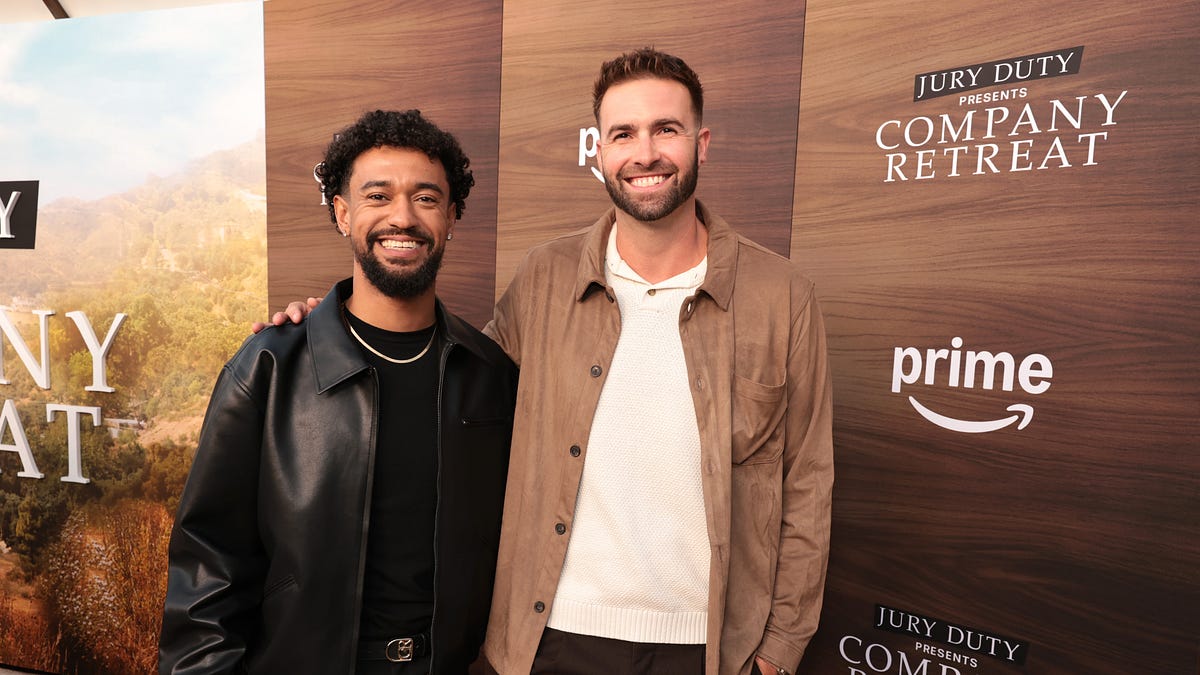
The other half is the cast. The new hero, Anthony Norman, perfectly chosen, shares Gladden’s penchant for heart-wrenching enthusiasm, well-placed blind spots, and radical acceptance of strange and flawed people. (Can’t help but appreciate the accidentally evocative nature of the heroes’ names: glad-guy Gladden and normal-guy Norman.) The principal difference in season two is that the long-con takes place at a fake company retreat, with the cast having a scripted history spanning 20 years—Norman is hired on as a temp to help out. Where season one had a group of “strangers” coming together, season two invites the hero into a well-established relational dynamic, with all the warmth and intimacy that entails. This renders the stakes much higher and the reveal more complicated. Still, the cast members surrounding him are funny and sweet and hard not to love. Their ability to stay in character is a testament to their comedic talent—apparently they didn’t learn each other’s real names until the end, lest they slip up.
My initial grievance with Company Retreat, which I enjoyed to a point, is the unrelenting presence of its comedic influence, The Office, where creators Eisenberg and Stupnitsky (very obviously) both worked for years as writers and producers. The now-20-year-old style of humor feels pretty played out, not to mention the quirkier bits and characters favored by the mockumentary format never felt particularly “real.” Applied to a supposedly realistic scenario, this spirit of hyperbole strains the terms of the feel-good prank, making Norman seem increasingly dense as he doesn’t catch on.
In the first piece of proper, non-sensationalized media criticism I could find on the show (article, social post, or otherwise), The New Yorker’s Inkoo Kang skewered this aspect of the show’s pollyanna perspective: “Too often, the season asks the audience to see [Anthony’s tolerance for nonsense] as evidence of [his] unstinting optimism, rather than the quality they must have cast him for: an apparent inability to recognize red flags.”
The setting of season two heightens the nature of the show’s deceit. The retreat is for a fake hot sauce company called Rockin’ Grandma’s, and turns dramatic when the retiring CEO pivots from bequeathing the position to his deadbeat-but-earnest son to selling to a private equity company. Through this existential crisis, the charming cast of characters take on Norman as “one of their own.” They draw him continually into intimate conversations and moments of personal strife and transformation; they bond; they tell him he’s part of the family. From our fly’s perch on the wall, his growing affection for his fake coworkers verges on devastating; you can’t help but wonder if he’s hoping for a full-time job. Eventually he’s set up to save the company from financial and spiritual ruin, in a climactic moment that could only make someone at the center of it swell with pride—that is, unless it all turned out to be an elaborate ruse.
The reveal takes place shortly after, and it’s no accident that he’s told about the $150,000-dollar check within the first 60 seconds. (Note his payout is 1.5x larger than Gladden’s, and you can guess why.) The news of the windfall is presented like an award, but it feels more like a covert gag order. Who could be mad in the face of such spoils? Still, Norman is unable to fully process what he’s hearing. He’s smiling a lot, but you get the sense he’s doing this for the sake of the crowd swarming around him, who are understandably unable to contain their excitement at what they’ve pulled off. They must feel drunk with relief and pride of their own.
In rare moments that feel like glimmers of the truth, Norman looks sick, unconvinced, reeling and overwhelmed. As a viewer, I felt the reveal ought to have been slower, gentler, more like a confession than a celebration. But that wouldn’t have played very well, ethically speaking. Anyway, the crew doesn’t appear very interested in the intricacies of Norman’s emotional state during this denouement, they’re much more focused on showing him the location of each hidden camera. The cast, meanwhile, appear more conflicted, showering him in professions of love that seem genuine but also feel a little like apologies.
Luckily, Norman isn’t the type to get mad. In the press following the season finale, he has consistently referred to the show as a positive experience (although initially “there was sadness”). He’s in close touch with the entire cast, he says, joking that it took him a while to learn their real names. They talk all the time! Maybe he’ll have a brief future in show business like Gladden, with whom he’s also connected. He’s open to anything. He’s very grateful.
Both seasons offer the same trade-off to their respective heroes: Forgive us the staggering levels of deceit, exposure, and surveillance to which you couldn’t possibly consent, and we will pay you a lot of money, connect you with Hollywood, and show the world how amazing you are with our flattering edit. Audiences, meanwhile, are offered a similar exchange: Look past the duplicity and the manipulation and we’ll entertain and delight you for four hours straight. We might even make you cry! (I will confess to shedding a couple tears both seasons.)
Lightweight as this TV show may be, or well-meaning as its creators are, this bargain feels familiar. As modern civilians, we’re offered increasingly shiny spoils in exchange for our willingness to look past the surveillance-industrial complex. However variable the stakes, the playbook is the same. The show’s success, its easy brandability as “life-affirming,” only underlines our vulnerability to this style of trickery. Offer us enough and we won’t worry about things like privacy or consent. Nothing is so precious that it can’t be traded up.
After wrapping production on season one of Jury Duty, Gladden was destabilized. “[I]t took that entire weekend to realize what had happened,” he told the New York Post. He was intermittently paranoid, wondering if cameras were still following him. Per Page Six, he told iHeartRadio that it took a long time for him to process. “Months and months down the road, things would just randomly hit me. I’d be doing laundry or washing the dishes or something, and I’d be just like, ‘Oh, wow, was that fake?’” Thankfully, James Marsden was only a phone call away, and his invite to Kendall Jenner’s 818 tequila party was already in the mail.

Last week’s 15 things including a comedy show I highly recommend you catch while it’s on tour, a movie that made me cry harder than expected, and four articles worth reading. The rec of the week was best ways to prep tofu. Thank you for your wisdom!!! Last Wednesday’s podcast was on maternal ambivalence and my random love of potty training (lol).
Take care,
Haley
Cover image via Getty | Eric Charbonneau / Contributor