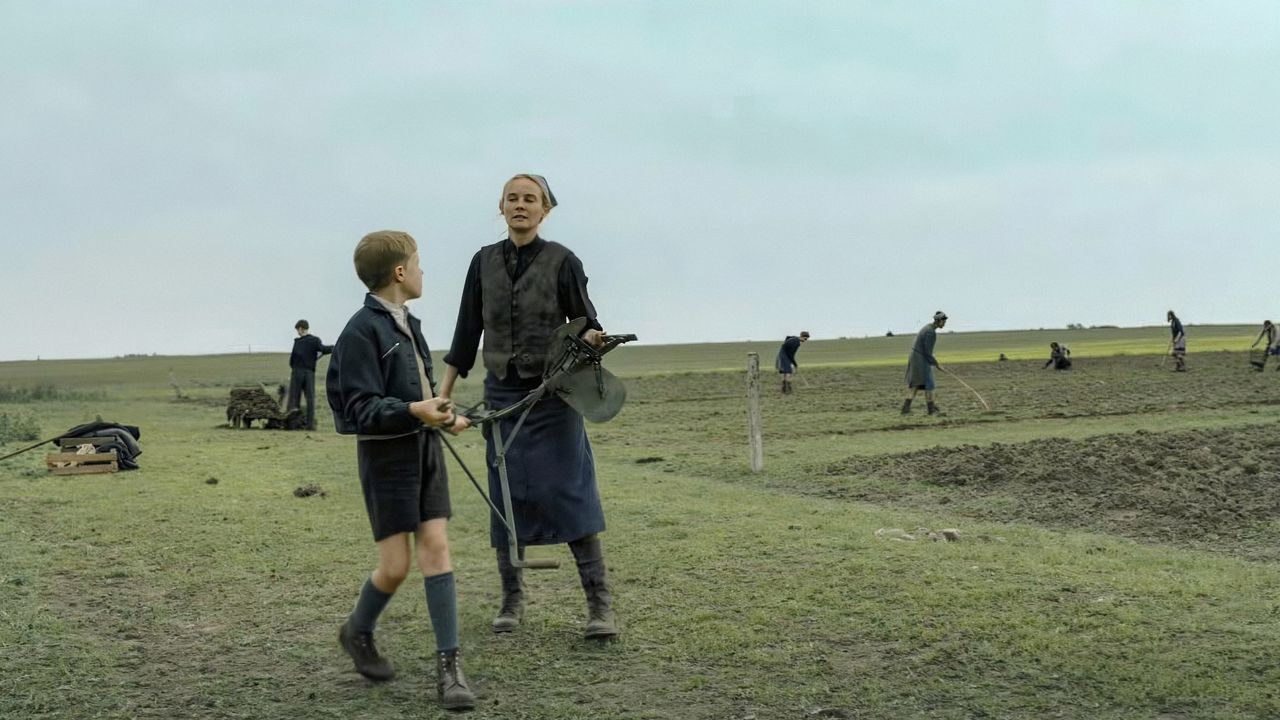
Arjan, a grizzled fellow with mirthful eyes, is one of many locals who quietly expand Nanning’s horizons. The old man once went to New York to make his fortune; so did Nanning’s grandfather and other Amrumers, a revelation that sheds new light on the pride, insularity, and xenophobia of this community, where even German mainlanders are regarded, contemptuously, as outsiders. Nanning, who was born in Hamburg, is bullied by a schoolmate who tells him that he’s no more a native Amrumer than the Polish refugees who have recently arrived on the island. Hille tries to reassure Nanning, noting that they are dwelling in their ancestral home: “Through me, your Amrumer blood goes back nine generations.” Tonke, in a haunting performance, gives these words an unmistakably fanatical chill. Hille’s every thought, word, and deed is governed by an obsession with blood purity. Clinging to her sense of racial and cultural superiority with an ever more unyielding grip, she seems utterly beyond saving. Her children, mercifully, are another story.
Fraught questions of national identity and dislocation have long weighed on Akin, who was born to Turkish-immigrant parents in Hamburg, and who charted the difficult journeys of German Turkish protagonists in his two major international breakthroughs, “Head-On” (2005) and “The Edge of Heaven” (2008). Since then, Akin’s restless streak has sent him all over the map—geographically, dramatically, and stylistically—and although he seldom seems disengaged, he has struggled to retain, or regain, the bristling urgency and jagged formalism that gave his early work its undeniable vitality. He confronted the Armenian genocide in “The Cut” (2014); went after neo-Nazi terrorists in the revenge thriller “In the Fade” (2017); and, most inexplicably, chronicled the life and crimes of a notorious Hamburg serial killer in “The Golden Glove” (2019), a little-seen abomination. My personal favorite of Akin’s films might be one of his most lighthearted: the shambling foodie comedy “Soul Kitchen” (2010), whose culinary concerns give it the slenderest of links to “Amrum” and its bread-and-honey mission impossible.
The new film is both Akin’s strongest and, with its stately, picturesque classicism, his least characteristic work in some time. “Amrum” almost acknowledges as much; it comes billed as “A Hark Bohm Film by Fatih Akin,” an unwieldy yet moving onscreen declaration of joint authorship. But, by dint of its story and its subject, the movie also feels like part of a broader cinematic conversation. It can’t help but conjure the vast range of films that have shown us the horrors of war from a kid’s perspective—a field that has yielded a few masterpieces, including Andrei Tarkovsky’s “Ivan’s Childhood” (1963) and Elem Klimov’s “Come and See” (1985), and, more recently, an underappreciated future classic, Steve McQueen’s “Blitz” (2024). Curiously, and through no fault of Akin’s or Bohm’s, the children-at-war picture that “Amrum” most resembles on its face is Taika Waititi’s “Jojo Rabbit” (2019), the rare film to which I’d admit a grudging, gun-to-my-head preference for even “The Golden Glove.”
Like “Jojo Rabbit,” “Amrum” tracks a young Nazi boy’s reverse indoctrination and moral awakening during the last gasp of the Second World War. (Both films also feature scenes of bunny slaughter, clearly a popular rite of passage for that demographic.) Unlike “Jojo Rabbit,” “Amrum” does not infantilize the audience, trivialize the Holocaust, abuse the music of David Bowie, turn Hitler into a grotesque imaginary-friend caricature, or shy away from the idea that Nazis might, in fact, be terrible people. The two films’ most relevant point of connection might concern their pint-size protagonists, both of whom appear to have been cast for maximal cherubic appeal, as if to short-circuit any qualms we might have about embracing a Hitler Youth in training. Billerbeck, a first-time actor and a superb discovery, is such an immediately likable screen presence that it’s only natural to wonder if you’re being worked over.
Worry not. Nanning is an engaging lead, but he isn’t sentimentalized. He is, like many children, susceptible to the pressures of obedience and groupthink—qualities that can be weaponized under totalitarian circumstances—but he also has sufficient clarity to be horrified when he learns how antisemitism has shaped his own family. His character is, in a way, as malleable and half-formed as the white coasts of Amrum: invitingly sandy beaches that can turn instantly harrowing when the tide rolls in. More than once, Nanning, carrying a precious portion of butter or sugar, must wander into that treacherous tide. In one instance, he’s forced to make a swift, momentous decision about the value of another human life.










Comments (0)