
Remember me




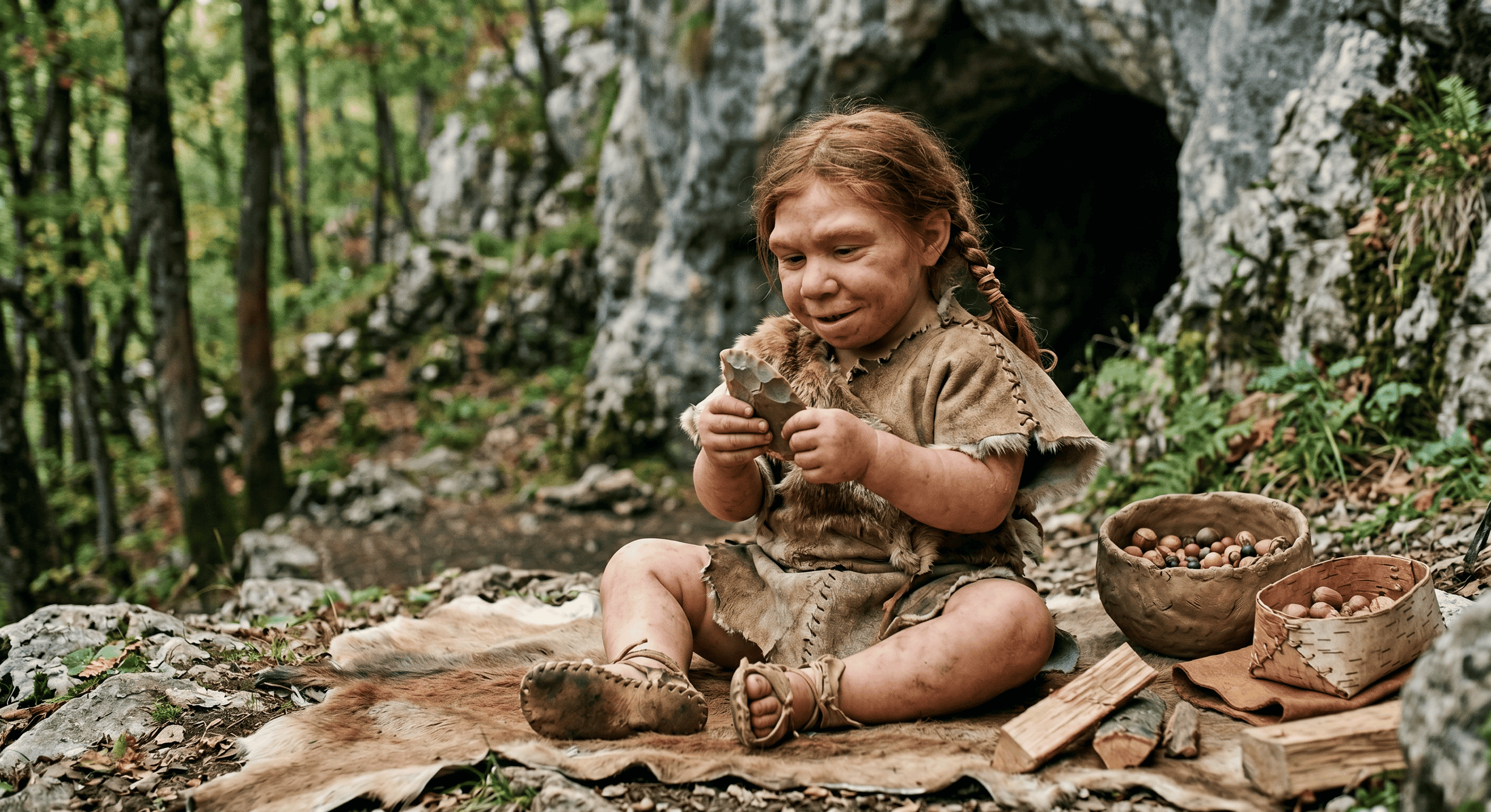

 AI-generated illustration of a Neanderthal toddler. Credit: ZME Science.
When scientists examined the incredibly well-preserved skeleton of a Neanderthal infant from an Israeli cave, they were in for a surprise. The baby, known as Amud 7, was only about six months old when it died. Yet, its body and brain were already the size of a one-year-old by modern human standards.
This suggests that our extinct cousins pursued a completely different, high-speed strategy for growing up in a harsh Paleolithic world.
Neanderthals made tools, buried their dead, and even mated with our Homo sapiens ancestors over many millennia. Despite many similarities, the Amud 7 skeleton shows that from their earliest days, Neanderthals were still quite different.
The Age Paradox
Discovered in a cave near the Sea of Galilee in the 1990s, Amud 7 lived roughly 51,000 to 56,000 years ago. The infant is one of the most complete Neanderthal babies ever found. Researchers recently completed a thorough 3D reconstruction of the 111 skeletal pieces recovered from the cave floor.
What they saw was unmistakably Neanderthal, even though the child was barely six months old.
Ella Been, a professor at Ono Academic College in Israel and first author of the study, tells El Pais: “There are some notable differences: robust bones, a large endocranium, no chin, a highly curved clavicle, a superior inclination of the scapular spine, an inferior orientation of the glenoid cavity, and a relatively short tibia.”
“The fact that these differences appear so early in life indicates that Neanderthal morphology is deeply rooted in their biology, and not shaped by the environment or behavior,” Been added.
To determine the age of the baby’s remains, researchers first looked at the teeth. Based on microscopic growth lines in the dental enamel and the eruption stage of the jaw, Amud 7 was around 5.5 to 6 months old. Only the two lower milk teeth had just begun to push through the gums.
×
Thank you! One more thing...Please check your inbox and confirm your subscription.
“I think Amud 7 is closer to 6 months old,” Been tells New Scientist. Speaking to El Pais, she adds: “I believe that the histological age of the teeth is more accurate than age measured by the volume of the long bones or the endocranial cavity for estimating such a young age.”
However, the baby’s long bones — the arms and legs — also spoke volumes.
 Credit: Neanderthal Museum, Mettmann.
If this were a modern Homo sapiens baby, the length and robust thickness of these limbs would belong to a toddler aged 12 to 14 months. The brain size, estimated at nearly 880 cubic centimeters, also perfectly matches that of an older modern child. The baby had a young dental age but a much older skeletal age.
It follows that Neanderthal children most likely physically grew much faster than H. sapiens.
“In the first few years of life, from birth through early childhood, Neanderthals grew faster than modern humans,” Been explains to New Scientist.
The Price of Growing Up Fast The Amud 7 skeleton during excavations in the 1960s. Credit: Yoel Rak.
Why would Neanderthals evolve to grow at such a breakneck pace?
The Paleolithic landscape was unforgiving. Neanderthals endured brutal, fluctuating Ice Age climates across Eurasia. Growing a larger, stronger body quickly meant retaining vital body heat better and reaching physical independence sooner. Meanwhile, H. sapiens evolved near the African equator, where resources were more abundant and environmental shifts more forgiving.
“We cannot say how advanced Neanderthal babies were in their behaviour. We do not know whether they started walking at a different time than modern human babies do,” Been points out. But, she adds, they were big and “not necessarily chubby.”
There’s no such thing as free lunch, though. This biological sprint came with a massive energetic bill. Building thick bones and a rapidly expanding brain simultaneously requires incredible amounts of calories. Neanderthal mothers and their wider social groups must have been highly proficient at sourcing rich nutrition to feed their young.
 Excavation site at Amud cave. Credit: Erella Hovers.
So, what did they eat to fuel this growth? A 2020 study on Neanderthal milk teeth from Italy shows they introduced solid foods around five or six months of age — exactly when modern humans do.
Alessia Nava of the University of Kent says that “the beginning of weaning relates to physiology rather than to cultural factors. In modern humans, in fact, the first introduction of solid food occurs at around 6 months of age when the child needs a more energetic food supply, and it is shared by very different cultures and societies. Now, we know that also Neanderthals started to wean their children when modern humans do.”
“In particular, compared to other primates, it is highly conceivable that the high energy demand of the growing human brain triggers the early introduction of solid foods in child diet,” adds Federico Lugli of the University of Bologna.
To consistently meet these immense dietary needs, Neanderthals relied on a deep, generation-spanning knowledge of their local environments.
“They were less mobile than previously suggested by other scholars; the strontium isotope signature registered in their teeth indicates in fact that they have spent most of the time close to their home: this reflects a very modern mental template and a likely thoughtful use of local resources,” Wolfgang Müller of Goethe University Frankfurt.
“Despite the general cooling during the period of interest, Northeastern Italy has almost always been a place rich in food, ecological variability and caves, ultimately explaining survival of Neanderthals in this region till about 45,000 years ago,” said Marco Peresani of the University of Ferrara.
A Pattern, Not a FlukeCould Amud 7 just be an unusually large baby?
To verify their findings, researchers checked Amud 7 against other Neanderthal children, including a two-year-old from Syria known as Dederiyeh 1, and a three-year-old from France called Roc de Marsal. The accelerated growth pattern holds true across the board.
“Seeing the same pattern in three different Neanderthal infants shows that this is not accidental,” Been tells New Scientist.
“Amud 7 is not an isolated case. When compared with other known Neanderthal infants, the same pattern emerges: faster body and brain growth, suggesting greater energy expenditure. Understanding this pattern is crucial to understanding who Neanderthals were and how they adapted to their environment,” Been told El Pais.
However, this high-speed growth did not last forever. By about seven years of age, the developmental differences between our two species seem to fade, and children of both species follow a more similar trajectory.
All in all, researchers identified three different growth stages in juvenile Neanderthals. Newborn Neanderthal teeth developed in sync with their bodies. Then, in infants like Amud 7, a massive surge in body and brain growth outpaced dental development. Later, in older children, the dental and body development sync back, while brain growth continued at a fast rate.
Ultimately, as adults, Neanderthals ended up a similar size to modern humans, “though they were on the short side,” Been notes.
Different Path, Same Destination?Modern humans with ancestry outside of Africa directly inherit approximately 1% to 4% of their DNA from Neanderthals due to ancient interbreeding events. Overall, however, modern humans share around 99.7% of their total DNA sequence with Neanderthals, who were our species cousins on the human family tree.
If we are so genetically close, why did we grow so differently?
The secret to their rapid maturation most likely does not lie in a completely different genetic blueprint, seeing how much DNA is shared among the two species. Instead, the differences likely lie in how those shared genes were switched on and regulated as the child developed.
There’s also something to keep in mind: perhaps Neanderthal children didn’t grow abnormally fast, but rather H. sapiens children grow abnormally slow. Humans spend almost twice as long in childhood and adolescence as our closest living relatives, like chimpanzees and gorillas.
Neanderthal babies likely spent the same amount of time developing in the womb. However, by weaning their young and pushing them toward physical independence at an accelerated rate, Neanderthal mothers might have been able to shorten the gap between pregnancies.
Our ancestors traded the early physical independence seen in Neanderthals for a prolonged, vulnerable infancy. While Neanderthals grew up at the urgent pace their harsh, unpredictable world demanded, modern humans hit the developmental brakes — a uniquely slow, high-stakes gamble that gave our brains the long childhood they needed to eventually shape the world.
The findings appeared in the journal Current Biology.


Comments (0)