
Remember me




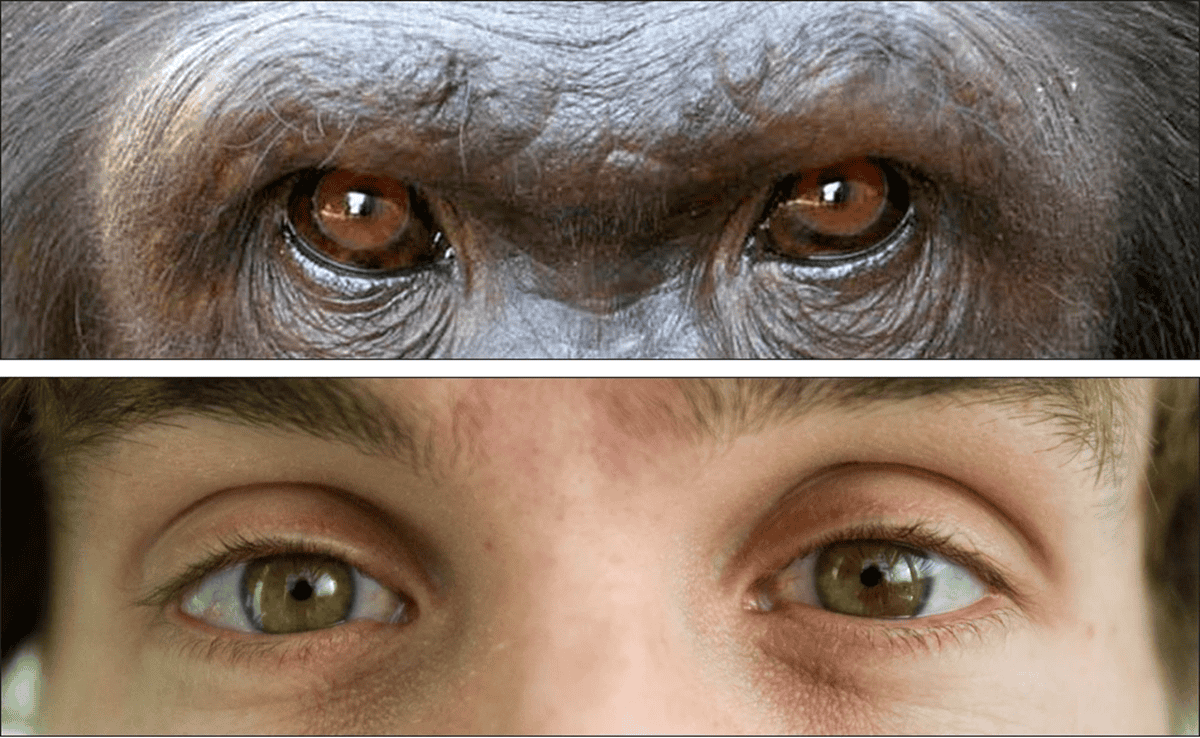




 Scientists speculate that human eyes stand out more than chimpanzee eyes because there’s an advantage for humans in being able to see the subtle cues communicated by eye movement. Credit: PR Newswire
Lock eyes with a chimpanzee, and you will notice something is missing. The tissue surrounding their iris, called the sclera, is a deep brown or nearly black. You cannot easily tell where they are looking.
Now, look at another human across the room. Within milliseconds, you know exactly what holds their attention.
Most mammals’ eyes are camouflaged with dark tissue, likely to stay hidden from predators in the shadows. Sometimes it perfectly matches the color of the iris. And, usually, only a sliver of it ever meets the light.
We humans, however, evolved bright white sclerae that loudly broadcast our focus. In addition, our eyes are more horizontally elongated and disproportionately large for our body size compared to most apes. Gorillas, for example, have massive bodies but relatively small eyes.
The whites of our eyes have turned humans into an open book, and that has actually worked out very well for us. But why exactly is that?
The Cooperative Eye HypothesisScientists have wrestled for some time with the question of why humans’ white scleras stand apart from the rest of the great apes.
The leading explanation began to take shape in 2001, when researchers at the Tokyo Institute of Technology proposed what we now call the Cooperative Eye Hypothesis. They argued that instantly reading the direction of someone’s gaze forms the bedrock of non-verbal communication.
Michael Tomasello and his colleagues at the Max Planck Institute for Evolutionary Anthropology later formalized this idea. They suggested that human eyes evolved specifically to make our attention visible.
×
Thank you! One more thing...Please check your inbox and confirm your subscription.
To test this, the researchers conducted a now classic experiment published in a 2007 issue of the Journal of Human Evolution. They presented human infants and great apes with a scientist who looked toward the ceiling. Sometimes the scientist moved only his eyes. Other times, he moved his head.
The great apes consistently followed the scientist’s head. The human infants, however, almost exclusively followed the eyes.
This revealed a special human sensitivity to eye direction. It suggested that our bright white sclera is the exact anatomical feature that makes such efficient, wordless coordination possible.
“It would be especially useful to know when in evolution human’s highly visible eyes originated, as this would suggest a possible date for the origins of uniquely human forms of cooperation and communication,” Tomasello and colleagues write.
A Peace Signal on the SavannaThe logic is straightforward. If you want to track a moving object, you need high contrast. A dark iris floating on a white background acts like a compass needle. A dark iris lost on a dark background reveals almost nothing.
This eye contrast may have been helpful even during our lineage’s early days in the African savanna. A quick flick of the eyes allowed early human hunters to silently alert their group to prey. We see this trend elsewhere in the animal kingdom; canines that hunt in packs are far more likely to possess white sclerae than those that hunt alone.
 A team of Japanese researchers looked at pictures of nearly every canid species and found that those with highly social pack and hunting behaviors were more likely to have easily visible eyes. They then watched some of those species interact in zoos and concluded that those with eyes that were easier to see were more likely to be social. Credit: PLOS ONE.
Perhaps not incidentally, canines with light sclera were also more social. A 2022 study published in Scientific Reports analyzed the eyes of 108 primate species. The researchers measured scleral pigmentation against social tolerance, prosociality, and lethal aggression.
The findings were unambiguous. Primates with brighter eyes engaged in highly cooperative behaviors. Species with dark eyes exhibited less cooperation and had higher rates of lethal violence among their own kind.
This contrast remains robust even in bad visibility conditions. In 2022, scientists published a study in eLife showing images of human and chimpanzee eyes to both species. They added visual noise, simulated bad lighting, and increased the distance.
Both humans and chimps read the human gaze far more accurately. When researchers digitally painted the chimpanzee eyes with a white sclera, gaze discrimination immediately skyrocketed for both viewers.
On a deep, evolutionary timescale, the whites of your eyes act as a non-aggression signal. They advertise that you live in a community where it is safe to share your attention. You only broadcast your focus if you view the creatures around you as mostly allies, not enemies. Because of these advantages, the thinking goes that natural selection helped those ancestors with lighter eyes foster more offspring until the trait spread across populations of the human lineage.
The Byproduct of a Kinder SpeciesBut that’s not the only explanation. A competing hypothesis known as the Self-domestication Hypothesis offers a fascinating alternative. In a way, the case and effect are reversed relative to the Cooperative Eye Hypothesis.
This theory suggests that the whites of our eyes emerged merely as a byproduct of humans becoming kinder to one another. As our ancestors evolved to become less aggressive and more socially tolerant, they experienced changes in their neural crest cells.
These embryonic cells are responsible for developing both stress-reactive adrenal tissue and pigment-producing melanocytes. When you breed mammals for tameness, you routinely diminish these cells. This results in a predictable cluster of traits: floppy ears, curly tails, juvenile faces, and reduced pigmentation, including in the eye.
In other words, if you reduce the aggression response, you also reduce melanin (dark pigment) production. From this perspective, natural selection did not target the eye directly. The brightening of the sclera was simply a collateral effect in the quest for a gentler species.
Furthermore, a white sclera acts as a transparent health billboard. Diseases like hepatitis quickly turn the white tissue yellow. Because scleral brightness declines with age across primates, sexual selection may have favored white eyes as an undeniable cue of youth, health, and fertility.
The Geography of Light Eye color variations in primates. Credit: Juan Olvido Perea-García
We know the bright whites of our eyes forged a social revolution, acting as a canvas that broadcasts our attention. But what about the colorful centerpiece they surround?
The main assumption has been that iris coloration mainly evolved for communication or sexual attraction. Yet, a 2022 study from the National University of Singapore found a striking geographic pattern. They examined hundreds of photographs covering 77 primate species.
As a primate population lives further from the equator, their eyes physically change. The tissue surrounding the iris grows lighter, and the iris itself sheds its brown pigment to become greener or bluer.
“We have known for a long time that humans are exceptionally good at using their eyes in communicating with others, so many researchers had tried to find these same functions in primates. Understanding that ambient light, instead, may have an impact in the appearance of primate eyes brings a fresh perspective to this field,” said Dr Juan O. Perea-García, a postdoctoral researcher at the National University of Singapoare.
For instance, lighter eyes are better suited to colder, darker climate. Blue eyes trap more ambient blue light, which stimulates retinal receptors and tune our circadian clocks.
“What is exciting about this research is that by using the comparative method in evolutionary biology, we find that many species of primates independently evolved bluer eyes at higher latitudes, just like what happened within our own species. This helps tip the balance towards an ecological, rather than sexual selection explanation, for the evolution of blue eye colour in humans,” said Professor Antónia Monteiro of the National University of Singapore Department of Biological Sciences.
Evolution, however, rarely leaves a perfectly clean trail.
“Even though this study provides a possible solution to the puzzle of iris colour variation, many mysteries remain — for example, why some species living in the equator sometimes have striking blue eyes, like the brown spider monkey (Ateles hybridus), or why some species with similar ranges have different levels of conjunctival pigmentation, like the chimpanzee and bonobo, remains to be addressed,” said Dr Perea-García.
More Variation Than We ThoughtOf course, nature is rarely this straightforward. For years, textbooks claimed humans were the only primates with white sclerae. Yet, while our closest living relatives, Chimpanzees and bonobos, do indeed possess predominantly brown sclerae, researchers recently realized that primates actually display a wide, gradual spectrum of eye pigmentation.
A 2025 study in Biological Reviews noted that white sclerae occur far more commonly in mammals than previously believed.
In fact, a 2023 study of chimpanzees at Ngogo in Uganda revealed that nearly one in six apes had full or partial white sclera in at least one eye. An additional 41% had some other form of lighter sclera, such as tan or brown sclera, or sclera with patches of lighter color. Light and white sclera were most common in infants under one and a half years old and often darkened as the animals aged. The researchers noted that even a tiny sliver of white makes gaze direction apparent, particularly when the ape averts its gaze.
“The fact that chimpanzees supposedly have uniformly dark sclera has been used as evidence to support the narrative that they are more competitive than cooperative,” said Isabelle Clark, a University of Texas at Austin doctoral candidate and co-first author of the 2023 paper.
“This is the first study to look at such a large sample of wild, individually identified chimpanzees, made possible by the sheer numbers at Ngogo, along with Kevin Lee’s skilled and prolific photography. Just like in humans, there is a lot of variation between individuals and perhaps populations of chimpanzees, which may get overlooked if we only consider a small sample.”
The Ape Who Side-Eyes Some chimpanzees do have light sclera. Credit: Kevin Langergraber.
By the way, apparently, non-human primates give side-eyes, too. An international team showed this in 2019 after examining the eyes of over 150 humans, bonobos, and chimpanzees. They found that despite having darker eyes, the subtle contrast between the ape’s iris and sclera still allowed their peers to follow their gaze.
“Humans are unique in many ways, as no other animal can communicate with similar intricate language or build tools of such complexity,” said Juan O. Perea-García at the National University of Singapore in a statement accompanying the release of the research. “Gaze following is an important component of many behaviours that are thought to be characteristically human, so our findings suggest that apes might also engage in these behaviours.”
Our bright eyes may not be entirely unique, but they remain a powerful social tool, whose role in communication likely predates language. Babies learn to follow them from birth.
The next time someone asks you to look them in the eye, remember that you belong to a species that survived and thrived because it learned to read, and be read.


Comments (0)