
Remember me


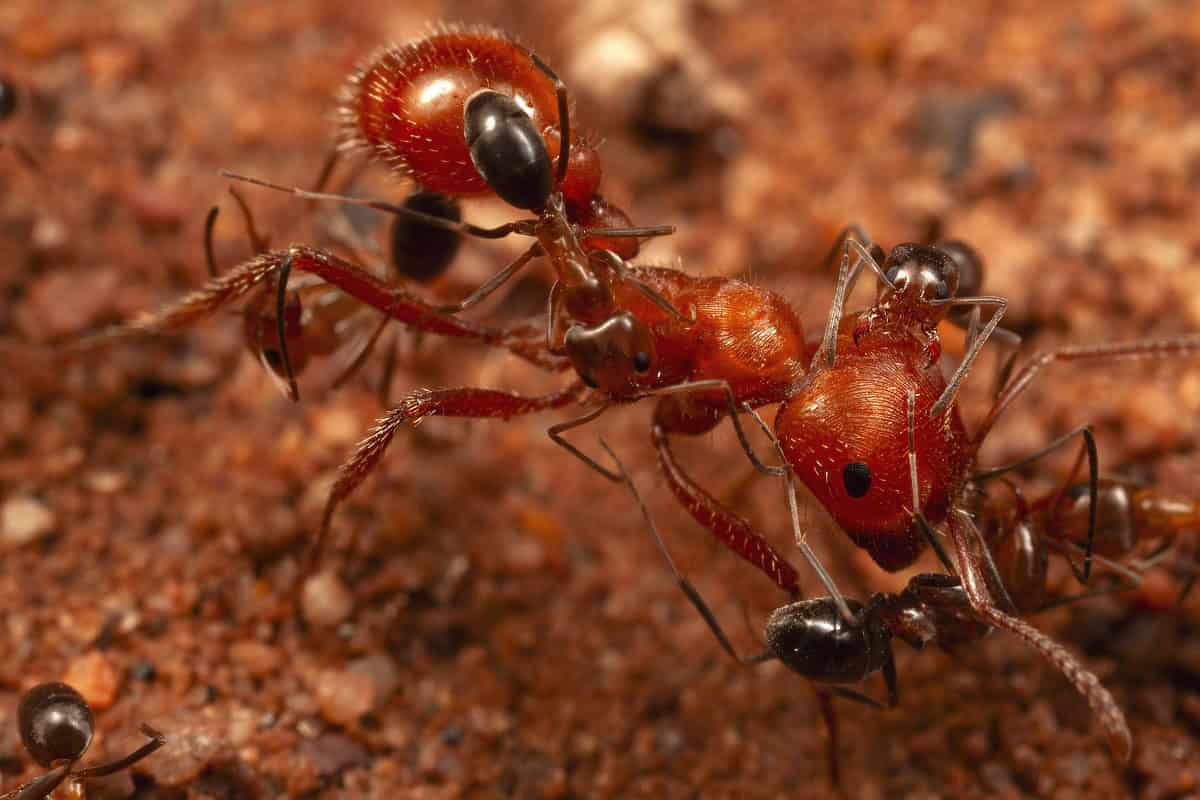




 Image credits: Mark Moffett / Ecology and Evolution
In 2006, biologist Mark Moffett noticed an unusual behavior. The usually aggressive harvester ants would park themselves near the nests of the much smaller cone ants. They just stayed there, like statues, with their mandibles open.
Normally, this would be a threatening posture. But the smaller cone ants come in, climb onto the harvester ants, and give them a full spa treatment. They clean the harvesters everywhere, even on their eyes, while the harvester ants stay completely still.
No one knows why they do this.
Moffett, who specializes in studying the social behavior of ants and other animals, witnessed this in Arizona, while enjoying his coffee early one morning. He initially assumed it to be an aggression, but then noticed that the larger ants would seek out the smaller ones by visiting their nests, allowing the smaller ants to nibble all over.
Although the behavior was first observed twenty years ago, Moffett has only now described it.
“The year was 2006. I had hoped to return to gather additional hard data for insights on the function of this remarkable behavior. I never did, but over the course of those days I captured images documenting each step of these interactions, some of which I publish here for the first time,” the researcher wrote in the study.
 Image credits: Mark Moffett / Ecology and Evolution
He watched at least 90 harvester ants get groomed this way, and their restraint was striking.
These ants are big and strong for insects. Yet they permit tiny visitors to roam their body. Up to five cone ants would swarm a single harvester ant, prompting no visible reaction. The sessions usually end when the harvester ant has had enough. She will violently jolt herself, sometimes flipping onto her back to knock off her tiny spa cleaners before hurrying away.
×
Thank you! One more thing...Please check your inbox and confirm your subscription.
Moffett proved that this isn’t some random behavior. He tested the cone ants with dead harvester ants. He froze some of them, thawed them out, and placed them near the cone ant nests. The cone ants curiously looked them over, but they didn’t offer the “spa treatment”. The behavior requires a living, posturing client.
Why Do They Do It?Moffett (or anyone else, as far as we know) has never seen or heard of such a behavior in any insect. Ants are careful groomers, of course, but they do it themselves.
But there is one similar behavior, in the ocean.
 Image credits: Mark Moffett / Ecology and Evolution.
Some large marine fish are known to seek out distinct “cleaning stations” where smaller fish and shrimp eat dead skin particles and parasites. Like the cone ants, some of these cleaner fish even feed inside their jaws. And, like the harvester ants, the large fish show remarkable restraint, otherwise the system doesn’t work.
Moffett doesn’t know for sure that this is the same type of behavior, but he speculates that it is. This would make it a type of symbiotic activity, where both parties have something to gain. The larger ants get a free grooming session, while the smaller ones get a free meal eating crumbs and parasites off their peers.
Another possibility is social engineering. Howard Topoff at the City University of New York notes that extended contact could lead to the transfer of colony pheromones. If the cone ants smell more like the harvester ants, the harvesters might be less likely to attack them. This “peace through chemistry” would allow the smaller cone ants to nest safely near the massive harvester colonies, in exchange for their grooming services.
Whatever it is, it’s a stunning example of insect collaboration. It suggests that nature might have much more of these collaborative behaviors than we previously thought.
“All kinds of amazing discoveries are still there to be made outside of the lab,” Moffett said. “Finding new species and behaviors in nature often requires us to pay close attention to the small things — including the ants.”
The study was published in Ecology and Evolution.


Comments (0)