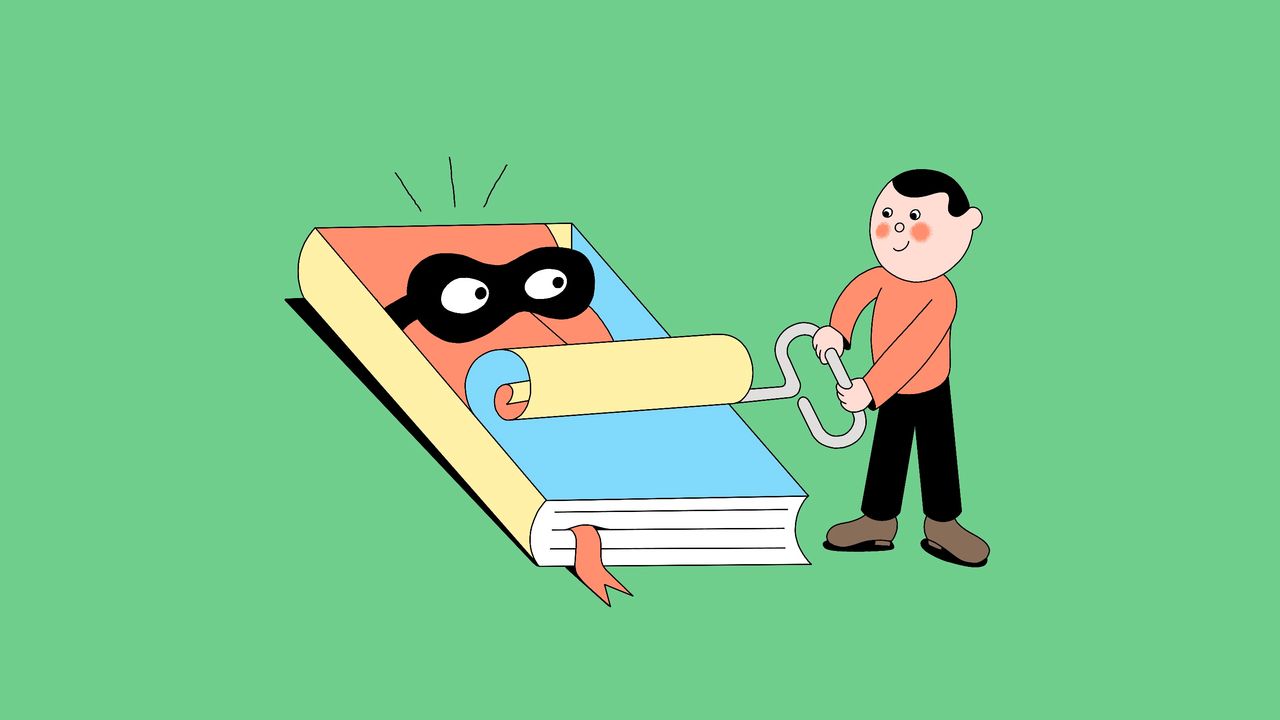
If you’ve ever been on the receiving end of a five-year-old’s withering “You are not the boss of me” (having caused offense by, say, helping to zip a jacket or tie a shoelace), you’ve seen how young children yearn for power. The draw of books with unreliable storytellers is that they give kids the chance to be in charge, deciding for themselves what the real story is. In a picture book from 2024, “Don’t Think of Tigers” by the South African author-illustrator Alex Latimer, the narrator breaks the fourth wall with an irresistible promise to the reader: “This book in your hands is MAGIC. Here’s how it works—whatever you picture in your mind I will draw on the next page.” The test case—picturing a cow doing ballet—produces a smug bovine pirouetting. But then the narrator cautions, “I really, really can’t draw tigers, so whatever you do, please DON’T THINK OF TIGERS!” Hence the joke of the book: kids listening to the story can’t stop imagining tigers, and, since their wish is the narrator’s command, each ensuing page is filled with a new, very silly iteration of a tiger: shaped like a cube, carrying a briefcase, flaunting a mermaid’s tail. The narrator, who has been getting a lot of practice drawing tigers, turns out to be quite good at it, and the low-key message that mistakes are the pathway to mastery won’t be lost on children, even while they relish bossing the narrator around.
In Daniel Bernstrom’s “One Day at the Bottom of the Deep Blue Sea” (2025), illustrated by Brandon James Scott, the “boss” in the story (and the adult proxy) is a giant toothy shark who meets his match in a little girl determined not to become his supper. Like Scheherazade telling stories to save her own life, the pigtailed scuba diver must convince the shark that there are better things to eat than herself. Kids will quickly see through her ruses. The girl’s menu offerings include a squid squirting ink, a puffer fish that’s “quite a filling treat,” and a delicacy guaranteed to zap the shark cross-eyed:
“Don’t give up,” said the girl.
“Ever thought of boneless meat?
You could try the dotted ray!
It is very safe to eat.”
By the time the girl bamboozles the shark into chomping down on a sea turtle’s hard shell, knocking out his teeth, kids will feel almost as sorry for him as they do gratified at being too wise to fall for such tricks. The shark is a pleasing stand-in for a big bossy grownup, easily fooled. Although Bernstrom’s rhyming verses don’t always scan, they have a rollicking energy perfect for reading aloud, and Scott gives his characters a goofy, cartoonish appeal—round eyes, expressive mouths—amid an undersea palette of rich blues, greens, and purples.
Even as they make both kids and grownups laugh, these picture books grant children a rare authority over the story, allowing and even encouraging young readers to know more than the characters about what’s actually going on. In the real world, it’s an important human skill to recognize another’s viewpoint: to exercise the muscle that identifies when someone has a bias or when their version of a story tilts to their advantage. Anaïs Nin wrote, “We do not see things as they are, we see them as we are.” Books with unreliable storytellers highlight this fundamental aspect of human nature—while urging kids to think more deeply about why we see things the way we do. ♦





Comments (0)