
Remember me






What will A$AP Rocky wear to the Met Gala? This year, the pre-Met chin wagging about which celebrities will show up to the megawatt Metropolitan Museum of Art Costume Institute fundraiser — and, crucially, which designers will dress them for the occasion — has exited the group chat and entered the betting markets. That’s right: It being 2026, Kalshi is setting odds on whether Rocky will hit the museum’s Fifth Avenue steps in AWGE, Dior, or Saint Laurent. (My money is on Chanel.)
Of course, the betting sites don’t address the more interesting question, which is how VIPs and benefactors are actually going to interpret the official Met Gala dress code. This year, it’s “Fashion Is Art.” The theme is a nod to the Costume Institute’s blockbuster spring exhibition, “Costume Art,” which promises to unite fashion with art from the Met’s permanent collection in the museum’s brand-new Condé M. Nast Galleries.
As Vogue puts it, the dress code “leaves a lot to the imagination.” Compared to last year’s relatively straightforward (and menswear-focused) “Tailored For You” theme, which encouraged a bonanza of fine men’s suiting, “Fashion Is Art” is more of an argument than a clear guideline, especially for men. We are familiar with the idea that women’s fashion can be art (look no further than the Costume Institute’s famous 2011 exhibition on Alexander McQueen), but menswear is more closely associated with function and utility. How can men elevate their outfits on a night when a beautiful tuxedo won’t exactly cut it?
According to Andrew Bolton — the Costume Institute’s curator in charge, and the man who coins the Met Gala dress code with Anna Wintour — the prompt is intended to encourage a high level of creativity.

Suit, Glenn Martens (Belgian, born 1983) for Y/Project (French, founded 2010), fall/winter 2022–23; Gift of Y/PROJECT ARCHIVES, 2025.
Paul Westlake / Courtesy of The Metropolitan Museum of Art
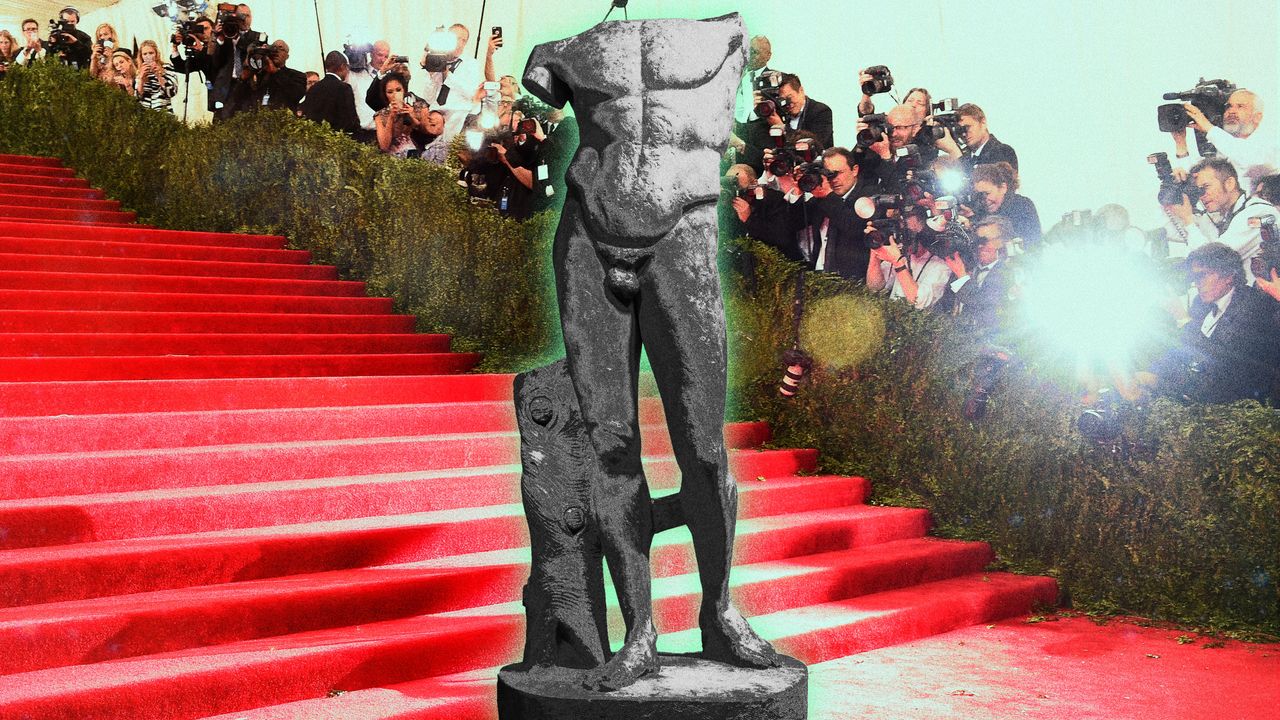
Marble statue of the Diadoumenos (youth tying a fillet around his head), Roman, 1st–2nd century CE; Gift of Mrs. Frederick F. Thompson, 1903.
Anna-Marie Kellen / Courtesy of The Metropolitan Museum of Art“At one point, I had toyed with the idea of calling the exhibition itself ‘Fashion Is Art.’ Period,” Bolton says. The full, declarative stop, Bolton adds, is “very much a spinoff of what Andy Warhol said, which is that ‘Fashion is more art than art is.” Ultimately, Bolton decided it would make for a better dress code: “It is more open-ended, and it will allow guests to interpret it in different ways.”
Speaking of Warhol, Bolton suggests that there is in fact a wrong way to interpret this year’s dress code. “My fear is that people will come as a Campbell’s soup can or [John Singer Sargent portrait subject] Madame X, that they’ll take it too literally and interpret a painting — or wear an Andy Warhol wig,” the curator jokes. “This year, there's so much room for experimentation. I do think some might be literal, and literally have a painting embroidered onto the back of their suit. But I hope people will be more imaginative.”
If you’ve got a ticket to the Met Gala and a custom pop-art ensemble hanging in your closet, don’t worry — there’s still time to pivot. The teasers from the exhibition itself offer a wealth of inspiration. “Costume Art” centres on fashion as an “embodied art form,” which is to say the connection between clothing and the body, and the ways in which the clothed body has been depicted throughout the history of art. The show unfolds in the Costume Institute’s new galleries across a series of categories, including the “classical body,” the “abstract body,” and the “anatomical body,” among others.
Comments (0)