
Remember me


The following story contains spoilers for Beef season 2.
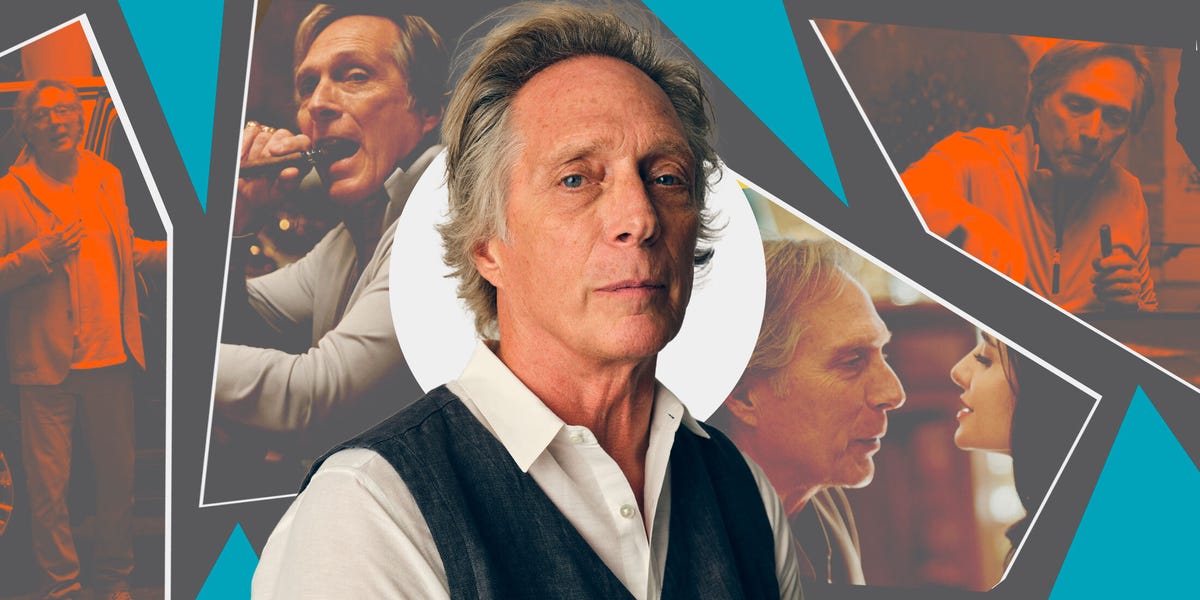
EVERYTHING IS BETTER if William Fichtner is in it. That’s true for his most notable roles on the big screen, showing up for key spots in movies you’ve probably watched over and over and over again, like The Dark Knight, Heat, and Black Hawk Down. It’s also true for his many appearances on television, bringing memorable characters to life in shows like Fox’s Prison Break and CBS’s Mom. And now, like clockwork, it continues to be true in the second season of Netflix’s Beef.
The second go-around of creator Lee Sung Jin’s anthology series takes a bigger, more ambitious swing than the first, telling a globe-trotting story that puts themes of relationships and class at its center. Fichtner, 69, plays Troy, an extremely wealthy member at the country club where Josh (Oscar Isaac), Austin (Charles Melton), and Ashley (Cailee Spaeny) all work, and where Lindsay (Carey Mulligan) spends most of her time. While the season primarily follows the two couples (Josh and Lindsay along with Austin and Ashley) engaging in a social joust of increasingly escalating stakes, Troy waltzes in and out of scenes seemingly without a care in the world. When he talks to Josh, the club’s general manager, the subjects are wide. There’s talk of hopping on the “PJ” (a private jet, for those of us who aren’t privy to the slang of the 1%) for a quick trip. He’ll use phrases like “mi amigo” and “see you mañana” like the cool guy he is. And, oh yeah, he’ll also complain about lunch being borderline cold, and ask what the hell was going on with those squash blossoms. In case anyone starts to forget who pays to come here, and who works here, it’s clear that Troy never does.
“I felt like I had a tremendous amount of room to just kind of find that guy,” Fichtner tells Men’s Health less than a week after the season’s release. “Every time I read a script, it confirmed that Troy's quite certainly never worked a day in his life, which was a nice thing to have inside my being while playing these things.”

It’s been a busy time for the veteran actor, who’s just made it back to Los Angeles from Biloxi, Mississippi. He’s been stationed there in production, outside of one quick 18-hour swing to L.A. earlier this month for Beef’s second season premiere. In fact, he says, he hasn’t even watched the show yet. He’s seen early cuts, but still needs to carve out the time to sit down and watch the full, finished thing. If he’s tired at all, though, you wouldn’t know—with pennants from his beloved Buffalo sports teams lining the walls of his home and a glimmer in his eye, it’s easy to tell that Fichtner is revved up and comfortable, and that this project means a whole lot. After all, he says, so much of Troy on the screen came from things he brought to the table after reading and digesting the script. His character was originally only slated to appear in two episodes of the show, but as production went on, more and more was added, particularly to the back half of the season.
“I would bounce things off of [creator Lee Sung Jin], but the best directors and showrunners I've ever worked with, which I put these guys right at the top of that list, don't have to go at you with 16,000 little things,” he says. “They really want to see where you're going to go.”
And as we got to the bottom of Beef’s newest story, we were delighted to see where it all went. To dive deeper, Men’s Health spoke with Fichtner about the biggest differences between movies and TV, whether Josh and Troy’s friendship was real, and how he reflects on Michael Mann’s Heat, 30 years after its release.
MEN’S HEALTH: What’s the biggest difference between working on a big TV show and a big movie?
WILLIAM FICHTNER: If you asked me that question 20 years ago, I'd have a different answer. They don't make as many movies as they used to—that's a fact. And today, in the world of streaming, a 7-8 episode series… the production values are so high. It's almost like 20 years ago, doing a studio film that you're going to shoot over four or five months.
It's way different from network television. I worked on a show called Prison Break for three seasons, and you shot a one-hour episode every eight or nine days. And then you literally went right into the next one. So to me, the biggest difference was that even smaller independent films would take their time. You just had more time built in. That's changed now, because with Beef as an example… the production values on Beef were as high as you could get. And there's such attention to detail.
You take somebody like Sonny Jin, who created Beef, and our incredible director, Jake [Schreier]—You put those two guys together, and they're not going to move on until they get exactly what they want.
 Netflix
Fichtner and Michaela Hoover play a married couple, Troy and Ava, in Beef.
MH: Jake Schreier, who worked on a little movie called Thunderboltsin between seasons of Beef.
WF: Yeah, a small little thing. But when you take something like this that's as special as this, and you put all the pieces together, everybody's at an incredibly high level of talent. And you're talking from DP to cast. I mean, the cast in Beef season 1 was amazing. Season 2, most of what I do is with Oscar Isaac, who is one of the finest people I've ever met. Forget about being a great actor, just an awesome guy. And that was really up and down with everybody who crossed my path on the show.
MH: Your character, Troy, and Oscar’s character, Josh, have a friendship on screen. Did the two of you have to work on anything to make sure it came across the way you wanted it to?
WF: When we were setting up to shoot that early scene outside Oscar’s office, he and I sat in the office right next to it, where Oscar has many scenes in the show. And we just sat there and started talking. He's just one of those people. It was seamless talking to him from the get-go. Didn't feel like we had to feel each other. None of that. We just started talking. He's got kids, I’ve got kids, yada, yada, yada, boom. We were talking about this, talking about the experience of working on that, working with Sonny, working with Jake. And it felt seamless literally from the get-go.
MH: Was there something specifically about Troy that spoke to you?
WF: I never like to make any judgment on a character. Even if you play like a bad guy, bad guys don't think they're bad guys. Good guys don't think they're good guys. They are who they are. You know that little coffee table book, Don't Sweat the Small Stuff?
MH: Of course. My mom has that.
WF: There you go. I have a feeling that's Troy's existence. I don't think he sweats the small stuff. I think he just lives his life, and I think he truly really likes Josh. Appreciates him. So, if you find rhythms like that that seem to really fit with the guy you're playing, you don't really need to give it a name. You don't need to spell it out and write a paragraph about what all that stuff means. A great feeling is a great feeling, and just hang on to that.
 Netflix
Fichtner and Oscar Isaac in Beef.
MH: Do you think Troy and Josh’s friendship was real? Why do you think he ultimately turned on him?
WF: A hundred percent. I really do. I mean, I think when he sees him in that dining room in episode 5, and it's like, "Come on, man, you need some time right now. We’ve got to help you decompress, put him on the private jet. Let's just go have a moment for you." All of that is really real. I also think Troy identified with that club. It was special to him. Maybe he had incredibly wealthy parents that really never paid attention. I don't know, but I know being at that club and the people he would be with meant a tremendous amount to him. And when Troy finds out things are happening that are detrimental to the club ... I never felt like I was betraying the friendship. I felt like he was betraying my home.
To me, actors look for the things that make sense to them, that speak to their character, that fit in a world they live in. And that's what made sense to me—I couldn't have that happen.
MH: Were you able to draw on any of your past experiences in other projects, films, or television for this role? Did any experience come in handy particularly?
WF: Well, I'd like to draw on the fact that I had a private jet, but that's not true. My jet has “Delta” written on the side of it. Listen, we all experience the ups and downs in life. We all experience love and hate. We experience disappointment and joy. And I think actors take that. They pick those things from certain places of their life. And it's never the same. It's not like I don't like me, but I don't really want to play me. I'd like to find something else that's a bit of a different rhythm. And that’s always the goal: to find something original, to whatever degree you realize that or not.
MH: Of all the couples depicted in season 2, Troy and Ava (Mikaela Hoover) are easily the healthiest and most functional relationship. How did you work on that?
WF: The very first night we worked on the show together, it was really cold by L.A. standards. And it was when we were walking out of the big event with Carey and Oscar, and we hop into our car. It was that scene. And Mikaela's got high heels on and all that. It was cold. And so each take, we tried to get her in the car so she could warm up a little bit.
That was the first time I met her, and we spent four nonstop hours talking to each other. And it was wonderful. I think the world of her. It's not like we had to say, "Hey, what do you think about this?” It was just us talking.
We both loved this whole thing. You can't underestimate how wonderful it is to go to work on something you know is special. You don't have to know how it's going to come out. There are so many things that have to happen from the time you shoot it till the time it actually makes it on TV or on a screen and that you have no control over, but it's the process of doing it. That's where the joy is. And we had a lot of joy working on this.
MH: You basically got to do that scene you’re talking about two times, in episode 1 with Oscar and Carey, and in episode 8 with Charles and Cailee. What was that like?
WF: You get back to the storytelling of it. And when I read that script and you get to that scene again, first and foremost, I said to my lovely wife, "Oh, I just read episode 8. It's so cool." It's just so cool, this come-full-circle moment. But it’s interesting to look at, because are Troy and Ava really all that different? No, their life is rolling on. Everyone else has gone upside down or sideways, but it's a really cool element to great storytelling.
 Netflix
Fichtner and Mikaela Hoover in Beef.
MH: What do you think happens to Troy after the story ends?
WF: If they made a Beef season 3 ten years from now, and it was at the golf club, outside of a few more gray hairs, I'm not so sure Troy's any different. Maybe he found yoga.
MH: Maybe Cailee and Charles have been cycled out for another new GM by then.
WF: Oh, they're definitely gone. Yeah. No, they got Oscar back [Laughs]. There you go. Oscar and Carey are back.
MH: Before we go, I have to ask about Michael Mann’s Heat, which you played a memorable part in and has become a beloved classic. It celebrated its 30th anniversary recently—how do you reflect on that film and your time making it?
WF: I was clicking around a year ago, and Heat was on TV and it was a scene I was in. After five seconds, I looked at my wife and I'm like, "Oh my God, I look like I'm 12." It was one of the first things I ever worked on. And it was a big deal. And Bonnie Timmermann, the iconic casting director, brought me in to see Michael for that particular part. I do remember going in to meet him and asking him about another role, which, being young and naive, was probably not the best advice to give somebody. But Michael was such a gentleman. He was like, "You know what, Bill, I hear you, but let's read for this part." And I ended up getting it. And it was a big deal. It was Pacino and De Niro on the screen together, for the first time, and to be a part of it was a big deal.
MH: What was the other part?
WF: I did the Val Kilmer part. And of course, being young and not understanding, No, no, no, they're not giving you that part, Bill. That's going to a bona fide movie star. I loved that part when I read it. But what I remember is how respectful Michael was with my question.

Fichtner as Roger van Zant in Heat.
MH: I mean, van Zant and Val Kilmer’s part, Chris, are both really important. They're all great.
WF: I'll tell you one thing. I did only two films before that, and one of them was a film called Virtuosity that no one in the world has ever seen. And they cut 90% of what I did in that film out of the film. I learned a big lesson on my second film of what's inconsequential. So, when my agent sent me the script for Heat, and Bonnie Timmermann said, "You want to audition for this part?" I remember I read it and my agent said, "It's only five scenes." And I was like, "But it's five scenes you can't cut." You can't cut van Zant.
MH: Do you keep in touch with anyone from the movie? Michael is now making Heat 2…
WF: Not really. To be honest, I'm quite the homebody, as opposed to the Hollywood body. But I've had the occasion to run into Ted Levine a couple of times. I worked with him on a film a long time ago called Switchback, and I was always a big fan of his as an actor, but not really.
Listen, of all the wonderful things we get a chance to do, it's not like everybody you meet you're going to keep in touch with. There are only so many hours in a day. I did run into Michael on the 20th anniversary of Heat, when they did a screening at the Academy Theater. I saw Michael Mann and Ted Levine that day.
MH: I think that’s going to keep happening. It’s one of those movies that’s going to live forever. Every anniversary will be celebrated.
WF: There is nothing dated about that movie. You can not say that about many movies that are 30 years old.
This interview has been edited for length and clarity.
 Why Michael Mann's 'Heat' Still Rips 30 Years Later
 Charles Melton In Charge
 The 49 Best and Most Anticipated New Shows of 2026
Evan is the culture editor for Men's Health, with bylines in The New York Times, MTV News, Brooklyn Magazine, and VICE. He loves weird movies, watches too much TV, and listens to music more often than he doesn't.