
Remember me
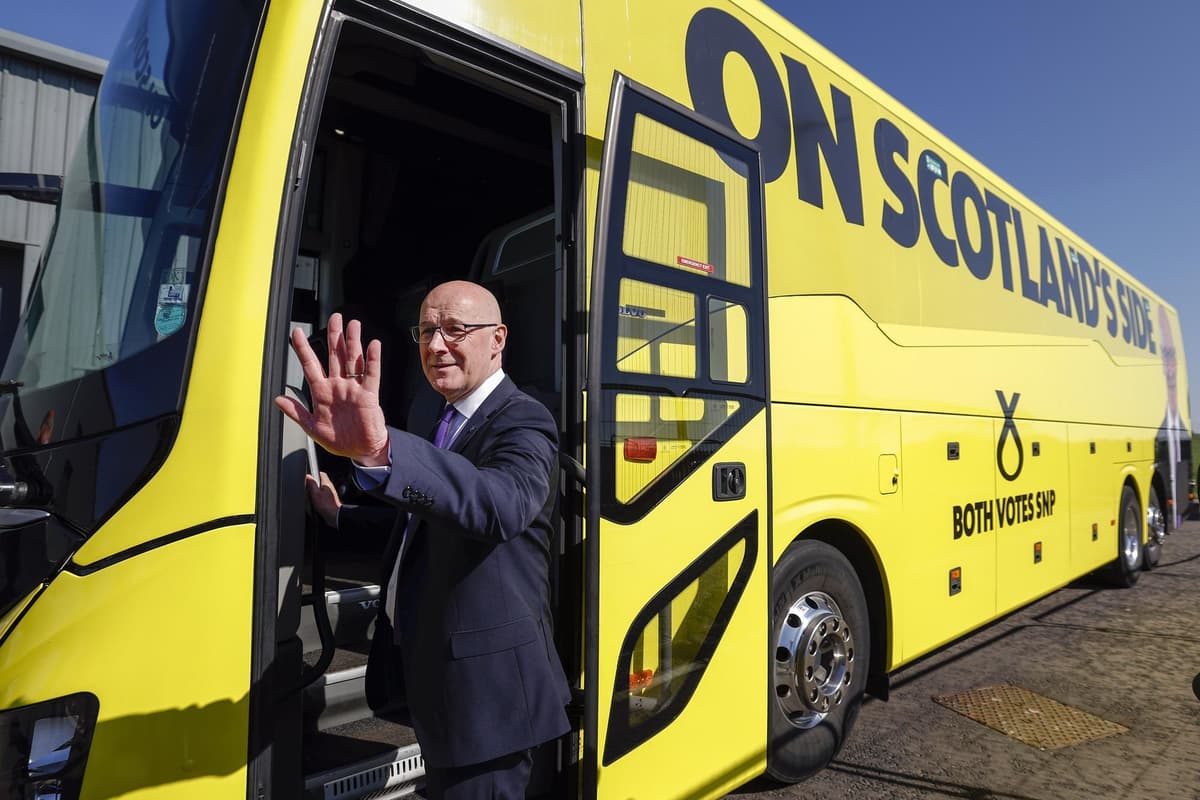




 First Minister John Swinney boards the SNP battle bus in Tranent, East Lothian. Picture: Jeff J Mitchell/Getty Images
If an overall majority is not secured, Swinney could be vulnerable to unionists’ determination to take independence out of the equation altogether
During what’s been an uncommonly tedious Holyrood election campaign, it stands out as a rare moment of drama.
During a Channel 4 debate two weeks ago, Reform UK’s Scottish leader Malcolm Offord claimed Labour’s Anas Sarwar had suggested the pair – supposed mortal foes – should work together.
Offord said that, despite Sarwar three times describing him as a “racist” on national television, the Labour boss had come “bouncing up” to him at an event in Paisley last December proposing a combined effort to remove the nationalists from office.
SNP leader John Swinney hammed it up something terrible with an entirely performative display of shock.
Since then, the nationalists have been relentlessly promoting the idea that Labour and Reform are in cahoots. Meanwhile, Offord has doubled down on his insistence the exchange took place and Sarwar has repeatedly denied he made the remarks reported. Offord’s claim was, said the Labour leader, “a desperate lie from a desperate man”.
Nobody but Offord and Sarwar themselves knows what words were exchanged between them in private four months ago. And, even if Offord’s claim begins to look vaguely accurate, so what?
Do we think what, at worst, sounds a bit of banter seriously constitutes a shared strategy to vanquish the SNP?
I’m inclined to believe in the need for a certain honour among thieves, perhaps even an esprit de corps, among rival politicians when it comes to their private interactions. It is, I think, in the interests of our democracy for foes to feel able to engage with a degree of trust.
Anyway, the truth of what was said in Paisley last December is not, I think, likely to affect the result of May 7’s election, which is expected to see the SNP win a remarkable fifth successive election victory.
The nationalists’ record may be pitifully unimpressive, they may have been rocked by financial scandal, and their manifesto may be threadbare but the loyalty of a substantial portion of the minority of Scots who support independence means the SNP, as the party still seen as best placed to deliver constitutional change, are all but unbeatable.
Some recent polls have suggested the SNP’s destination is an overall majority. Others predict that, while the party will return to Holyrood as the largest party, it will require the support – formally or otherwise – of the Scottish Greens to govern.
Either of these two outcomes – a majority or an agreement with a rival party to support budgets – would allow Swinney to leave the chests of drawers in Bute House filled and render speculation about what went on between Sarwar and Offord in Paisley.
But other results are available.
There are 129 MSPS at Holyrood, which means whichever candidate for First Minister can command the support of 65 members gets the chance to form a government.
Despite polls last week, it is very far from impossible that, by the time votes are counted next month, there is no pro independence-majority and that John Swinney doesn’t have the backing of the required number of MSPs to continue in office.
And, if a combination of SNP, Scottish Green and – perhaps – nationalist independents such as Fergus Ewing cannot be assembled into some kind of workable majority, that will mean some tricky discussions for the Unionist parties.
The simplest outcome would be if Reform UK returns to Holyrood as the second largest party. It would be politically unthinkable for Sarwar to support Offord in his ambition to become First Minister. Sarwar’s members would rather an SNP Government than a Reform one.
It is also wholly improbable that either of the other Unionist parties – the Conservatives and the Liberal Democrats – would rally behind the Reform flag.
If Reform becomes the largest Unionist party then – regardless of the size of the nationalist vote – Offord’s reward will be five years as leader of the opposition.
If, however, Labour comes second next month, and there is no pro-independence majority, a path to power opens up. Having declared his ambition to become First Minister, it would be incumbent upon Anas Sarwar, in the circumstances I describe, to try to travel it.
The late Alex Salmond showed after the 2007 election when the SNP won just 47 seats – one more than Scottish Labour and, even if the Greens had then been a declared secessionist party, far short of a majority – that it is not only entirely possible to govern as a minority and to do so effectively.
Between 2007-11, the SNP was supported on key votes at Holyrood by the Scottish Tories, then let by Annabel – now Baroness – Goldie.
There was no formal deal between the SNP and the Conservatives. Rather, there was an agreement that – in return for concessions on some policy demands – Goldie would ensure her members did not bring down Salmond’s government.
Politics is an unreasonable business full of necessary hypocrisies and crashing contradictions.
One such inconsistency exists when it comes to the possibility that Unionist MSPs might be in a position to make one of their own First Minister.
While it would be impossible for Anas Sarwar to back Malcolm Offord for FM, the opposite is not true.
If Sarwar was leader of the largest Unionist party in a parliament with a Nationalist minority, it would be up to Offord, Tory leader Russell Findlay, and the Liberal Democrat boss Alex Cole-Hamilton to decide whether to support him in the vote for First Minister and, in doing so, play a part in ending almost two decades of SNP rule or to bear responsibility for John Swinney’s survival. And to get something, policywise, for their trouble.
With less than two weeks until polling day, the SNP is on course for a fifth consecutive Holyrood win.
But is remains perfectly possible that Anas Sarwar and Malcolm Offord could end up locking John Swinney out of power without having to strike any kind of deal at all.
Comments (0)