Few stories have been quite as successful as Homer’s Iliad. The 3,000 (or so) year old epic has inspired and entertained readers for millennia. A case in point: fragments of the text were recently discovered on top of a mummy buried in the town of Al Bahnasa, Egypt, 118 miles (190 kilometers) south of Cairo.
This is not the first time papyri containing ancient Greek text have been found on top of Egyptian mummies, but they tend to be ritualistic or magical in nature. The Iliad appears to be the first known literary text used in this context.
The discovery was made by researchers involved in the Oxyrhynchus Archeological Mission led by the University of Barcelona Institute of Ancient Near East Studies (IPOA) in Spain.
Papyrus Placed on a Mummy’s Body
When archaeologists excavating Oxyrhynchus discovered a papyrus placed on the body of a mummy buried in Tomb 65 of Sector 22, covering its abdomen and chest, it was the content of the text that stood out. The papyrus, appearing in a fragmentary state, contained a section from Book II of the Iliad called the "Catalogue of Ships,” which describes the various forces that lay before Troy as the Greeks prepared for invasion.
The mummy in question belongs to an individual who most probably died between the first and second centuries C.E., but it is just one of several mummies found in the tomb. Archaeologists have discovered at least 20 sealed papyri or “papyrus packets” that appear to have been placed on the bodies deliberately.
“The archaeological context and associated objects clearly place these manuscripts within the traditional Egyptian funerary sphere,” Leah Mascia, a specialist in the material written culture of Greco-Roman Egypt from the University of Hamburg, said in a statement. “However, their content is strikingly unconventional and stands as an exception in the repertoire of ritual compositions customarily associated with mortuary procedures in the Egyptian tradition.”
According to Mascia, one would expect to see canonical funerary texts, such as the Book of the Dead or the Book of Breathing, but the “papyrus packets” found in Al Bahnasa appear to contain a diverse range of texts, from Greco-Egyptian magical papyri to Greek and Demotic documentary papyri to even the Iliad. The packets appear to have been sealed with clay devices known as embalmers’ seals and intentionally left on top of the deceased during the funerary rituals.
“These ‘sealed papyrus packets,’ which include texts of various genres, may have been regarded as part of an alternative funerary procedure, but this is only a preliminary interpretation,” Mascia explained.
Read More: Ancient Egyptian Book of the Dead Contains 3,000-Year-Old Wite-Out
The Al Bahnasa Necropolis
The mummy in question was found at the Al Bahnasa necropolis, next to the Bahr Yussef (Waterway of Joseph) branch of the River Nile.
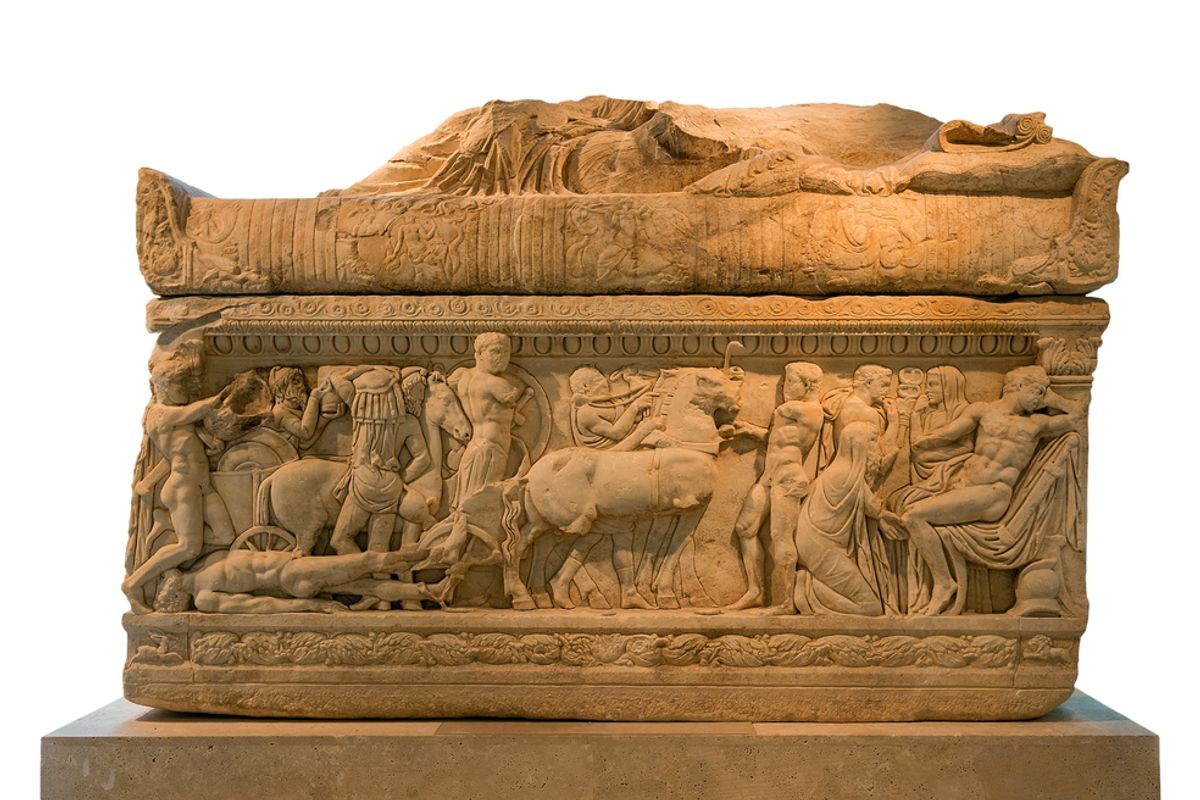
The funerary complex consists of three limestone chambers and houses several mummies in ornately decorated wooden sarcophagi alongside several artifacts, including the bones of an infant, the head of a cat, and jars containing cremated remains. According to a statement released by the Egyptian Ministry of Tourism and Antiquities, some of the mummies were found wrapped in bandages decorated with geometric patterns. Archaeologists have also unearthed three golden tongues and a copper tongue.
At the time of its burial, the site would have been the Greco-Roman city of Oxyrhynchus. While it is first referenced in hieroglyphic sources during the Nubian period (712 to 664 B.C.E.) and it may have existed as early as the 20th Dynasty (1186 to 1070 B.C.E.), it is thought that it reached its peak in size during the Roman era.
Greek Influence
The site was first discovered by a scholar, Vivant Denon, who joined Napoleon Bonaparte during his mission to Egypt between 1799 and 1802. Excavations began sometime later, in 1897, and resulted in the discovery of thousands of papyri, the majority of which were written in Greek and dated to the Roman period beginning in 30 B.C.E.
The Greek influence dates to Egypt’s invasion by Alexander the Great (332 B.C.E.), when Greek colonists moved to the area and renamed the city. The settlers embraced the funerary rites and gods of the local population but retained their native tongue. To this day, inscriptions written in Greek can still be found carved into the walls of the necropolis.
Article Sources
Our writers at Discovermagazine.com use peer-reviewed studies and high-quality sources for our articles, and our editors review for scientific accuracy and editorial standards. Review the sources used below for this article: