An inquiry into a rise in antisemitism across Australia before a mass shooting killed 15 people at a Hannukah celebration on Bondi Beach late last year has recommended that authorities should prioritise gun reform.
The Australian government established the Royal Commission on Antisemitism and Social Cohesion after father and son Sajid and Naveed Akram allegedly opened fire with legally-owned guns at the celebration in Sydney on December 14 2025.
Authorities say their attack was inspired by the so-called Islamic State group.
Royal Commissioner Virginia Bell made 14 recommendations on Thursday in her first interim report, five of which were not made public because they were classified as confidential for national security reasons.
The report also noted there had been a sharp rise in antisemitic incidents in Australia since the war between Israel and Hamas began on October 7 2023.
The United States and Israel’s attack on Iran in February was “likely to have increased the risk of attacks directed at the Australian Jewish community”, it said.
The recommendations included that the federal and state governments prioritise implementing nationally consistent gun laws and a gun buyback.
Sajid Akram was shot dead by police at the crime scene. He was licensed to legally carry the guns used in the massacre.
Under new restrictions proposed by the federal government, the Indian-born Australian permanent resident would have been banned from holding a gun licence because he was not an Australian citizen.
The gunman’s son was injured but survived. Naveed Akram has been charged with committing a terrorist act, 15 counts of murder and 40 counts of attempted murder. He has entered no pleas.
The government has also proposed limiting the number of guns someone can own to as few as four and implementing periodic reviews of existing gun licences.
There has been a rise in antisemitism. That is a global phenomenon
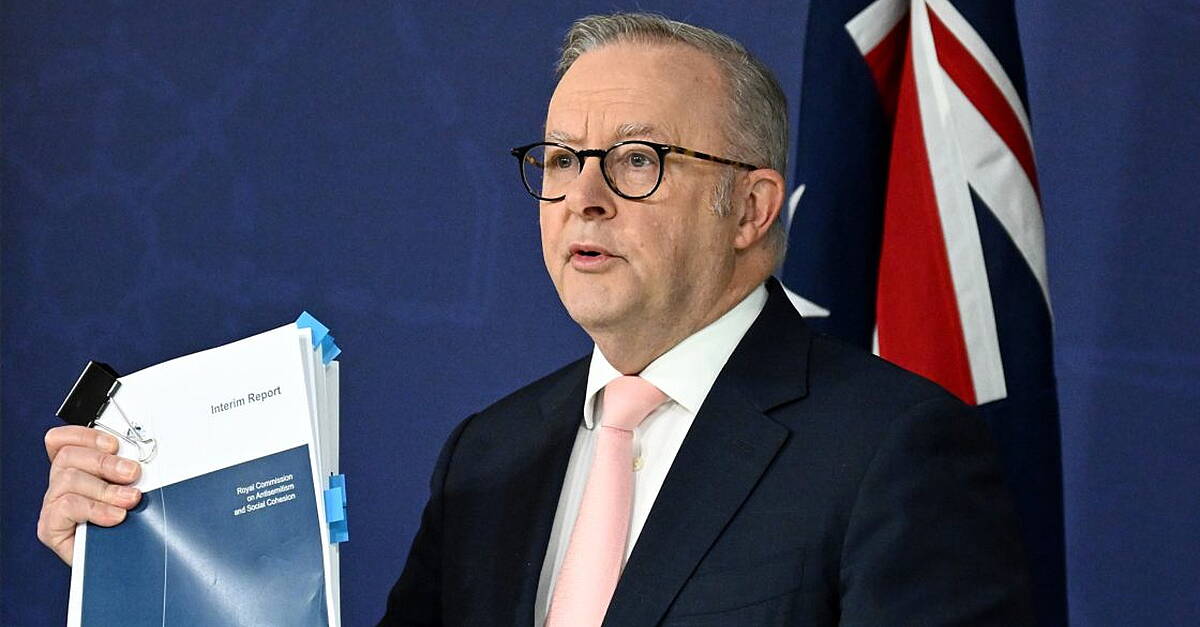
Anthony Albanese
The new restrictions would be accompanied with a gun buyback scheme to compensate gun owners who must hand in weapons.
The government has proposed sharing the cost of the buyback with the six states and two territories. But some states have said they will not pay.
Australian prime minister Anthony Albanese said his government had agreed to implement all the recommendations that were relevant to federal authorities.
Mr Albanese said he hoped the recommended gun reforms were implemented.
“I certainly hope that that occurs and would continue to engage constructively with state and territory governments to say that this is reform which is necessary,” he told reporters.
Mr Albanese noted that Australia commemorated on Tuesday the 30th anniversary of Australia’s deadliest mass shooting in modern times.
A landmark national firearms agreement virtually banned rapid-fire rifles after a gunman killed 35 people in Tasmania state on April 28 1996.
“The nation is safer because of that,” Mr Albanese said.
He noted that despite concluding that risks to Australian Jews were rising, the report found that no urgent changes were required to keep Australians safe.
“There has been a rise in antisemitism. That is a global phenomenon,” Mr Albanese said.
“That is something that has happened right around the world. Governments need to respond to it. We are responding to it.”
The report noted that the government had allocated 102 million Australian dollars (£54 million) to increase security at Jewish sites including synagogues and schools.
The money is administered by the Executive Council of Australian Jewry, the community’s peak organisation.
The council’s co-chief executive Alex Ryvchin said the report was an important part in the process of making Jewish Australians feel safe again.
He told the Australian Broadcasting Corp: “We need to get to a point where Jewish Australians at Hanukkah this year … feel safe, that we can gather again, that we won’t be targeted.
“It’s going to be a long process to get us to that point. There’s a deep sense of trauma in the community and … a lot of unanswered questions, but this is an important step in the process.”
Public hearings in the inquiry begin on Monday next week.