Preparations were in full swing at Nosson’s home. With a sheva brachos scheduled for that evening, tables were being unfolded, tablecloths smoothed, and trays of food arranged.
Nosson drove with his son to a nearby gemach to pick up 20 plastic chairs.
The gemach owner, Mr. Adler, met him. “There are 10 chairs in each stack,” he said. “Can you get them all in your car?”
Nosson eyed the stacks. “I should have just enough room,” he said. “We’ll take care of it.”
After some forceful shoving, tilting, and maneuvering, Nosson and his son succeeded in getting all 20 chairs into the car.
Back home, with guests soon arriving, they began arranging the chairs around the tables.
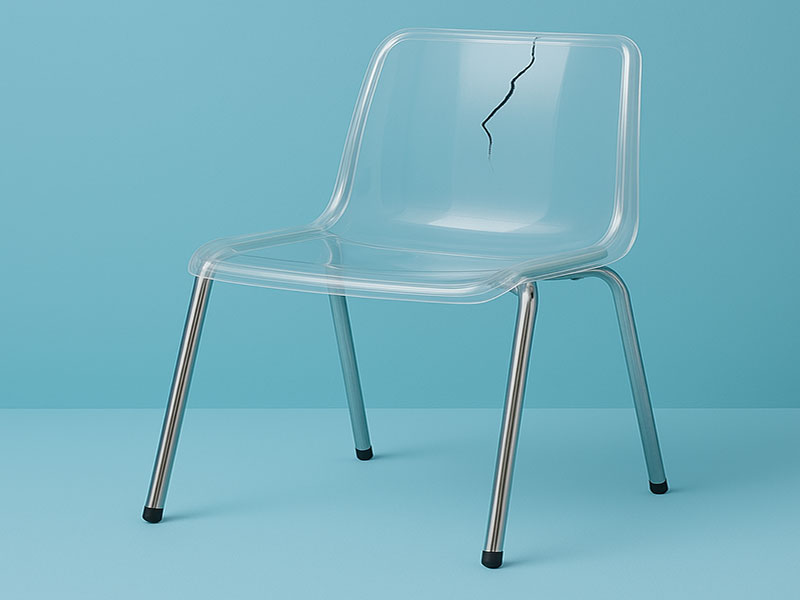
“Hey… look at this chair.” Nosson said, pointing. One of the plastic supports in the back was cracked. “Did we get the chair broken, or did it happen when we loaded the chairs into the car?”
His son shrugged. “I didn’t notice anything, but we didn’t look at each chair,” he answered. “It’s still usable.”
Nosson frowned. “It’s true that we squeezed the chairs in,” he acknowledged, “but none of the other chairs are broken.”
After the sheva brachos, Nosson returned the chairs to Mr. Adler, and mentioned the issue to him.
“I honestly don’t know whether that chair was already cracked or if it broke while I was loading the chairs,” Nosson said. “If it was my fault, I want to pay for it.”
Mr. Adler examined the chair. “Hard to know,” he replied. “I don’t inspect the chairs individually when people return them. Let’s ask Rabbi Dayan what the halacha is.”
They met with Rabbi Dayan and asked:
“Is Nosson liable for the damage that he discovered in the chair?”
“A borrower is liable for any damage, even through oness, unless a result of normal usage (meisah machamas melacha),” replied Rabbi Dayan. “If the chairs were shoved into the car with force and one of them broke, that is not considered routine use” (C.M. 340:1).
“The Rishonim dispute whether a guardian is liable when loss occurred but it is unclear whether it occurred in a manner for which he is liable, such as whether meisah machamas melacha or not (Shach 291:44).
However, if it is reasonable that the item may have been damaged from the beginning, this is like other cases of ‘eini yode’ah im nischayavti’ – where it is questionable whether the person ever became responsible. Out of doubt, he is exempt (C.M. 75:9).
Nonetheless, there is a halachic principle that when damage occurred but it is not known when, we presume that it occurred in the hands of the one who now possesses it – ‘kan nimtze’u, kan hayu.’ For example, if a person bought an animal and slaughtered it several days later and it turned out to be treif, but it is unclear when the treife blemish occurred – the burden of proof is on the buyer to void the sale, because the blemish was discovered in his possession (Kesubos 5b; E.H. 117:8; C.M. 224:1, 232:11).
Based on this, Chochmas Shlomo (C.M. 224:1) addresses the case of one who borrowed a clothing item and later discovered a stain but it was unclear whether the stain happened while the garment was in his hands or was there from the beginning. He distinguishes, though, based on Tosafos (Niddah 58a), that a borrowed item remains in the possession of its owner so that the borrower is exempt, out of doubt, even though the stain was discovered during his use.
Some Acharonim question this distinction, based on alternate explanations in Tosafos, but do not disagree in practice (Pischei Choshen, Pikadon 8:3[7]).
Thus, Nosson is not liable for the chair, because it is questionable whether it came into his possession intact, especially since gemach chairs can typically develop minor cracks unnoticed. Nonetheless, if he wants to contribute something to the gemach, that would be commendable.
“I should further note,” concluded Rabbi Dayan, “that even if Nosson were liable, halacha does not require him to replace the chair with a new one, just to pay the loss of value of the chair due to the damage” (C.M. 344:2).
Verdict: If damage is discovered in a borrowed item and it is unclear whether the damage occurred before or after the item was borrowed, the borrower is exempt due to the doubt, as in other cases when it is questionable whether the person became responsible in the first place.








Comments (0)