
Remember me


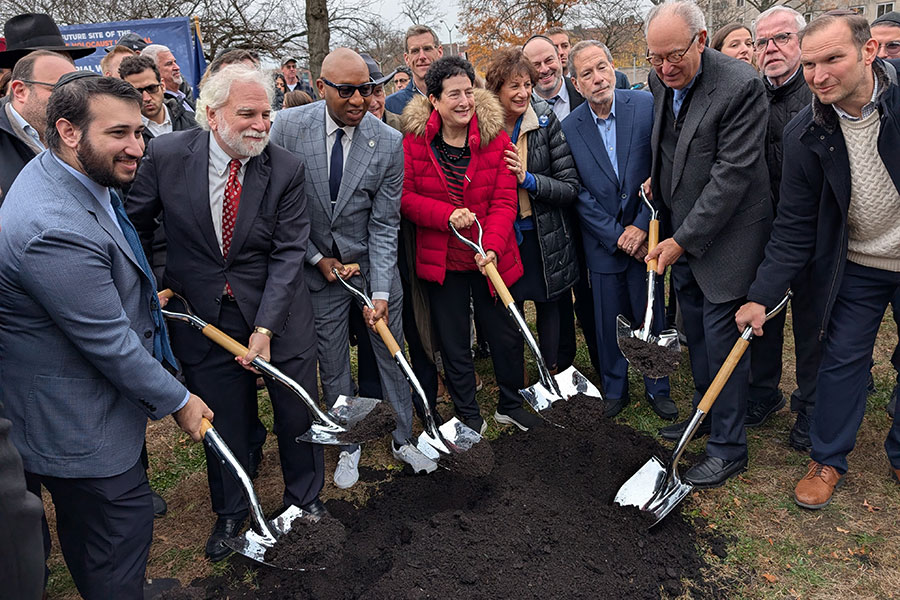




Elected officials and Holocaust survivors gathered for the groundbreaking of a Holocaust Memorial Garden on the grounds of Queens Borough Hall on the corner of Queens Boulevard and 82nd Avenue.
The 22,000 square feet dedicated for the memorial will include three parts: a memorial, a path of remembrance with a glass walkway underneath through which people can look down and see railroad tracks, and a reflecting pool where people can sit and reflect.
The cost is estimated to be upwards of $10 million. Elected officials have pledged $6.5 million toward the project to date. The breakdown includes: $1 million from Senator Toby Ann Stavisky (D – Whitestone); $1.5 million from the 18-member Queens Assembly delegation, a sum which is not committed but will hopefully be included in next year’s budget; $2 million from Queens Borough President Donovan Richards; and $2 million from the Mayor of New York City, pledged by Eric Adams. Assemblyman David Weprin (D – Hollis) told the crowd, “I will do everything I can from my capital budget as well to contribute to this project.”
 Assemblyman David Weprin (D – Hollis), at microphone; also pictured is Moshe Davis, the first executive director of the Mayor’s Office to Combat Antisemitism.
The groundbreaking proceeded before funding was in place. The project also has to go through several layers of governmental red tape before it can begin construction. The site is moving from DCAS (Department of Citywide Administrative Services) control to the borough president’s office to expedite this process. A conceptual design of the project must be finalized, and hearings must be held for community support or opposition.
The memorial will include works of art for the public to view. The artist selection process will be led by the New York City Department of Cultural Affairs’ “Percent for Art” program in consultation with artists, historians, and Holocaust survivors. The Public Design Commission will also be involved in the initiative.
So far, the project has been in the planning stages for three years. It is not known how the installment of the new mayoral administration will impact the completion of the project. Ali Najmi, lead counsel to Mayor-elect Zohran Mamdani, attended the groundbreaking.
 Ali Najmi, lead counsel to Mayor-elect Zohran Mamdani, shakes hands with Vladimir Epshteyn, a Holocaust survivor from Bessarabia. Michael Nussbaum, chairman of the Queens Holocaust Memorial Garden stands between them sharing a laugh.
“All levels of government will work hand in hand to make it happen,” Assemblywoman Nily Rozic (D – Fresh Meadows), told The Jewish Press. “We know how important it is to Queens residents and to the Queens delegation. I’m a big proponent of this and making it happen. I’ll make sure Mayor Mamdani receives an invite.”
 Assemblywoman Nily Rozic (D – Fresh Meadows); Michael Nussbaum, chairman of the Queens Holocaust Memorial Garden; Queens Borough President Donovan Richards; and Assemblyman Sam Berger (D – Kew Gardens Hills).
Rozic, who was born in Jerusalem, continued, “Education is one way to fight antisemitism. It’s also an important tool in fighting all kinds of hatred. At the end of the day, we have to make sure that people understand the lessons of the Holocaust so that we don’t repeat them. The rise in antisemitism is ticking upwards and we have to fight back. This is one way to do that.”
More than 13,000 Holocaust survivors live in New York City, more than in any other city in the world. The largest number of those are in Brooklyn and Queens.
The Queens Borough President spoke about the importance of this memorial from his perspective. “It’s an emotional day for families across the borough – families who have survived the Holocaust, people who lost loved ones in the Holocaust, and families who see the rising surge of antisemitism in our society and worry if the phrase ‘Never Again’ had become hollow. We will never forget because we cannot forget,” Richards said. He said the memorial will “send a message to the world that [we] will not sit by and let antisemitism rule the day. We will learn from the past and the lessons history teaches us about runaway hate.”
This project is being carried out under the auspices of the Queens Jewish Community Council. “The whole point of the Holocaust memorial is to remember the people who tragically were murdered because of their faith, because of their heritage, because they were Jews – that’s key – but also again it has got to be in combination with “Never Again,’” Rabbi Mayer Waxman, executive director of the Queens Jewish Community Council, told The Jewish Press. “This has been a long time in the making and it is not here yet, so if nothing else, all of this attention to this proposed initiative should keep the minds of the politicians throughout New York on the memories of the Holocaust, the contributions by the Jewish community to New York, and the focus of ‘Never Again.’”
More than one speaker told those gathered that the memorial will be a center for teaching and learning about the Holocaust.
 Left to right: Michael Nussbaum, chairman of the Queens Holocaust Memorial Garden; Assemblywoman Nily Rozic, (D – Fresh Meadows); Assemblyman Sam Berger (D – Kew Gardens Hills); Randy Mastro, first deputy mayor of New York City under Mayor Eric Adams; Ruben Davidoff, managing attorney at Davidoff Law; and Queens Borough President Donovan Richards.
“I am still dismayed as a former teacher by our children today and others who do not know our history or even deny the history. They do not understand,” said Michael Nussbaum, chairman of the memorial project. “As Jews, this was the greatest antisemitic crime ever committed by the human race against people who were targeted for only one reason – they were Jewish. We need to educate, we need to heal, but we need to also talk about our similarities, not just our differences.”
The Queens District Attorney also talked about the educational purpose of this memorial. “After October 7, there has been a 16 percent increase in antisemitic crimes in NYC. Over the last year, antisemitism accounts for 55 percent of all the hate crimes that are in NYC,” said D.A. Melinda Katz, the only Jewish D.A. in the state. “That means we need to educate, we need to teach, we need our children to have locations like the Holocaust museum here to be able to come to with their teachers and learn about the history of the Holocaust.”
One elected official shared a personal story.
“On a personal note, my grandmother was born in Czechoslovakia. My grandfather was born in Hungary. They had everything taken from them. Their homes were stripped away, friends were murdered, loved ones butchered. My own great-grandfather, Shmuel, who I am named after in part, was murdered by the Nazis in Auschwitz along with my great uncle,” Assemblyman Sam Berger (D – Kew Gardens Hills) said as he choked up with emotion.
 One of the artists’ renderings from the Rafael Viñoly Architects shows the Ring of Immortality (gold circle), a tree-lined Path of Remembrance, and the Ring of Peace (the blue circle at the top of the picture). The memorial is at the corner of Queens Boulevard and 82nd Avenue in Forest Hills.
 A second artists’ rendering from the Rafael Viñoly Architects shows the Ring of Immortality with a monument in the center of the gold circle, a tree-lined Path of Remembrance with railroad tracks under a glass walkway, and the Ring of Peace with a reflecting pool (the green circle at the top of the picture). The memorial is at the corner of Queens Boulevard and 82nd Avenue in Forest Hills on the grounds of Queens Borough Hall.
“The survivors refused to be defined by what was taken from them, instead choosing to be defined by what they would give back,” he continued. “It is my hope that this memorial becomes our way of giving back to future generations. A reminder that they should not be defined by the trauma we face now or by the pain and suffering we see today, but by the good and the strength we strive to bring into this world just as those before us did.”
Also appearing at the event was Vladimir Epshteyn, a Holocaust survivor from Bessarabia. He told the audience that 68 members of his family – grandparents, aunts, uncles, and nephews –were murdered solely because they were Jewish.
Rabbi Shlomo Nisanov, spiritual leader of Flushing-based Kehilat Sephardim of Ahavat Achim closed out the event with his take on the memorial.
 Rabbi Shlomo Nisanov, spiritual leader of Kehillat Sephardim of Ahavat Achim, who gave closing remarks, shown flanked from left to right by Moshe Davis, the first executive director of the Mayor’s Office to Combat Antisemitism; Michael Nussbaum, chairman of the Queens Holocaust Memorial Garden; and Assemblyman David Weprin (D – Hollis).
“This is a very opportune time to remember that I, as a Soviet Jew, [came] here to have the opportunity to be able to wear this yarmulka, a Bukharian yarmulke, any yarmulka. To be known that our city, Queens – I like to call it Queensbekistan – [has] opened its doors for our Jews and for everybody to come in and to help,” Rabbi Nisanov said. “We’re not going back to Uzbekistan. We want to make sure the next generation of BAs – Bukharian Americans – and not BSs – Bukharian Soviets – we’re going to survive here and make a difference, make this place look beautiful in Rego Park and Forest Hills, and make this opportunity for all of our brothers and sisters from wherever they are to come together and live in peace as one.”
Rabbi Nisanov also runs the Kew Gardens Kehilat Sephardim Food Pantry. Speaking of New York City’s mayor-elect, he said, “Zohran Mamdani was in my food pantry and we had a very nice time and a very nice talk.”
Comments (0)