
Remember me



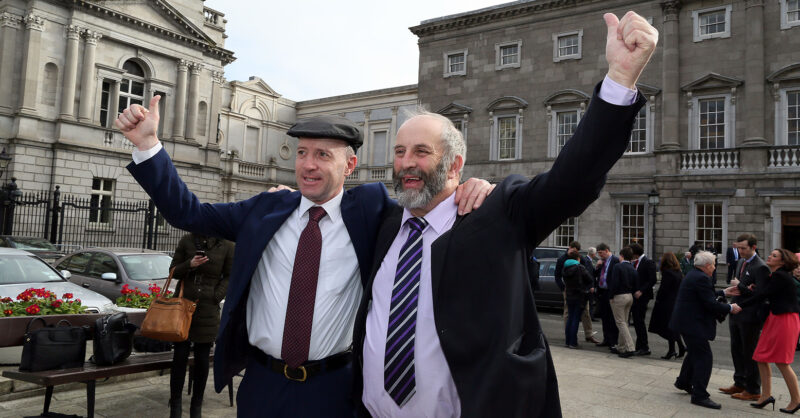


Every political sphere has its court jesters. In Ireland, it’s the Healy-Raes, the South Kerry political dynasty who lead processions of blazing turf sods, dance jigs on Dublin City roads and advocate for the right of rural people to drink and drive. Brothers Danny and Michael’s broad, melodic accents and memorable political hijinks regularly land them on front pages, opportunities they use to deftly execute cute hoorisms to deflect attention. As such, the Irish electorate routinely writes the independents off; to mention their name in a Dublin pub is to be met with scoffs or laughter. But it is the family who tends to have the last laugh.
At the time of writing, the Healy-Raes hold three county council seats, two seats in the Dáil and have never lost an election. “Back in the 2016 Dáil election, Michael was elected with one of the biggest votes ever in the country,” Dr Liam Weeks, Head of the Department of Government and Politics at University College Cork and author of Independents in Irish Party Democracy, says. “That’s a remarkable achievement for independents, who tend to get voted in first time around but can then lose support as the expectations around their populist-type promises are not met,” he pauses. “But they also simply provide what the electorate wants; someone to answer the phone, cut through red tape and get things done. Snobbery does exist around them, but what they do is actually not a lot different to party politicians…in many cases, they just do it better.”
The story of the Healy Raes began with the patriarch, Jackie. Born John Patrick Healy in 1931, he left school at 13 to work the family farm before joining Fianna Fáil in the run-up to the 1966 South Kerry by-election. Here, the newly-named Jackie Healy-Rae – prompted by his wife, an alleged distant cousin, who suggested he differentiate himself from the other John Healys in the area with a nod to his village, Reascaisleach – became known for his pyrotechnical flair; processions where constituents held blazing sods of turf above their heads on pitchforks became Jackie’s calling card.
His sons, Michael (58) and Danny (71), joined the family business in the late nineties. But in reality, they had been in training for most of their life, answering phones and delivering messages for their father from early childhood. As such, both men adopted their father’s mantra of personal connection to gain seats. “The first commandment in Healy-Rae land,” Donal Hickey, a local journalist, wrote in a biography of the family, The Healy-Raes: A Twenty-Four Seven Political Legacy, “is thou shalt not turn off thy mobile phone.” (One of Jackie’s funeral offertory gifts, on his passing in 2014, was a mobile phone, such was his tether to his own.) This laid down the gauntlet of provinciality becoming the Healy-Rae trade, so much so that the fervour with which they attend funerals has previously sparked claims of cloning. (As per the Irish Times, they reportedly bring their own pens to functions, sometimes green, often red, so their names stand out when they sign condolence books.)

Treat yourself or a friend this Christmas to a New Statesman subscription for just £2
On the same week that Ireland voted in a new socialist president, Danny Healy-Rae, who was invited to the inauguration but was “too busy,” hosted a clinic for constituents, criticised the new Beef Welfare Scheme, attended a funeral and helped a family whose 160 sheep were stolen from their farm over the course of two nights. When asked how many funerals he attends per annum, he responded “I couldn’t put a number on that”. When asked about the sheep, he replied with a smile, “we’ll find them”.
As he grabs a coffee – two presses of “cappuccino” on the Dáil canteen machine and three Canderel, paid with cash – he mentions how interviews with the media don’t worry him. “I speak to everyone,” he says. “There’s certain things I’ll support and some I won’t, and I’m happy to talk about them all.” (Michael, who many claim is the brains behind the operation, declined an interview on the grounds of personal reasons.)
Walking through Leinster House with the South Kerry TD feels like being arm-in-arm with a Kennedy. Everyone says hi, dozens shake his hand, and all the while his phone – a Nokia 2310, held together with clear tape and a hair tie – rings ad nauseum. He doesn’t save numbers, he says, choosing instead to keep a choice few inside his head. “The battery is great,” he says when he catches me looking. “I don’t have the time to be scrolling the whole world… I’m more interested in what’s happening here.”
Kerry people are familiar with the labels that precede them in the capital – unsophisticated, clueless, provincial. (Kerry is home to the Puck Fair, the annual Irish celebration which sees a goat hoisted in a cage for days; as well as the Rose of Tralee, a festival which has been parodied as the “lovely girls competition” by Father Ted.) This is despite the myriad great minds hailing from the mountainous peninsular; playwright John B. Keane, polar explorer Tom Crean, and actress Jessie Buckley. As such, the constituents of modern Kerry have mixed feelings on the two TDs. “Some love them, some hate them,” says a journalist from Kerry who did not want to be named. “Some claim they’re in it for the money, while others have this perception that if you need something, they’ll get it for you. Which is hard to disagree with.” The one thing that both sides agree with is that the Healy-Raes work exceedingly hard. By the time we speak, Danny has already clocked in 12 hours of work, having left his home at 2:50am to make it to Dublin for seven. And so reliable are they to get a problem fixed, calls have started to come from outside their constituency for their help. “A woman in Wexford rang me earlier this week,” Danny smiles. “She had a problem, and now it’s gone into the pile to be fixed.”
Strategists have routinely labeled the Healy-Rae schtick as an act. “They might like to present an image of simply country folk…” one anonymous political correspondent shares. “But they are smart, shrewd politicians. Michael, in particular, is a vote-getting machine.” This chimes with a leaked 2015 strategy paper from the Fine Gael party, that said Michael, a wealthy farmer and businessman, hid behind “the veneer of a friendly/simple country yokel” and was electorally “unbeatable”. Much of the same is said about Danny, whose recent controversies include denying climate change, allegedly hosting wedding celebrations in the family pub during Covid-19 regulations, proposing “drink-drive permits” for people in rural Ireland and, as recently as September 2025, musing whether the uptick in recent autism diagnoses was down to “lack of some vitamins”. (Danny has since apologised for the climate change comments.) Because of this, and more, people underestimate the Healy-Raes, despite them often not only coming out of elections unscathed, but setting voting records in the process. Outwardly, it doesn’t seem to bother them. “I don’t underestimate myself,” Danny says, before pausing a beat. “A lot of people come up here [Leinster House] and forget about below [where they come from]. A lot of them have great elections and get elected here,” he shrugs. “Then what happens?”
As more people stop us mid-conversation to chat – the tally, as it stands, is 6 – Danny reveals more about the thought processes that go into him speaking his mind. “I don’t get nervous [to talk about something] if I believe in it,” he says. “I do know that not everyone agrees with me about climate change, and that’s fine, but I’m entitled to my opinion, as they are theirs.” He pauses, taking a beat. “We know that the climate has changed since time began. But what’s changing now? Facts say that we had severe events going back in time, before there was ever talk of fossil fuels. In 1740, Ireland had a much bigger famine than what happened 100 years later. It was two years of bad weather, and people perished with the cold. People deny these things and that’s fine, but they’re facts that did happen.”
Speaking with Danny, whose manner is generous and interested, poses one ultimate question: is this an act? “I put on no act,” he says, definitively. “Whether I’m good or bad, that’s the way I am.” He pauses again, interrupted by another Leinster House staff member, before saying: “I don’t want to accumulate money, if I have enough to keep me going I’m happy. I often say I’m the cheapest man up here, because I’m taxed at 51 or 52 per cent.” (As per Business Plus, accumulated profits at Danny Healy-Rae’s plant hire company rose to €4,783,788 in 2024, from €4,778,501 in 2022, and €3,657,213 in 2021.)
Before I become one of the dozens that day to shake his hand before I leave, the one question I couldn’t help but ask came out of my mouth: what advice he might give to anyone looking to get into politics? A smile beams across his face. “First, be prepared for hard work,” he smiles. “Second, there’s not a lot of money in it, so be sure you know that.” Third, and finally, he catches my eyes before saying: “All politics, you can be sure, is local.”
[Further reading: At the ministry of magic]
Content from our partnersRelated
Comments (0)