Who is more likely to uphold journalism’s ideals of uncovering inconvenient truths, holding the powerful to account, and writing the first draft of history: a handful of decaying, unwieldy legacy news organizations or a million YouTubers?
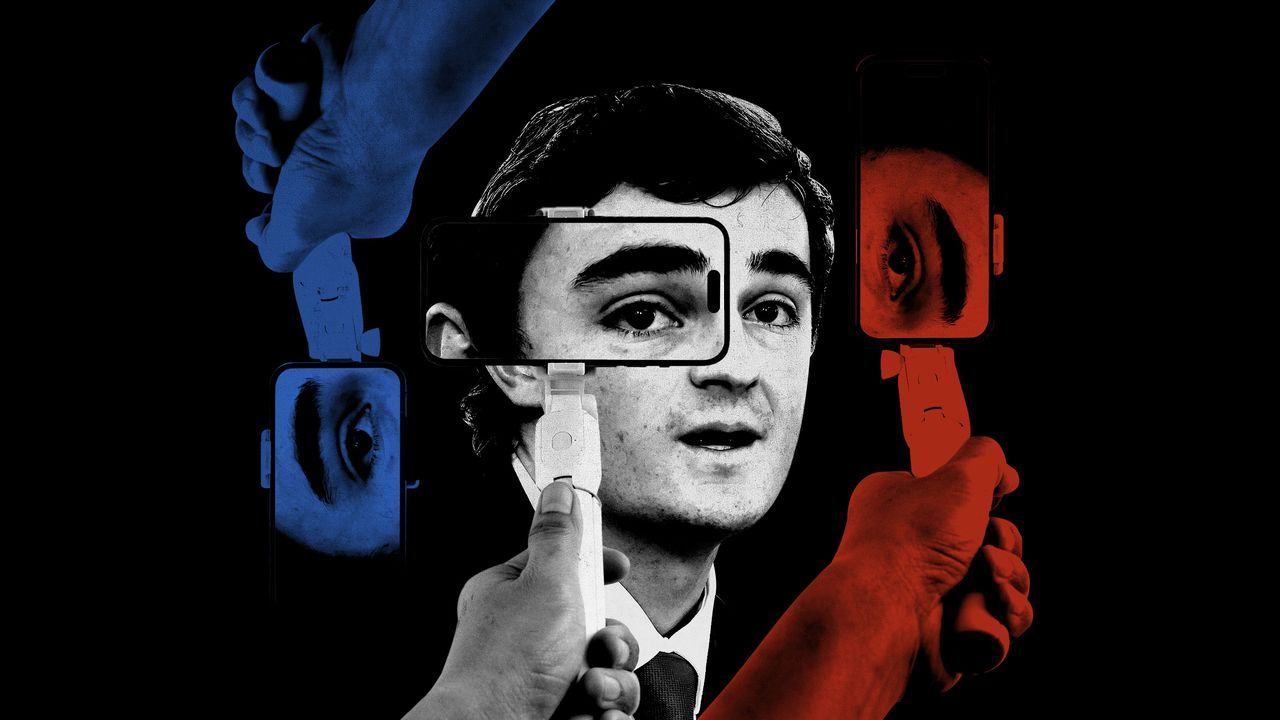
Nick Shirley, a twenty-three-year-old YouTuber whose investigation into millions of dollars of alleged day-care fraud in Minneapolis has drawn praise from Elon Musk, J. D. Vance, and Kash Patel, the F.B.I. director, might look, at first glance, like the future of journalism. In a video posted on X the day after Christmas, Shirley combines two of the foundational modes of live-streaming circa 2025—the man-on-the-street interview and the thrill-seeking adventure into an unknown and ostensibly dangerous place, whether the Mongolian Steppe or a tent encampment in Philadelphia—to produce a roughly hour-long narrative. He adopts the role of a guy who simply wants to know more about a problem, going from day-care center to day-care center in Minnesota and asking the people who work there, all of whom are of Somali origin, if they’re the ones stealing taxpayer money.
In Shirley’s most viral scene, which has been clipped and shared millions of times, he walks up to a storefront with a misspelled sign reading “Quality Learing Center.” According to Shirley’s investigative partner for the video—a man whom he refers to only as David—this day care has been licensed to care for ninety-nine children and received four million dollars in taxpayer funding. In a surreal moment, Shirley and David are confronted by a woman in the parking lot who mistakes them for federal immigration agents and starts yelling to anyone who might be inside, “Don’t open up! You have ICE here,” to which Shirley responds, “How do you have ICE here, ma’am? I’m literally a YouTuber.” The rest of the video is more of the same: Shirley walks into buildings, sometimes under the guise of trying to enroll his fictional son “little Joey” into the day care, and then interviews the people he finds there, whether workers or random passersby.
If you’re among the credulous who believe there’s no political motivation behind Shirley’s reportage, there’s a thrill to watching all this unfold, especially because Shirley presents himself as just some dude on a quest for the truth. He is quite talented in this role, for what it’s worth. The best on-camera investigators often come across as Shirley does: curious, a bit slow, and pathologically stubborn about asking the same questions over and over.
After Shirley posted the video, the Minneapolis Star Tribune visited the same day-care centers and also combed through court filings and state enforcement records. They found no evidence of fraud, although a few of the centers had incurred other violations, particularly Quality Learning Center, which, the Star Tribune notes, has been “cited for multiple safety violations.” This doesn’t mean that day-care fraud has not taken place in Minneapolis—there’s a years-long history of such malfeasance, and both state and federal law enforcement have convicted dozens of offenders, as Kash Patel subsequently pointed out. But the reason that we (and, I imagine, Shirley) know that this has been going on for a while is because local news outlets have, indeed, reported on it.
Last week, the Republican speaker of the Minnesota House of Representatives said that her caucus had worked with Shirley to point out day cares to visit, a claim that raises questions about whether Shirley really was just a YouTuber on an independent search for the truth or if he could have been acting on behalf of the Minnesota state G.O.P. (On X, Shirley insisted that this was “completely false,” adding, “I have no idea who this lady is.” Over the weekend, The Intercept published a piece pointing to evidence that the man called David in the video is David Hoch, whom The Intercept identified as a “political operative with connections to the Minnesota state House.”) A few days later, the Trump Administration paused federal payments to day cares around the country, a policy that will affect countless children and families. Was this a good-faith attempt by the government to root out fraud, which they learned about from Shirley? Or are Republicans simply using this moment to cut yet another federal spending program? After all, as Patel noted, the F.B.I. had been aware of fraud in Minnesota for years.
Journalism isn’t a patent office: you don’t get credit only for being first. And Shirley, for better or worse, has shone a giant spotlight on an ongoing story, which has led to the things that journalists often want out of their stories: more of the public was informed about a problem and the powers supposedly responsible were held to account. On Monday, Minnesota Governor Tim Walz, who has borne much of the public blame for failing to prevent fraud in the state, announced he would not be running for a third term, saying he needed to use his time “defending the people of Minnesota against the criminals who prey on our generosity and the cynics who prey on our differences.” On X, Shirley wrote, “I ENDED TIM WALZ.”
Whether Minnesota had done enough to address that fraud can and should be a point of debate. I suppose it’s also worth asking if the story had garnered enough national attention, though I’m not sure why fraud in Minnesota would be headline news across the country. But what Shirley and his cheerleaders have suggested is that he uncovered this fraud on his own because liberals in the government and the media were covering it up. Musk spent the better part of two days reposting reactions to the video, some of them falsely claiming that nearly every prominent news organization—the Times, CNN, the Washington Post—had failed to report at all, prior to Shirley’s video, on the Minnesota fraud story. The implication was that the woke media wants to protect criminal immigrants and feckless liberal politicians, most notably Walz, who supposedly let all this take place. Musk, who owns X, wants to promote the belief that the truth can be found on social media, and that the practitioners of real journalism are allegedly independent amateurs, such as Shirley, who can ask questions without being cowed by the woke agenda.
Shirley’s video gained a lot of traction because it was promoted by some of the most powerful and followed accounts on social media—but it went mega-viral because of its form. It’s true that local and national news reported on fraud in Minnesota, but there’s nothing quite like watching a secret get revealed on video, especially if you believe that everyone is trying to suppress it. The reality is that traditional investigative journalism is a frequently boring and frustrating endeavor that takes a lot of time, money, and patience. A lot of effort is expended tracking down paperwork from public-records requests, or looking through LinkedIn profiles to find people who might have worked together, or knocking on the doors of potential sources. When the work is done and enters the world, there’s a decent chance that the reporting garners relatively little attention. Print-media outlets—at least the types of places that can still afford investigative desks—are often sclerotic, quasi-puritanical institutions that discourage their practitioners from too much self-promotion or marketing.







Comments (0)