
Remember me







Some homeowners and Realtors are accusing a private equity firm that owns mobile home parks in Ontario of using questionable and illegal tactics to raise lot rents beyond what many can afford, making these once affordable homes nearly impossible to sell.
"People have to pay until they either walk away from these homes or they die. They have no choice,” said Monique Mitts, who wants SunPark Communities held accountable for how she says it handled the sale of her late mother's mobile home in Quinte West.
Mitts, who lives in Trenton, quickly got an offer after putting the mobile home in Skyview Estates for sale.
Skyview Estates is run by SunPark Communities, the manufactured housing division of Toronto-based Firm Capital Properties, a private equity real estate firm. SunPark oversees six mobile home parks across Ontario and one in Calgary.
 Monique Mitts, right, put her late mother's mobile home in Quinte West for sale and quickly got an offer, but is objecting to how SunPark Communities handled things. (Submitted by Monique Mitts)
SunPark Communities has the right to match any offer in the sale of a home at one of its parks, in what's called the right of first refusal. So Mitts emailed SunPark about the impending sale and asked the company to transfer the tenancy to the potential buyer, should it not wish to exercise its right.
Transferring the lease was crucial because it meant the sale could be made without a major change in the monthly lot fee that would be paid by the purchaser. A landowner can’t refuse a lease transfer without permission from Ontario's Landlord and Tenant Board (LTB).
When a lease is transferred, the owner can only raise the rent by $50 above what the previous tenant paid, unless the property owner gets approval from the LTB for a higher increase.
Mitts said it took a lot of back and forth to request transfer of the lease, but SunPark refused the buyer. According to Mitts, she found out later that the park “tried to negotiate with the buyer.”
She said a SunPark manager tried to ask the buyer to offer her $30,000 less, in return for mutually decided land fees. CBC reviewed the email communications between Mitts and the company — in one email submitted by Mitts, the buyer wrote that the manager approached him to “lowball” the offer to Mitts.
Realtor says she’s seen many questionable practicesCBC spoke with more than a dozen people in SunPark communities in Ontario about their dealings with the company. Four Realtors and four residents say they experienced the company throwing up roadblocks in order to stop lease transfers so it could raise land leases.
Many of these homes were mobile at the point of installation but now are referred to as manufactured or modular homes. They’re usually listed for under $200,000 each.
According to the latest figures by the Canadian Real Estate Association, the average price of a home sold in November across the country was just over $682,000.
Cheryl Carrier, Mitts’s Realtor, said she has seen such practices in both the Quinte West and Peterborough parks “at least eight times” in the past couple of years.
“I would have to say in my experience, each transaction has some attempt to do something that is illegal from the office's standpoint of negotiating a higher rent,” she said.
It's “truly exhausting,” Carrier said, to inform sellers and buyers of their rights.
“They’re taking advantage of the seniors.”
In a statement, a spokesperson for SunPark said it was not prepared to respond to “baseless allegations or speculate on the motivations of individuals speaking with the CBC.”
“We can, however, reaffirm our long-standing commitment to meeting our statutory obligations as housing providers and our belief that all parties to a contract must meet their mutual responsibilities.”
The company also said that manufactured home communities play an “important role” in addressing housing challenges by providing affordable opportunities for home ownership.
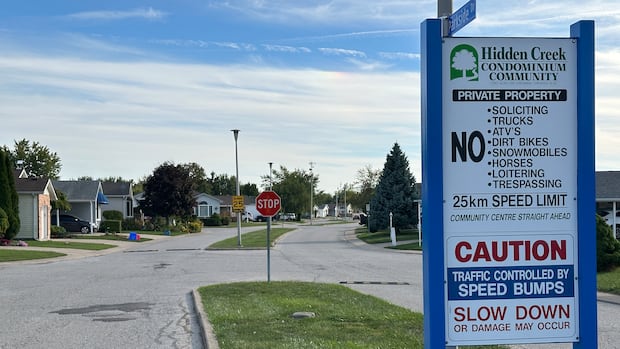
Modular home owner says she was denied lease transferEssex resident Sarah Battersby bought her modular home in SunPark’s Hidden Creek mobile home community in McGregor in 2022, leasing for about $675 a month.
Following health conditions and long-term disability, Battersby said she planned to sell in the fall of 2024 and that the lot rent rose to $895, with an added maintenance fee, bringing the total to upwards of $1,000 a month.
She had asked SunPark for a lease transfer to facilitate a sale and said she was told “"No, we don't do that here,’" she said.
“My Realtor said people [potential buyers] were calling and just hanging up. People would come in, they would look at it, but wouldn't really agree with the land rent,” she said.
 Sarah Battersby says she had to surrender her mobile home to the bank after being unable to sell it for almost a year. The single mother of two says she is now dependent on food banks, as the ordeal has left her life upside down (Pratyush Dayal/CBC)
Facing the loss of her home and having gone bankrupt, the single mother of two said she had to surrender her mobile home to the bank after being unable to sell it for almost a year. Dependent on food banks, Battersby said the ordeal has left her life upside-down.
“That stress I do not wish on my worst enemy. It's unbearable and disgusting.”
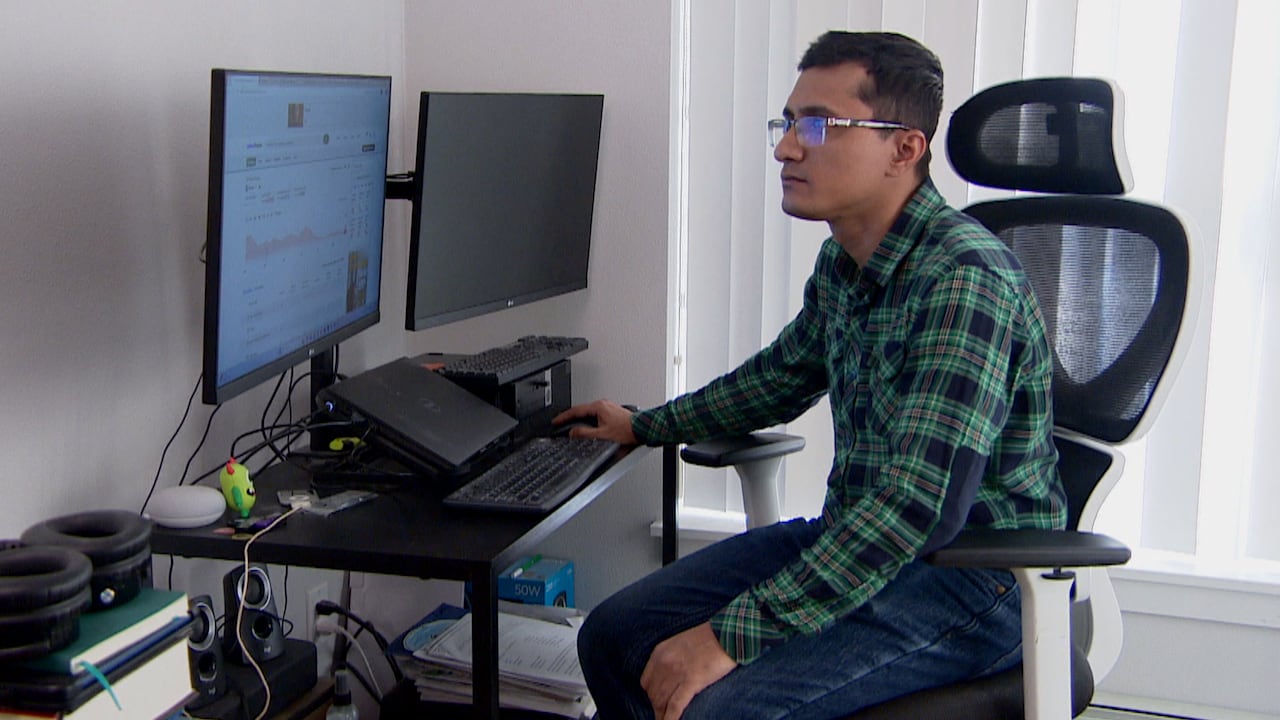
Another resident, Reg Major, who has owned a mobile home at Hidden Creek in Windsor-Essex since 2018, said many in the community are worried. As of late last month, he said, there are 14 such homes on the market “that are not moving."
Major, a senior and military veteran, said he feels “trapped” there.
“My only concern is when we pass on, my daughter's going to inherit the property and she'll be stuck with something that she cannot sell. Instead of being a financial windfall for her inheritance, she's going to be stuck with a millstone around her neck,” he said.
“They're refusing to even consider or have a conversation about a lease transfer.”
 Reg Major, resident of a mobile home in Hidden Creek, is honorary head of an Essex mobile homeowners’ association, and says residents are feeling “trapped” in their homes due to land-lease increases. (Pratyush Dayal/CBC)
Major said the high land rent is not an attractive bid to buyers who are seeking affordable housing and may also have a mortgage to pay.
“We came here because it was affordable housing. That affordable housing is going out the window very, very quickly.”
Dwindling affordability ‘a tragedy’Ruth Eves, a retiree who owns a property at the SunPark Hidden Valley estates north of Woodstock, put her home on market last year.
She said while her Realtor has received countless inquiries, she didn’t get an offer for months as people lost interest once they heard of the new lot fee she was told the company would be charging. CBC spoke with Eves’s Realtor, who confirmed this.
“It's kind of like the last place where affordable housing could be had, and they've kind of priced it so that people can't afford it. That's a tragedy.”
 Ruth Eves says she had to reduce the asking price of her mobile home near Woodstock by $25,000 to finally get a couple of offers. (Submitted by Ruth Eves)
After reducing the price by $25,000, Eves says, like others in the community who had to sell their homes at a loss, she finally got a buyer.
Liz Burns, a Realtor at Gale Group Realty in Woodstock who has listings in the community where Eves lives, said she advises people against moving there.
She said the company is putting up roadblocks by not honouring the transfer of leases, compelling new tenants to pay the new lot fees or justifying the arbitrary refusal of applications.
“That right there is just a pure violation in itself. And that's just one of the many, many things that we see across the board that they kind of do. They don't really care about their tenants within the park,” she said. “They're really just out to make a buck.”
 Liz Burns, a Realtor at Gale Group Realty in Woodstock, says SunPark is putting up roadblocks by not honouring the transfer of leases. (Rachael Little)
She said she has seen the company try to cut deals with people putting in offers so they purchase from the park rather than the seller, allowing the company to get the fees it wants.
She said only one of her clients has taken the company to the LTB and she urges others to also file claims with the board.
“I've never seen anything like this. This is the only park I've ever experienced where it's like that.”
Interference in home sales can net big finesBarrett Beaudoin, a licensed paralegal and director of Lexbridge Legal Services Corporation in Cambridge, has been dealing with similar mobile home cases.
He said if a landlord doesn't reply to that right-of-first-refusal offer within 72 hours, then the tenant should be able to proceed with a sale with a prospective purchaser on their own, as opposed to buying from the landlord.
The Residential Tenancies Act says that if a landlord wishes to refuse an assignment of tenancy to a particular individual, Beaudoin said, the landlord has to apply to the board within 15 days.
 Barrett Beaudoin, a licensed paralegal and director of Lexbridge Legal Services Corporation in Cambridge, Ont., says SunPark is not executing the process outlined in the Residential Tenancies Act in good faith. (Christine Saunders Photography)
He said if the 15 days lapse without the landlord making an application to the LTB to argue the reasons for refusal are reasonable, the presumption is that the transfer can move forward.
“A lot of these cases don't end up being adjudicated upon regularly. So, there is not a lot of case law about what defines reasonable grounds in one circumstance versus another.”
Beaudoin said interference of a home sale is a breach under Section 156 of the Landlord and Tenant Act and a tenant could bring in application to seek damages. Corporate landlords found to contravene the act could face fines of up to $250,000.
“I think in the very least it's not executing the process that's outlined in the act in good faith,” he said, referring to the SunPark’s alleged conduct.
‘Overhaul’ of the system neededDavid Wiseman, an associate professor in the University of Ottawa’s faculty of law, said the system of settling landlord-tenant issues puts tenants at a disadvantage. He said the lease transfer process seems to provide a loophole for landlords to exploit.
“Certainly it's a practical loophole that the legislation doesn't seem to be able, doesn't seem to be effectively addressing. So then it leaves the tenant at the mercy of these sort of strategies which are, you know, working in the grey areas of the law,” he said.
“There is fundamentally a lack of access to justice, a lack of access to legal assistance and advice for tenants in this province, and landlords know that… Most of the publicly funded legal aid that goes towards landlord-tenant issues understandably is prioritized towards eviction and preventing eviction.”
The months-long wait to get an LTB hearing date is a deterrent too, he said. As of Sept. 23, the LTB said, it had a backlog of 36,689 applications.
In November, Ontario passed Bill 60, the Fight Delays, Building Faster Act, which aims to address issues in the LTB process. But there’s currently a wait period of about five to seven months for a hearing for tenant applications.
“Many aspects of this system need to be rethought and re-engineered to give proper access to justice to tenants,” he said. “The system itself could use an overhaul.”
 David Wiseman, an associate professor in the University of Ottawa’s faculty of law, has many concerns about private equity firms’ involvement in mobile home ownership. (University of Ottawa)
Wiseman said SunPark is not alone, as this phenomenon is spreading in Ontario and across the country.
“The financialization of mobile home parks, which is the phenomenon of private equity or other investor-oriented owners coming in and purchasing mobile home parks and looking to, you know, basically squeeze the occupants as much as they can to milk as much money out of the properties as possible.”
He said neither the Landlord and Tenant Act nor the LTB is “well-adapted” to this changing model of mobile home ownership.
“This investor mindset has penetrated the whole market. We know we're in a housing crisis, but we've got most of the development not interested in providing affordable housing.”
Comments (0)