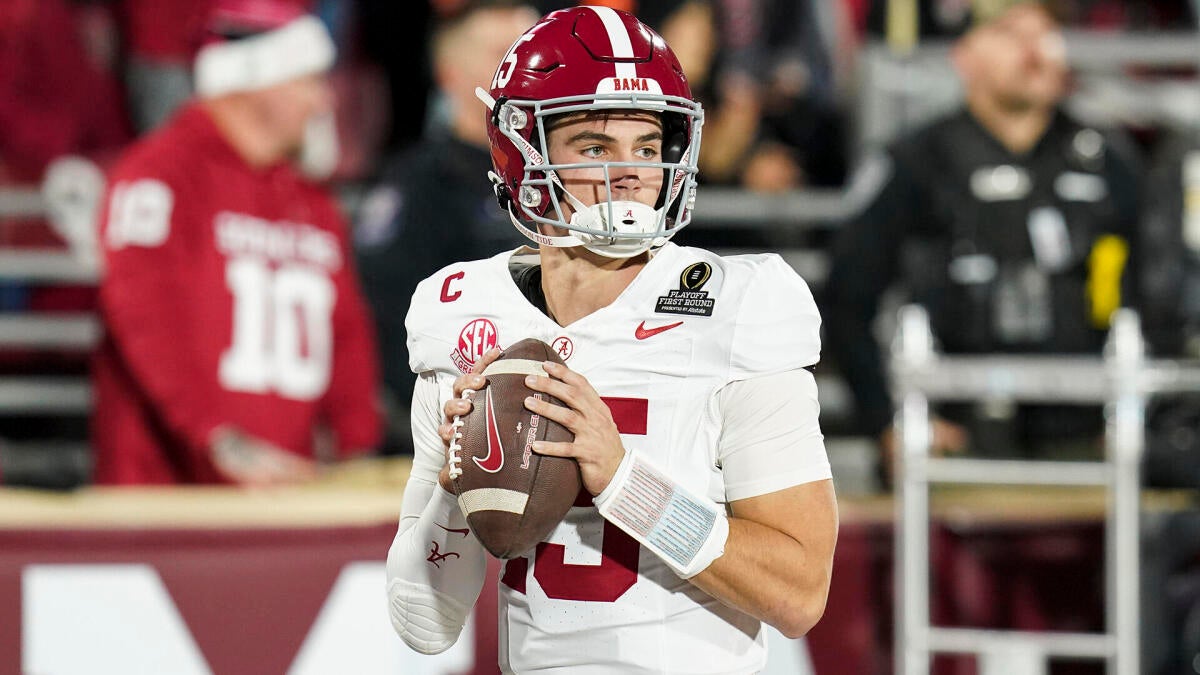
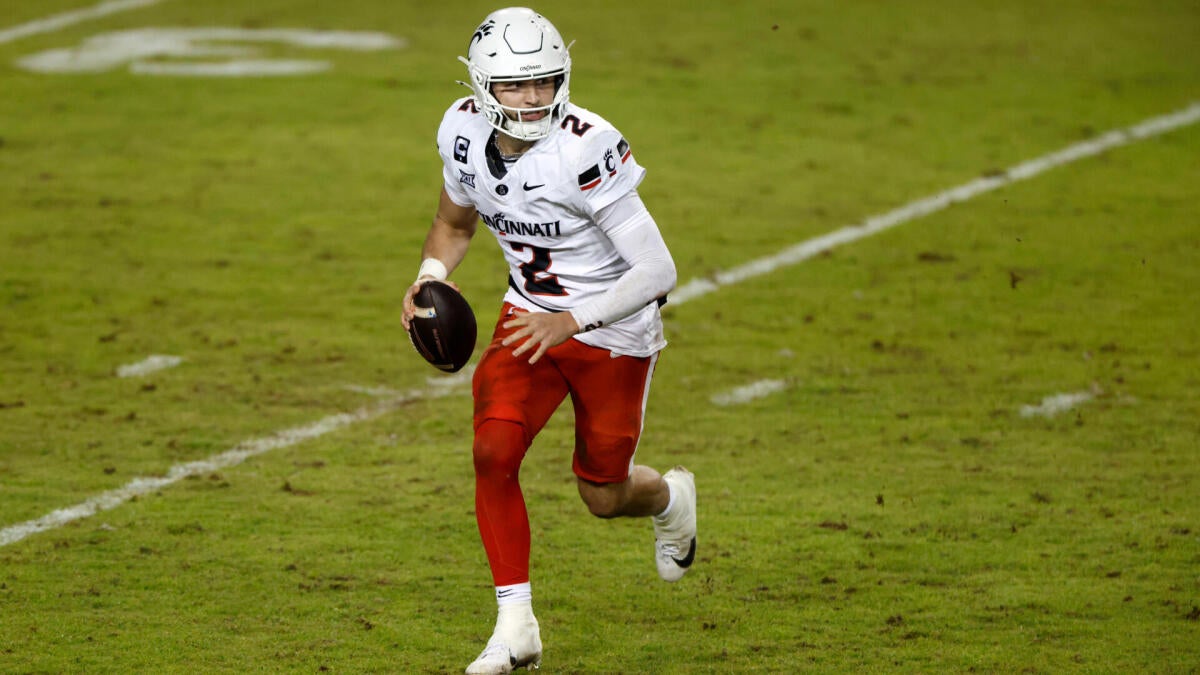
Ty Simpson has 15 career college starts -- all of them in 2025. Six days after Alabama's College Football Playoff loss to Indiana, he announced he's entering the 2026 NFL Draft. And given the state of this quarterback class, it's absolutely the right decision.
Simpson is betting that NFL teams will value what he is over what he isn't. In a draft cycle that has steadily thinned at quarterback, that may be a smart read. Because while history isn't on his side, the demand at the most important position in sports has a way of rewriting the rules.
History isn't on Simpson's side
The 2026 QB class is so watered down, as name after name decided to stay in college for another year, that it may not even compare to the 2025 group, which saw Cam Ward taken No. 1 overall and Jaxson Dart lasting until pick No. 25, when the Giants moved back into the first round to grab him.
But unlike Ward and Dart, who had 57 and 41 career college starts, Simpson is as green as they come. In fact, since 2010, 51 quarterbacks have been drafted in the first round. Of those, only Mitch Trubisky, Dwayne Haskins, Anthony Richardson and Cam Newton made fewer than 15 career Division I starts. And Newton, who won the Heisman Trophy and led Auburn to the national title in his only season with the Tigers, had started 12 games the season before at Blinn Community College.
Other names to consider: Kyler Murray made 17 starts between Texas A&M and Oklahoma, and Trey Lance, who didn't play his final college season at FCS North Dakota State because of COVID, also made just 17 starts in college.
The sweet spot for NFL success is at least 25-30 college starts, because it allows for reps -- and a lot of them -- which is exactly how good quarterbacks become great ones. Joe Burrow was just a guy at Ohio State before playing his final two years at LSU and going No. 1 overall in the same draft class as Justin Herbert and Tua Tagovailoa.
Reduce those starts and reps by 50 percent, and history suggests that desperate teams will find themselves overdrafting names like Mitch Trubisky and Anthony Richardson with top 5 picks.
Why Simpson is different
But unlike Trubisky, Richardson and even Murray -- all players who relied heavily on their athleticism and were far from polished passers in college -- Simpson, who is 23 years old and has been at Alabama since 2022, plays the position like someone who has started all four seasons.
He's one of the best processors, both before and after the snap, of any quarterback in college football during the 2025 season, and he was a technician on short and intermediate throws, consistently getting the ball out on time, to the right target, and often with NFL-level anticipation.
Where Simpson struggled, and I wrote about this in late November, was when he had to push the ball down the field. Through 12 games, on throws of more than 30 yards, he was completing a mind-bending 13.3% of his throws. By comparison, over that same span, Indiana's Fernando Mendoza was completing 53.3% and Oregon's Dante Moore was completing 46.7%.
And looking at every draft class since 2019, Simpson was still last, by a large margin, more than 15 percentage points behind Justin Herbert, who managed to complete just 30% of his deep throws during his last season at Oregon (Herbert, in case you're wondering, made 42 college starts), before the Chargers eventually took him No. 6 overall in 2020.
It was a glaring hole in Simpson's game, mostly because he was so efficient on intermediate level throws (15-30 yards beyond the line of scrimmage); he finished the season completing 55.7% of his throws in this range, behind only Mendoza and Arkansas' Taylen Green. And among draft-eligible QBs, Simpson was first in completions (54) and passing yards (1,273).
But in speaking with people around the program, Simpson has been battling an injury dating back to the Oct. 25 South Carolina game, which has affected his ability to push the ball downfield. NFL teams surely know this, and if they're comfortable with the notion that Simpson's deep-ball accuracy is a function of him being healthy, then there will be fewer concerns about taking him in the first round.
My comp for Simpson is a souped-up Mac Jones, the one coming out of Alabama after leading them to a national title, or even the one who played at a high level this season in place of an injured Brock Purdy, except he's a better athlete with a bigger arm. But the processing, the ability to get through his reads, the anticipatory throws -- all of those things looked like the Jones in Tuscaloosa but with the software upgrades.
Don't let Simpson fall to middle of first round
The other thing to keep in mind: Trubisky and Richardson landed in organizations that were somewhere between desperate and dysfunctional.
The Bears fired John Fox after Trubisky's rookie season, and while they went to the playoffs in Year 1 with Matt Nagy, the wheels fell off shortly thereafter. The Colts, meanwhile, were probably equipped to get the most out of Richardson -- Shane Steichen did just that with a healthy Daniel Jones for three months of the 2025 season -- but Richardson's lack of maturity doomed him (which, ultimately, is Richardson's burden to bear but also something the Colts should have understood before using the No. 4 overall pick on him).
This holds for just about every quarterback, not just the ones short on college experience. A good example of this is Baker Mayfield, Sam Darnold and even Trevor Lawerence. But I'd argue that Simpson, at least in terms of how he plays the game -- as a pocket passer, not the best athlete on the field who consistently chooses to win with that athleticism -- should also make his transition to the NFL a little smoother.
Still, fit matters, regardless of your college CV. And given that teams like the Raiders, Jets and Cardinals are picking high in the 2026 draft, there's every reason to believe that Simpson could also find himself in a similar situation to that of a lot of top draft picks. But Lord help us if he slips to the middle of the first round and he finds his way to, say, the Rams, a team with two first-round picks, and a Hall of Fame quarterback in Matthew Stafford, who, at 37, still could play at a high level in 2026 if he wanted to.
The infrastructure is in place, Sean McVay is one of the best play-callers on the planet, and in Los Angeles, Simpson could get those much-needed reps while Stafford ran it back for at least another season. There would be no "He's a first-rounder, so he's gotta play" mentality that stunts the growth of so many young quarterbacks. Just a graduate-level course in QB play without the immediate pressure of having to execute every single Sunday.
Let recent history be a lesson
The best way for Simpson to get live game reps is to stay in school. This is not controversial. But there's something to be said for on-the-job training with someone like McVay as your boss. There's also something to be said for returning to college when you've exceeded many of the expectations you may have had for yourself before the season.
Remember back in August, when Arch Manning was "can't miss," and LaNorris Sellers wasn't far behind? And Carson Beck would rediscover his first-round form in Coral Gables while Garrett Nussmeier was poised to finally put it all together and live up to the hype as one of the country's best college quarterbacks? We heard similar conversations about Cade Klubnik and Drew Allar.
Manning looked to be suffocated by expectations over the first few months of the season before improving down the stretch. Wisely, he returned to Texas for 2026. Sellers is one of the most athletic quarterbacks in recent memory, but he's still learning how to become a passer; right now, his game too closely resembles that of Richardson's coming out of Florida, and had Sellers declared for the draft, he very easily could have fallen to Day 2.
Nussmeier, Klubnik and Allar all, to varying degrees, had hugely disappointing 2025 campaigns, and all three could end up lasting until Day 3 of the draft next spring. All three might have been drafted higher had they come out after their 2024 seasons.
Sometimes, it makes sense to strike while the iron is hot, and sometimes even when it's lukewarm.
Finally, for all the NIL money flying around, especially for quarterbacks, my colleague Pete Prisco made this point and it's an important one: Sure, Simpson could get $4-$5 million to play another college season, but Cam Ward signed a four-year, $48.7 million guaranteed contract as the No. 1 overall pick in 2025. Simpson isn't going No. 1 overall, but he could make close to $45 million in 2026 as a top 5 selection, and around $29 million over four years as a top 10 selection.
More than that, however, he'll be one year closer to his second contract, and that's when the real money happens. Currently, Dak Prescott is the highest-paid player in the league, averaging $60 million a season. He's followed by Jordan Love, Burrow, Lawrence and Josh Allen, who are all at $55 million a season.
Simpson is walking into the league with one of the thinnest CVs a first-round quarterback can have -- and one of the most translatable skill sets. That's the gamble. The history ain't pretty, but the tape is compelling. And the context will matter as much as the player. If he lands in chaos, he could become another cautionary tale. If he lands in structure, with time, coaching, and patience, he could be the rare exception that proves the rule. QB-needy teams won't be betting against the data -- they'll be betting Simpson's different.

Comments (0)