
Remember me




Could it be that the markets are right and the massed ranks of commentators – at least on this side of the Atlantic – are wrong?
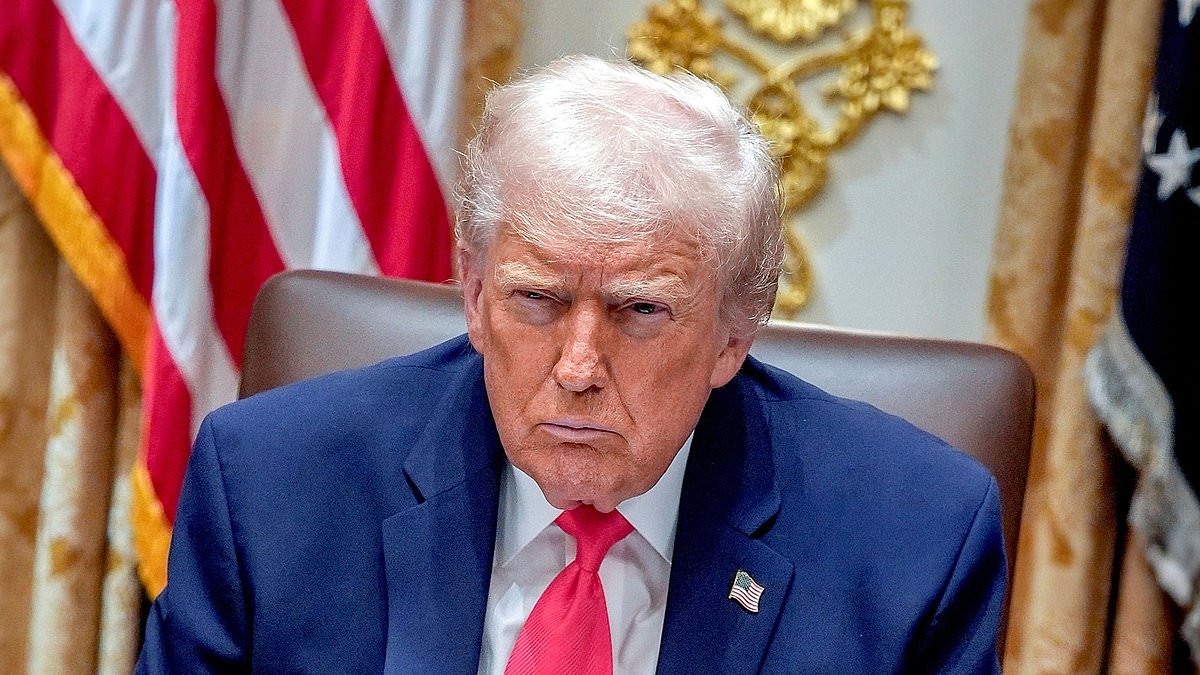
Or to put the question another way, could the uncertainties that Donald Trump has generated, most recently over Venezuela and Greenland, end up being a net plus for the world economy?
The general rule for the relationship between politics and economics has long been that order is good, chaos is bad.
The knee-jerk reaction in April to the US President's 'Liberation Day' tariffs was for share prices to crash by more than 10 per cent.
Those plans certainly generated huge uncertainty but, looking back, their overall impact has been pretty modest.
Share prices swiftly recovered in London and New York, and last week were at all-time highs.

Shenanigans: Could the uncertainties that Donald Trump has generated, most recently over Venezuela and Greenland, end up being a net plus for the world economy?
The market response to the latest shenanigans has been quite different. Insofar as the markets have reacted at all, they have been mildly welcoming.
You might imagine that abducting President Nicolas Maduro and his wife Cilia Flores in the middle of the night would be a big deal for the oil market. After all, Venezuela has the largest proven reserves in the world – greater even than Saudi Arabia.
Oil prices have indeed jumped about a bit, but on Friday they were within a couple of dollars a barrel from the level they had been a week earlier.
As for the Greenland saga, threatening to annex the territory of a Nato ally should surely be an even bigger shock. Yet the leading share index in Copenhagen is up 4.5 per cent so far this year.
Investors seem more interested in the prospects for Denmark's leading company, the pharmaceutical giant Novo Nordisk (which makes the weight-loss drug Wegovy), than the threat of the country losing Greenland.
So are the markets right? My answer is yes. As far as Venezuela is concerned, it is not an important economy and the country will probably be less badly run under its new president than under its previous one.
And there will be some sort of accord between the US and Denmark that gives the former more military control over this huge and strategically important territory, probably in exchange for access to mineral rights.
Given Russian and Chinese interest in the Arctic, you can understand Trump's motivation, even if his characteristically mercurial approach is unsettling.
Of course, it is humiliating if you are a British or European politician not only to learn that as far as America is concerned you don't matter, but for the markets to endorse that standpoint. But this is the world we live in, and we have to be grown up about it.
If this insouciance is justified, what should investors here, in America or elsewhere do? Put bluntly, do you buy or sell?
The best answer is to focus on the solid performance of the world economy, not on the theatrical behaviour of the current US President. So you look for any signs of weakness in world trade or in the US job market.
You worry, reasonably enough, about the danger of inflation in the US and elsewhere climbing back up, because that would limit the ability of the central banks to cut interest rates further. As argued here before, the US economy is puffed up by a huge fiscal deficit that is unsustainable.
Other countries, including our own, will at some stage have to tackle their deficits, too. The question there is whether they will do so of their own accord or whether the bond market vigilantes will force them to take action.
We all know that at some stage this bull market will end, and this will not be pleasant. But the trigger for that is much more likely to be an economic or financial event rather than a political one.
Trump does not want to go down in history as the President who crashed the US economy. There is an obvious danger he will miscalculate, just as he has done in the past with his property ventures. But the danger is that this will be an error in financial policy rather than a geopolitical one.
So don't worry about Venezuela or Greenland. If the American economy remains healthy, stay invested. If it weakens, that might be the time to sell.
DIY INVESTING PLATFORMS

AJ Bell
AJ Bell
Easy investing and ready-made portfolios
Hargreaves Lansdown
Hargreaves Lansdown
Free fund dealing and investment ideas

interactive investor
interactive investor
Flat-fee investing from £4.99 per month

Freetrade
Freetrade
Investing Isa now free on basic plan

Trading 212
Trading 212
Free share dealing and no account fee
Affiliate links: If you take out a product This is Money may earn a commission. These deals are chosen by our editorial team, as we think they are worth highlighting. This does not affect our editorial independence.
Compare the best investing account for you
Comments (0)