NPR's Juana Summers speaks with Jason Rezaian, who was imprisoned in Iran when he was the Tehran correspondent for The Washington Post, about the country's current wave of protest.
JUANA SUMMERS, HOST:
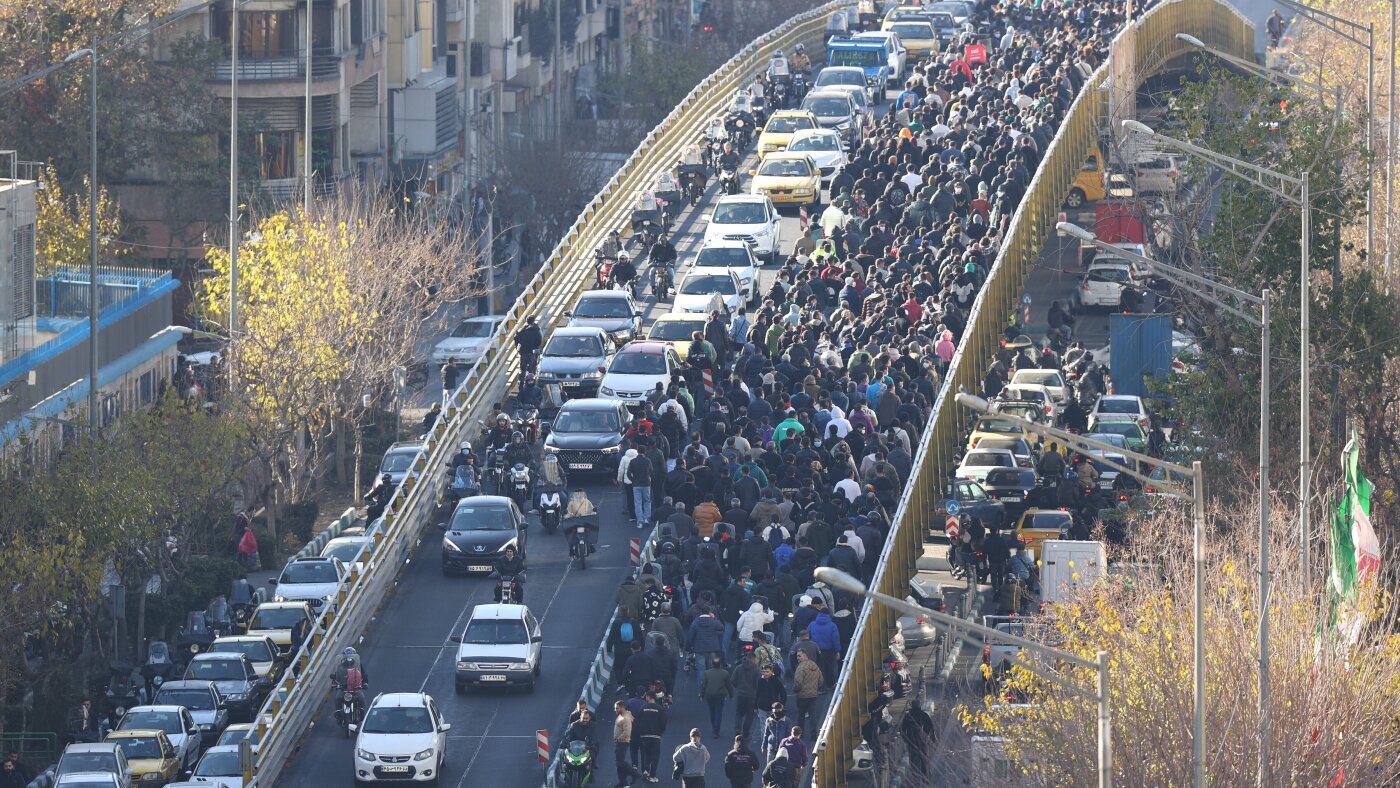
We begin today with a conversation about Iran. Antigovernment protests over the last few weeks have been met with violent repression from the authoritarian government. That has left more than 2,500 people dead, according to the U.S.-based Human Rights Activists News Agency. NPR, I'll note, has not been able to independently verify that number. The U.S. is weighing military action in response.
When there's big news from Iran, we often reach out to Jason Rezaian. He was The Washington Post correspondent in Tehran in 2014 when he was imprisoned by the Iranian government and later released during the nuclear deal negotiations. He's now the director of Press Freedom Initiatives at The Washington Post. And his op-ed this week is titled "I've Waited For This Electrifying Moment In Iran For 10 Years." Jason Rezaian, welcome back to the program.
JASON REZAIAN: Thanks for having me, Juana.
SUMMERS: I want to start with this. You've written that for the first time since leaving Iran in 2016, you're now allowing yourself to feel hope that one day you might return. Tell us what feels different about this moment from moments of protest that you've seen in the past.
REZAIAN: I think what we see, Juana, is that the velocity between protest movements in Iran is quickening. If you think back to 2009 and the Green Movement that followed the contested reelection of Mahmoud Ahmadinejad, then there were protests in 2017, '18, '19 that were much more regional in scope around economic discontent. Then in 2022, the Woman, Life, Freedom movement that was arguably the biggest protest movement in Iran.
To date, everyone was supporting each other in this very basic demand that we want a freer, more open society where people's rights are protected and guaranteed, and at the same time, we want a better financial future. And I think the regime has not been able to respond to those very clear demands. They don't have a plan to do so. And at this point in time, it seems like the expiration date of this nearly 50-year-old system is quickly approaching.
SUMMERS: I want to ask you, Jason, historically, as you see it, where has the U.S. gone wrong when it thinks about change in Iran?
REZAIAN: I think we've gotten it wrong for a lot of different reasons. But one of them is that we've rarely followed through on the things that we have promised to do. We talk a lot right now about the internet shutdown and blackout. And it's not just the internet. It's even, you know, landline telephones. We haven't been able to communicate with anybody inside Iran since a week ago today. Iranians should be able to access the internet. And there are ways to keep people online, right? Congress needs to vote on them. White House needs to put in an executive order around it.
And also, finding touchpoints with Iranian civil society. The truth is that there are very few people in Washington or other global capitals that have relevant, recent experience inside of Iran. And there are quite a lot of dissidents who have either left Iran in recent years or are still on the ground and willing to communicate their positions. We should be leaning on them to better understand the dynamics inside the country and how we can be most supportive.
SUMMERS: Yeah, I want to push on that a little bit. I mean, I've heard you make the argument, and you make it in your piece as well, that the U.S. needs to stop listening to the same voices in Washington and begin to build bridges with people inside Iran. If there is one shift in thinking you would like to see from U.S. policymakers right now, what would that be?
REZAIAN: I've always been somebody who's incredibly pro-engagement. I don't think of diplomacy as a weakness. I think of it as a strength, especially when you wield the type of firepower and influence in the world that the United States does. And I think talking to our adversaries is very important. That doesn't mean acquiescing to their demands or giving in to them. And I think, you know, engagement with the Iranian regime right now, especially around the nuclear program, would be a mistake. I think our focus should be centered on the people of Iran and their aspirations. A stable Iran, with an open economy and an open society that has the territorial integrity in the same borders that we know right now, would be in the region's interest and would be in the United States of America's interest.
SUMMERS: Jason, this week marks 10 years since you were released from prison, you were forced to leave Iran. When you look at what is happening there right now, how does that anniversary shape how you're taking in and watching this moment?
REZAIAN: Juana, it's hard for me to wrap my head around the fact that my wife and I have been out of Iran for 10 years. It's incredibly heartbreaking to me for her that she was very unceremoniously jettisoned and exiled from her homeland and hasn't been able to return and may not be able to do so for the foreseeable future. But for us, at this moment, while we watch the struggle of Iranian people and the fearlessness and the clarity with which they're standing up and demanding a new way forward - and at the same time, the brutal repression of the Islamic regime to kind of silence those demands - it's an incredibly mixed set of emotions.
I'm proud. I'm exhilarated. But I'm scared about the loss of life and also about, you know, the very real possibility that if this regime falls, there's no guarantee that something better would automatically replace it. And I think that that is a very strange thing to say after all of these years. I had hoped and wished we'd be much further along in these conversations,10 years ago, than we actually are.
SUMMERS: Jason Rezaian is the director of Press Freedom Initiatives at The Washington Post and the paper's former correspondent in Tehran. Jason, thank you.
REZAIAN: Thanks, Juana.
Copyright © 2026 NPR. All rights reserved. Visit our website terms of use and permissions pages at www.npr.org for further information.
Accuracy and availability of NPR transcripts may vary. Transcript text may be revised to correct errors or match updates to audio. Audio on npr.org may be edited after its original broadcast or publication. The authoritative record of NPR’s programming is the audio record.








Comments (0)