NPR's Ayesha Rascoe speaks to Arash Azizi of Yale University about the role of the Revolutionary Guard in Iran.
AYESHA RASCOE, HOST:
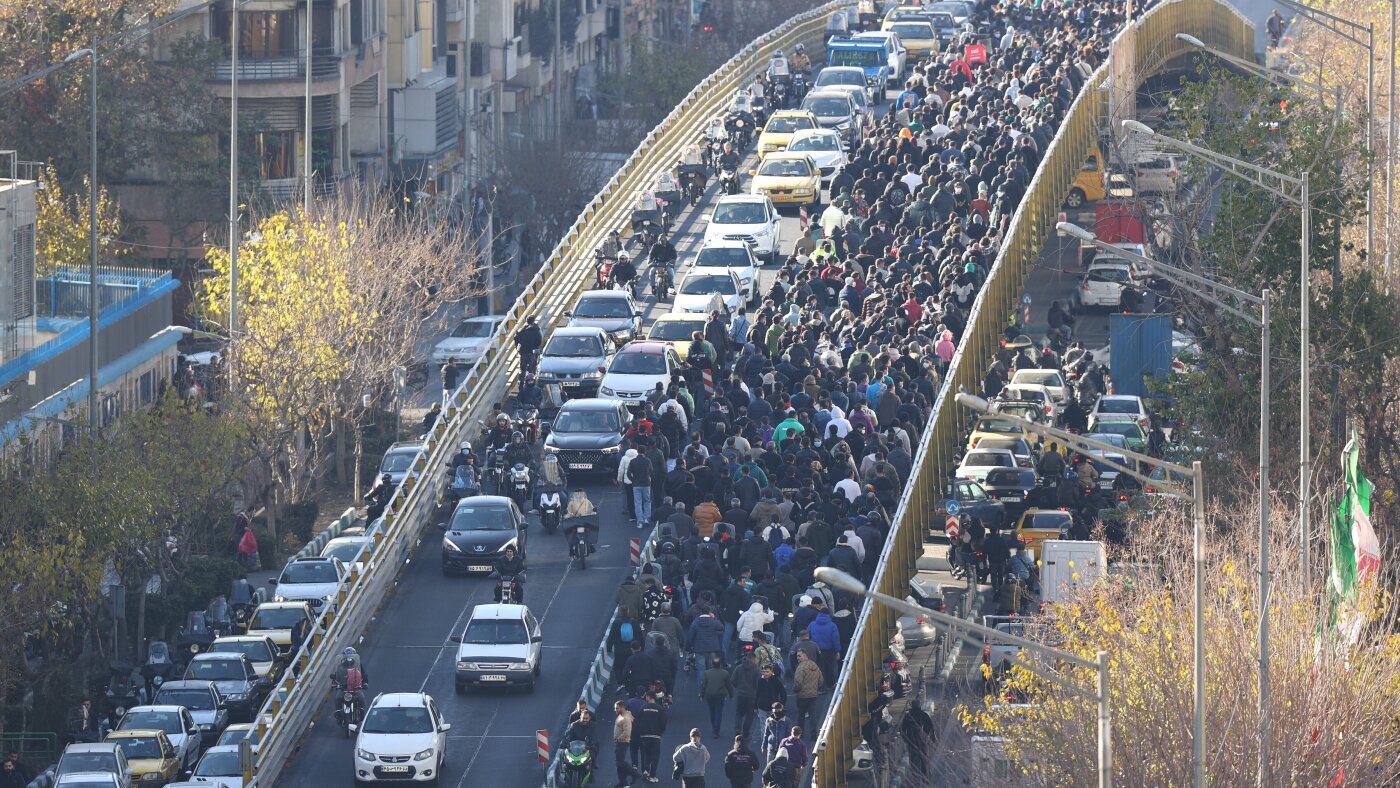
Another potential global flashpoint continues to be Iran. The country's supreme leader acknowledged yesterday that thousands of Iranians were killed during widespread protests. President Trump said Saturday that, quote, "it's time to look for new leadership in Iran." The country's Islamic Revolutionary Guard, also known as the IRGC, has played a key role in cracking down on the demonstrations. To tell us more about this elite force, we're joined now by Arash Azizi. He's a researcher at Yale University and an expert on the Revolutionary Guard. Welcome to the program.
ARASH AZIZI: Thank you, Ayesha. It's great to be with you.
RASCOE: So what role has the Revolutionary Guard played in the violent crackdown we've been seeing?
AZIZI: The Revolutionary Guards, or the IRGC, in Iran are really a massive behemoth of - they have 190,000 members. They are both a militia, a political party and sort of a big corporation or a series of corporations, mafia-like corporations hold together. So they've played an important role. They have a volunteer organization that, you know, organizes sort of militias, you know, that are less professional than its main thing. It's called the Basij, a sort of autonomous part of it. And they have definitely have been leading some of the crackdowns. And also, you know, they've been - they've organized the crackdowns since early January, the early part of the protests. And, you know, when things are investigated fully, I believe they will have had an important role in the killings. As you know, we've faced the gravest crimes of the Islamic Republic, easily since the 1980s in which thousands of protesters were killed.
RASCOE: Well, how does the IRGC fit into to the wider Iranian government?
AZIZI: The Islamic Republic was founded in 1979 as a - on the back of a really grand revolution. And one of the things revolutions do is that because they don't trust the existing institutions of a country, they create their own. This happened, you know, in many revolutions in world history, like Russia, China, France before the 19th century. So here as well, the leadership of the Islamic Republic created this group. You notice the IRGC stands for Islamic Revolutionary Guard Corps. A very important word is missing there, and that's Iran. And that's deliberate. They created it as a force that was not beholden to Iran. IRGC leaders say that they're not even beholden by the Iranian constitution. They're beholden to whatever interpretation they have of what the 1979 Revolution is. So they are extra legal and effectively a parallel state. They now control about 50% of the Iranian economy and much of the Iranian - they shadow the actual Iranian military. Iran has an actual military, right? - the standing military. They shadow it. They have a presence all over the institutions, and they really sort of lead in this sort of crackdown. But they're also not a united organization, nor are they as ideologically cohesive as...
RASCOE: Well...
AZIZI: Yeah.
RASCOE: ...Talk to me about that because I think a lot of people will look at this and say that, is this a religious ideological thing for members of the IRGC? Would they protect the Iranian regime at any cost? What are these differences that are there?
AZIZI: You know, it used to be an ideological force and militia that, you know, very much became very serious in the war with Iraq in the 1980s, by which I mean, it became more like an standing army. But what it is now is really a network of power. And my assessment is that a lot of its leadership are not particularly, you know, ideological, a lot of - certainly, its middling layers. It's a bit like if you looked at the Communist Party in China today, or Communist Parties in the sort of late Soviet era. I mean, you know, people in there were not there because they were devout communists or Marxists. They were there because it was a governing party, and it was - you know, it was a way to access wealth and goods, right? So that's basically the IRGC. Now, a lot of people see it as a vehicle for power. And, look, I speak to - I - you know, as - in my job as a reporter, sometimes I've spoken to top generals in the IRGC or people close to them. And this does not sound like people who are very ideological. They are often very pragmatic. They are - what they want is the preservation of their own privileges and their own wealth. So this tells me that, you know, they won't be always loyal to the regime or to its ideologies...
RASCOE: Well, so then you're saying...
AZIZI: ...And could very well part of a transition (ph)
RASCOE: So not to cut you off, but you're saying they're - what type of scenario could you see where the Revolutionary Guard could break with the country's leadership?
AZIZI: I think what we need is - excellent question, by the way. And I think what we need is a feasible transition plan, what we call a pacted transition, in which an opposition can show that it is strong enough, that is united enough, that has a cohesive plan that is not after revenge - right? - that it wants to put the past to the past and look for the future, and that it would able to, you know, gain the loyalty or - of parts of the Revolutionary Guards but also parts of the, you know, regime in general and bring about a transition that is seamless. And I think as Iranians, we really need to think about...
RASCOE: Well, can...
AZIZI: ...You know, transition.
RASCOE: Can - I just...
AZIZI: This has been a bloody 40 something years. So it's very important to...
RASCOE: I...
AZIZI: You know, when we think about the future, you know, think about how we can get there.
RASCOE: Well, I want to ask you, though, like, what's your sense of how things might play out in Iran in the coming days, given these recent protests?
AZIZI: I believe the protests have been quashed for now. Of course, they can resurface at any time, but the regime has not really regained its equilibrium. So what we really have is a regime that finds its core policies and core structures untenable. So, you know, it's very notoriously hard to predict things in the Middle East, certainly in the midst of a revolution. But I believe, ultimately, Ayesha, in - under the domestic pressure of peoples' discontent and external pressure from President Trump and, you know, Israel at some point and actually other regional countries who might not be happy with U.S. attacking but also not happy with the status quo - under these pressures, the regime will somehow change and transform. And I think movers and shakers of that transformation might very well come from within its own ranks.
RASCOE: OK.
AZIZI: So those of us who are in the democratic opposition will have to...
RASCOE: Thank you.
AZIZI: ...You know, work harder.
RASCOE: Thank you. Thank you.
AZIZI: ...To play a bigger role. But absent...
RASCOE: Thank you.
AZIZI: ...Of us getting organized, the change might come from within.
RASCOE: Thank you. That's Arash Azizi, a researcher at Yale University.
Copyright © 2026 NPR. All rights reserved. Visit our website terms of use and permissions pages at www.npr.org for further information.
Accuracy and availability of NPR transcripts may vary. Transcript text may be revised to correct errors or match updates to audio. Audio on npr.org may be edited after its original broadcast or publication. The authoritative record of NPR’s programming is the audio record.








Comments (0)