
Remember me



In 1994, a meeting of the legendary photo agency Magnum, convened to consider admitting Martin Parr as a member, quickly became the stuff of legend. Philip Jones Griffiths, veteran of the Vietnam War, was incandescent. “His photographs titillate in some way but the fact is they are utterly meaningless,” he thundered, further reproaching Parr for “kicking the victims of Tory violence”. After viewing a show of Parr’s pictures, 86-year-old Henri Cartier-Bresson, a founder of Magnum, was equally blunt: “I have only one thing to say to you. You are from a completely different planet to me.”

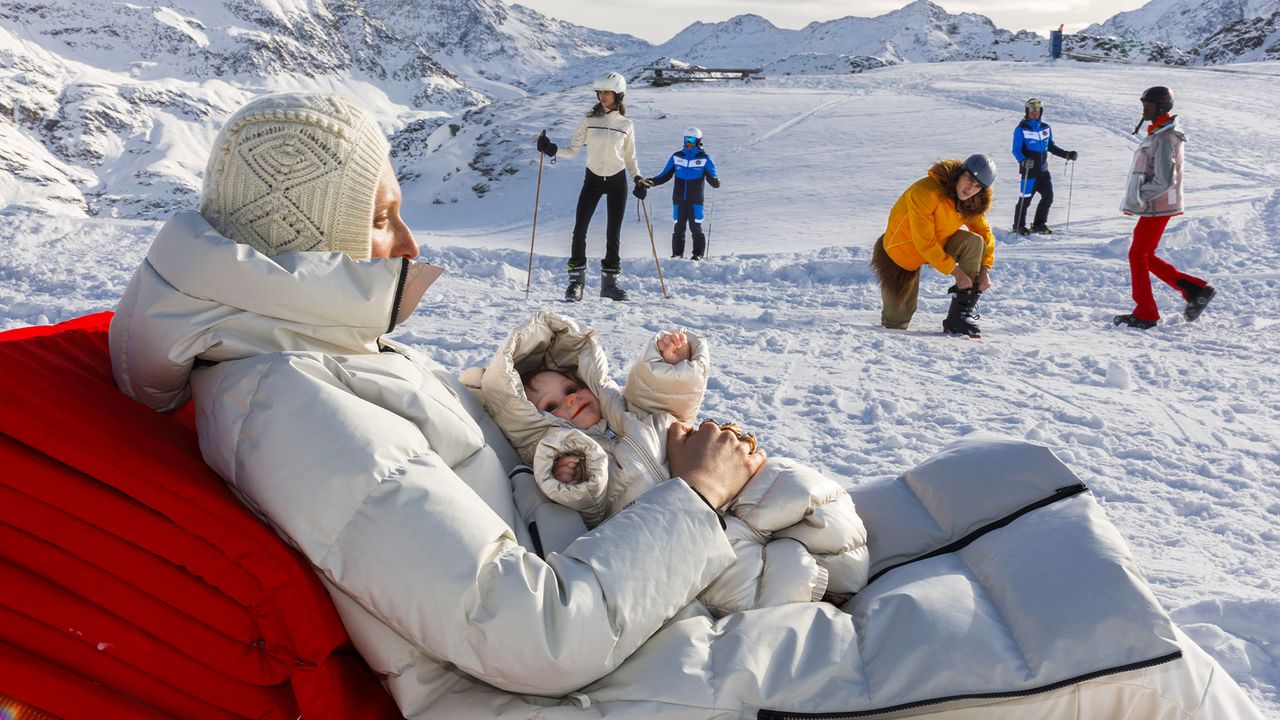
Taken in the mountains above the small Italian town of Bormio last December, as the Winter Olympics, Milano Cortina 2026, approached, this is likely the last portrait of Parr. Typically an unobtrusive observer of all human life, he frequently put himself firmly in the picture too.
Foto di Nathan Vidler / Martin Parr FoundationOn reflection, after he had got in by a single vote, Parr took Cartier-Bresson’s words as something of a compliment. Being from a completely different planet had always been his visiting card. Since he first picked up a camera and exposed a few frames – his first photo-essay as a 16-year-old was four snapshots of a Harry Ramsden’s fish and chip shop in Leeds – Parr scrutinised the world around him with a deadpan bemusement, as if planet Earth really were a final frontier, remote, unmapped, and he a latter-day Prospero, inviting us to marvel at its wonders and improbabilities.

From left, On Marta: Jacket by Moorer. Trousers by Goldbergh. Socks by Falke. Shoes by Christen. Hat by Yves Salomon. On Alessio: Shirt by Giorgio Armani. Hat by Giorgio Armani Neve. Trousers by Nike x Jacquemus. On Cara: Bodysuit by K-Way. Jacket by Herno. Trousers by Louis Vuitton. Hat by Giorgio Armani Neve. Shoes by Lariulà.
Martin Parr,© Martin Parr/MAGNUM PHOTOSFor many Magnum photographers, the terrestrial landscape was cratered with war and famine and catastrophe; for Parr, the front line was more immediately to hand: “I went out and round the corner to the local supermarket…” He dared to be dull. It was probably The Last Resort (1986), his full-throttle colour document of the working class finding pleasure where it could in the downside of the Thatcher years – in this case, the litter-strewn, defeated seaside resort of New Brighton, Merseyside – that made his reputation, for good or bad. His detractors flung it all at him: cynicism, fascism, opportunism, voyeurism, snobbishness; but an imperturbable Parr, rarely troubled by self-doubt, was working up a grander vision. “I just like to show the world as it is, with all its foibles and ambiguities,” he said. And not far from the surface (though sometimes you had to scratch hard) was a profound sympathy for the human condition not unlike Cartier-Bresson’s lofty ideals, just differently expressed.