
Remember me





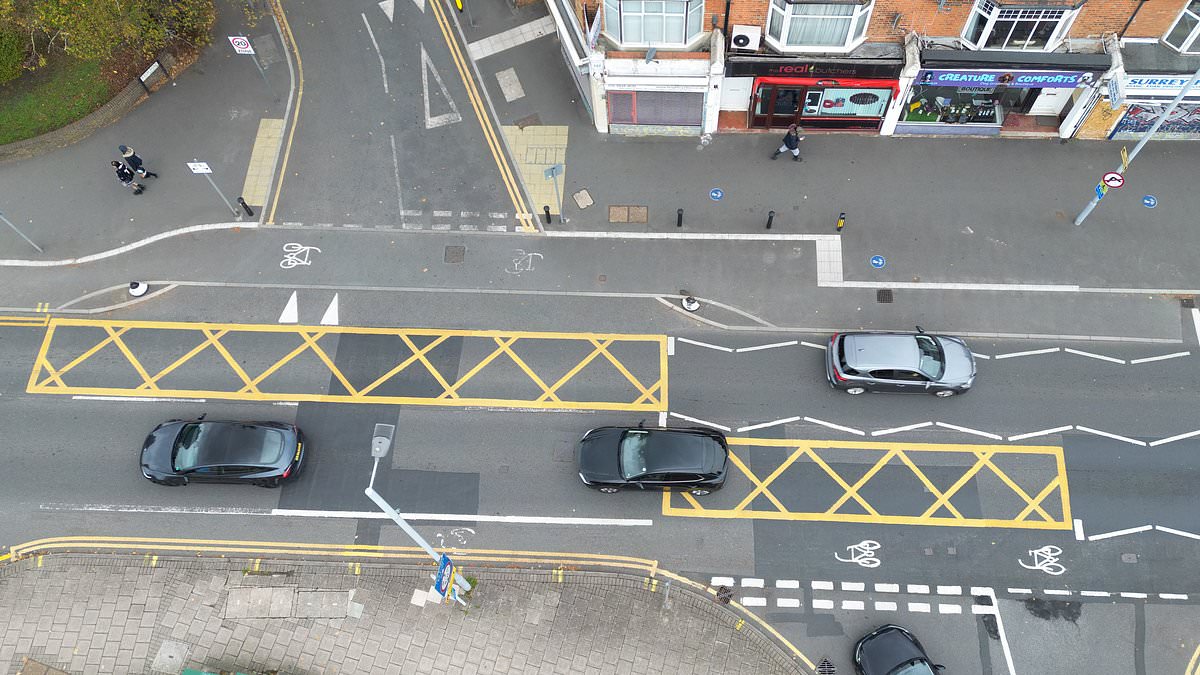




A Lib Dem run council says moneybox junctions that raked in £450,000 in just eight months are 'legally compliant' despite a slew of complaints.
Kingston Council will not make any changes to the layout or enforcement of the junctions on Kingston Road, in New Malden, despite concerns from residents and businesses that they operate as a 'cash cow'.
Council officers investigated the junctions after three councillors requested a special meeting to discuss concerns they had raised.
Officials said in a new report that they had found the layout and enforcement of the yellow boxes to be 'legally compliant and proportionate'.
But a special meeting will be held this Thursday at 7pm to determine whether the council will continue enforcing the junction.
The New and Old Malden Neighbourhood Committee, made up of 12 councillors - three Independents and nine Liberal Democrats, will vote on whether it should continue.
Independent councillors say they will table an amendment calling for enforcement at the box junction to cease.
The outcome of the vote will decide whether it carries on as before.

This is the box junction that raked in more than £450,000 in just eight months and has been deemed 'legally compliant' despite a slew of complaints. (Pictured: photo of the junction)

During the first eight months of 2025, the Royal Borough of Kingston upon Thames issued 6,568 penalty charge notices (PCNs) for the junction (pictured)

The fine for stopping in a yellow box junction is £160 in all London boroughs, but reduced to £80 if paid in the first 14 days. (Pictured: The Kingston Road junction)
Councillor James Giles, one of three independents who tabled this concern, said: 'The box is simply unfair, due to the number of people that get trapped in it.
'If you look at the number of appeals upheld, you will see that the fines are unfair.
'This is purely for the council to make a quick buck off unexpected motorists.'
Drivers who stop in the yellow grid when their exit is not clear, and they are not waiting to turn right, are automatically hit with a fine of £160. The fine is halved to £80 if it is paid in 14 days.
Councillors James Giles, Yvonne Tracey and Kamala Kugan requested a meeting after data from a Freedom of Information (FOI) request showed the authority dished out 6,568 penalty charge notices (PCNs) to drivers who had stopped in the yellow box junctions from January to August last year. This generated roughly £451,405, which they said equated to around £2,000 per day.
A total of 10,288 fines were handed out in 2021/2022, followed by 8,888 in 2022/23, 8,758 in 2023/24 and 7,359 in 2024/25.
The report said: 'The council uses enforcement measures to ensure compliance with yellow boxes designed to improve traffic flow and road safety. Our enforcement strategy aims to reduce contraventions, leading to better compliance with regulations and achieving our overall traffic management goals.

Made up of two yellow boxes, the junction (pictured) on Kingston Road causes 27 penalties to be issued on average per day

Council officers investigated the junctions after three councillors requested a special meeting to discuss concerns they had raised
It added: 'Officers are satisfied that the junction layouts are legally compliant and enforcement is proportionate. It is therefore proposed that no changes are made but the junctions be kept under review.
Officers recommended the layout of the junctions be maintained, but that separate enforcement data on each should be provided going forward to improve transparency.
Kingston Council has taken the most, on average, of any council in the country from individual box junctions since January 2022. An FOI request, conducted by The Times, revealed it had taken £3.6 million from eight box junctions – an average of £120,000 in fines per junction per year.
Traffic law expert Phillip Morgan, 73 has been fighting incorrectly issued tickets on behalf of motorists for 15 years. He believes the Kingston Road box junction breaks regulations because it is 'too big'.
What are yellow box junctions?A box junction is a traffic control measure designed to prevent gridlock at junctions.
It's easy to recognise – in the UK, it's a yellow box filled with criss-cross yellow lines painted on the road.
Under the rules of the Highway Code, you're not allowed to enter the yellow box unless your exit is clear and there is enough space on the other side of the junction for your car to clear the box completely without stopping.
The exception is turning right and waiting for oncoming traffic to pass.
Source: RAC
Morgan 73, said: 'The whole issue is the law states a yellow box junction must be two or more roads. This box junction extends two or more roads.'
Mr Morgan also revealed he purposefully received tickets so that he could successfully appeal them.
Roland Head, 75, who has run The Real Butchers for 42 years, which sits next to the junction, described it as a 'cash cow'.
'It's not about traffic control,' he said.
'The local government isn't going to change anything because it's making them money,' he said.
The two yellow boxes between Elm Road and Westbury Road have been in place since 2015, but fines were not introduced until five years later.
Only a fraction of yellow box fines are appealed by drivers, but the proportion of attempts that are upheld can be as high as 87 per cent in the case of Medway Council in 2024.
RAC senior policy officer Rod Dennis said a yellow box, which generates a small number of fines indicates it is 'working as it should', and must be the ambition for councils rather than using them as a 'revenue-raising opportunity'.
He said: 'Very few people set out to deliberately flout the rules and get fined.
'The large number of penalties being dished out over a small number of locations and in a short space of time should send alarm bells ringing in council offices.
'It's vital that box junctions are used in the correct places and are only as big as absolutely necessary.
'They must be fairly set up so that drivers don't find themselves stranded through no fault of their own.'
Chartered engineer Sam Wright was commissioned by the RAC to analyse the 100 boxes across London and Cardiff which were responsible for generating the most fines in 2019.
A report published last year showed he found 98 were larger than necessary for their role in preventing queuing vehicles from blocking the path of crossing traffic.
The average box was 50 per cent bigger than needed, according to the research.
Any extra income generated by enforcing yellow boxes and other traffic offences must be ringfenced for certain uses, including highways maintenance.
Kingston council have been contacted for comment.
Comments (0)