
Remember me




We're roughly eight years into the great subscription service experiment as companies like Microsoft, Nvidia, and Apple have all built new businesses charging players monthly for access to extensive libraries of excellent video games. The results have been fascinating. Some developers say they're crushing the value of games, others say they're "awesome and terrifying."
Who—besides these big tech giants—is earning extra revenue from the service? According from data from a late 2025 report from the Game Developer Collective (a research project orchestrated by our sibling organization Omdia), it's a specific subset developers whose games are based on selling downloadable content and expansions to players over time.
The Collective organizers asked developers how the inclusion of their most recently-released game on a subscription service has impacted the sales of their game. 17 percent of developers using subscription services reported seeing an increase in in-app purchase and downloadable content sales, while only 4 percent of developers selling premium games reported an increase.
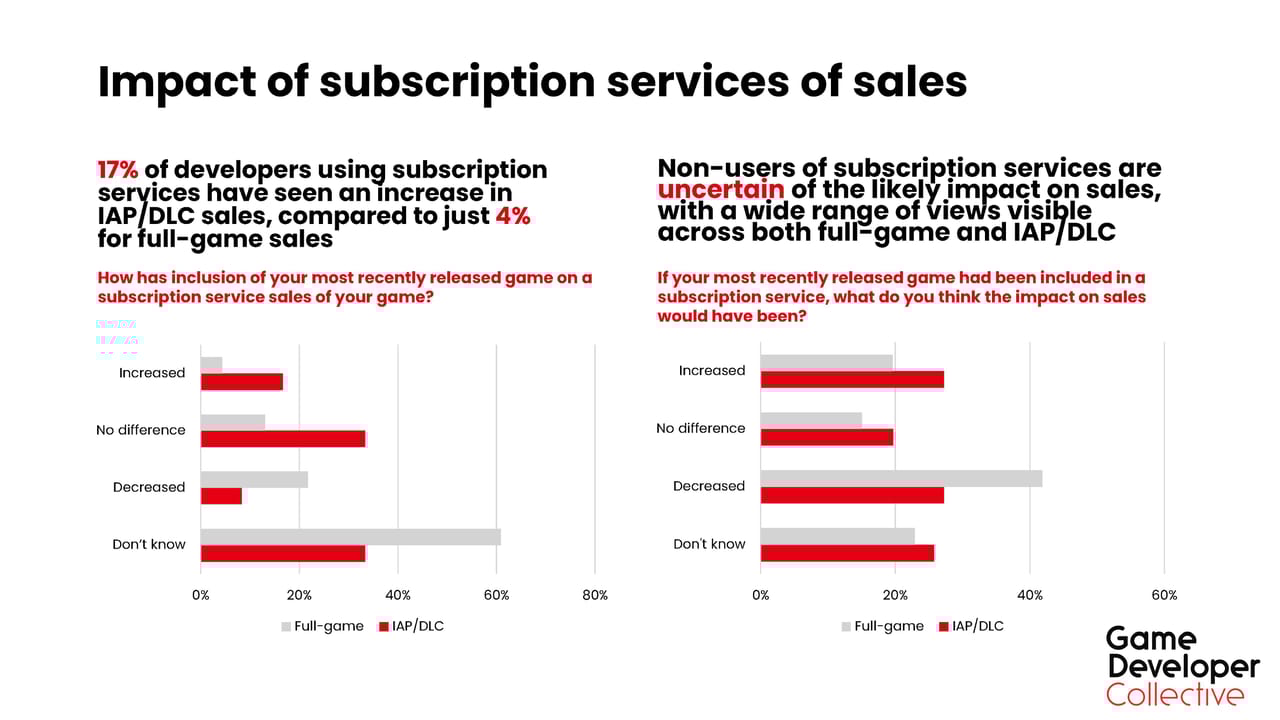
Image via Game Developer/Omdia
That's not a huge number of developers. Given that the majority of developers selling in-app purchases (IAP), downloadable content, or expansions reported there being "no difference" in revenue (or that they "didn't know"), the broad majority of studios aren't seeing exceptional games. But that 17 percent number indicates there's a category of games that convert subscribers into paying customers.
The only question is—what are those kinds of games?
Omdia senior analyst James McWhirter explained to Game Developer that developers making "games that generate long-term play with attractive DLC options" are most likely those reporting improved revenue from a subscription service. He pointed to games like Bethesda Softworks' Starfield, Rebellion Developments' Sniper Elite Resistance, sports titles on EA Play, and Dovetail Games' Train Sim World 5.
Given Xbox Game Pass' status as the most high-profile subscription service for console and PCs, we thought it was worth asking them what games selling IAP and downloadable content are seeing this kind of revenue bump. ID@Xbox Director Guy Richards told Game Developer that Sloclap's Rematch and Sumo Digital and Gun Interactive's The Texas Chainsaw Massacre are two games that fit the bill.
Players who tried The Texas Chainsaw Massacre on Game Pass also purchased the game before it exited the game pass library. Richards said this partly due to some promotion on Xbox's part that these games would be leaving the service, and that players may want to purchase the game and the available DLC to keep playing. "We work closely with creators to build a custom program to reflect what they need—including promoting DLCs or titles before they exit the service and sharing platform trends and best practices."
Gun Interactive CEO Wes Keltner affirmed Richards' findings, pointing to the new characters added to the game after launch as the key attractions in driving player spending. "The massive player base provided by Game Pass was instrumental in expanding the universe of Texas, propelling the game, the films, and the overall future of the IP."
Game Developer and Omdia are sibling organizations under Informa.