
Remember me

“Thank you, Mr President, for your leadership.”
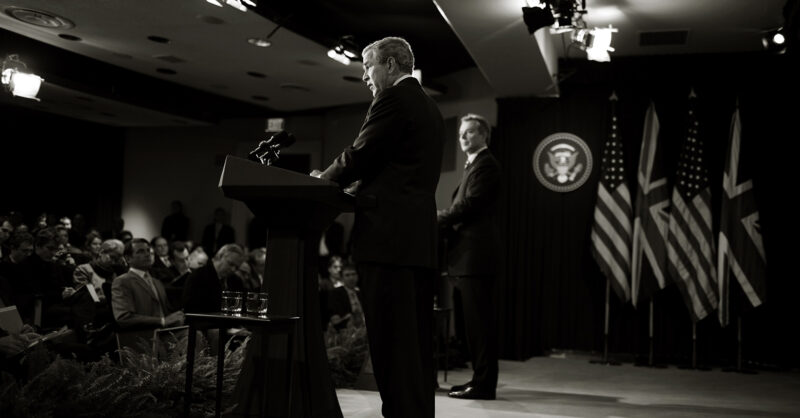
In July 2003, Tony Blair delivered a speech to the United States Congress. Four months into the invasion of Iraq, the British prime minister travelled to Washington DC to express his gratitude to his “ally” and “friend”, president George W Bush. “What the president is doing in the Middle East is tough, but right,” Blair said, dismissing the warnings of millions of ordinary people who could see the catastrophe ahead. Blair was then awarded the Congressional Gold Medal, for which he thanked Members of Congress in his speech. (Blair would not physically accept the Gold Medal until 2009.) According to David Manning, former British ambassador to Washington, Blair felt that if he picked up the medal while in office, he would be seen as “some sort of poodle”.
Now 23 years on, the memories of more than one million dead Iraqis should serve as an enduring reminder: blind loyalty to the United States is a “special relationship” that a rules-based international order cannot afford. Unfortunately, it’s a reminder that Keir Starmer seems desperate to forget. When the United States invaded Venezuela recently, our Prime Minister could not even bring himself to acknowledge a fact that was obvious to us all: bombing a sovereign nation and abducting its head of state is illegal. It’s not that the former human rights lawyer didn’t understand. He understood full well – and chose to desecrate the meaning of international law in order to protect the vanity of Donald J Trump.
Even though Nicolás Maduro awaits trial in the US, much of our political and media class have chosen to forgive and forget (for many, there was nothing to forgive to begin with). Maybe that’s what gave Trump the confidence he needed to move to the next country on his shopping list: Greenland. Now that he has backtracked on his threats to impose tariffs, politicians and journalists alike have largely gone quiet. Most have lulled themselves into a state of denial that everything is OK again, almost as if nothing ever happened at all.

New year, new read. Save 40% off an annual subscription this January.
This is what happens when you treat Trump’s actions as isolated moments of madness. There is nothing fleeting about Trump’s ideological goals. From the illegal kidnapping in Venezuela to the threat to “acquire” Greenland, Trump’s actions are not the signs of lunatic. They are signs of man who is driven by an unending desire to seize control of resources across the globe. As Trump declared back in April last year, “I run the country and the world.”
Trump’s so-called “Board of Peace” in Gaza is just the latest chapter. By assembling a gang of rogues, Trump is not only deliberately denying the Palestinian people the right to self-determination. By using war as a real estate opportunity, Trump is showing the world that there are no limits to his imperial desire. Deep beneath the rubble of Gaza is international law, buried by the US and the UK together. When the powerful speak of a “rules-based international order”, they mean rules for others and impunity for themselves. For too long, Britain has blindly followed the United States as it indulges in disastrous imperial fantasies around the world. It’s time to forge a different path. Now is not to the time to try to rescue a “special relationship” characterised by impunity, genocide and war. Now is the time to forge an independent foreign policy based on international law and peace.
An independent foreign policy is one that understands all of the challenges we face: global inequality, displacement and environmental disaster. This week, the president of Chile, Gabriel Boric, declared a state of catastrophe, after wildfires tore through the Ñuble and Biobío regions. Eighteen people have been killed and more than 50,000 people have been evacuated. And then, 10,000 kilometres away, severe floods in Mozambique have impacted more than 620,000 people. Earlier this month in South Africa, severe flooding forced Kruger National Park to close after several rivers burst their banks following days of heavy rain.
When we talk about “security”, climate change is the single biggest threat to us all. Our government, however, is only capable of talking about security through the lens of war. For them, there is no crisis that increased military spending cannot solve. In 2024-25, the UK spent more than £60bn – or around 2.5 per cent of GDP – on “defence”. Starmer has pledged to increase this to a staggering 5 per cent by 2035. Imagine if we spent as much time talking about climate alliances – and how to empower them – as we do about military alliances. Imagine if the money we spent on killing people overseas was spent protecting the planet that we all depend for survival.
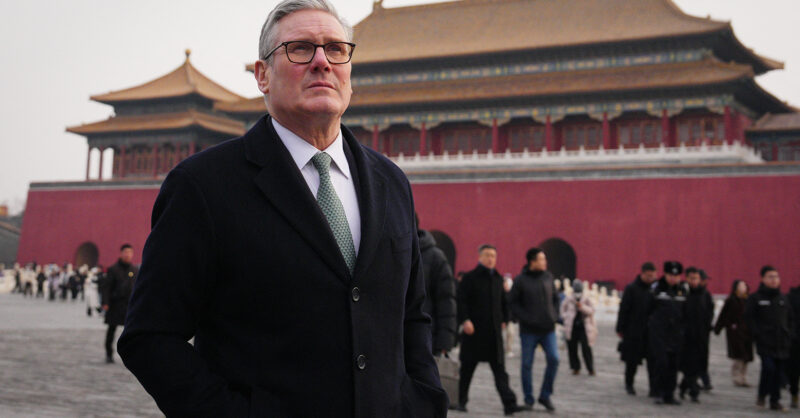
An independent foreign policy isn’t the same as an isolationist one. Far from it. It means understanding the changing nature of our multi-polar world. As Starmer lands in China, he should humble himself about the increasing role that countries across the Global South are playing in the global economy. When I was Labour leader, I wanted to develop an entirely new foreign policy that broke with principles of domination and imperialism. One that empowers nations in the Global South to decide their economic future. One that forges a partnership of equals, based on cooperation and mutual respect.
A partnership of equals will not emerge without significant reform of the United Nations – which should start with abolishing the veto of the five permanent members of the Security Council: the US, UK, France, China and Russia. An expanded, rolling membership would help to build a more equal, responsive and democratic application of international law. If the UK wants to be a leader on the world stage, it should have the moral courage to advocate for a system of equals, not one that allows a few powerful nations to hijack global peace.
Unlike Reform, Labour and the Tories, I think Britain’s foreign policy should be decided by Britain, not the United States. I believe in a foreign policy that cooperates with all nations in the pursuit of sustainability and peace. One that sees the Earth as something to care for, not carve up. One that builds a world for the many, not the few.
[Further reading: Britain needs a Gaullist leader]
Content from our partnersRelated
Comments (0)