Official PMIs released over the weekend suggest an unexpected and broad slowdown in January
Published Tue, Feb 3, 2026 · 05:49 PM
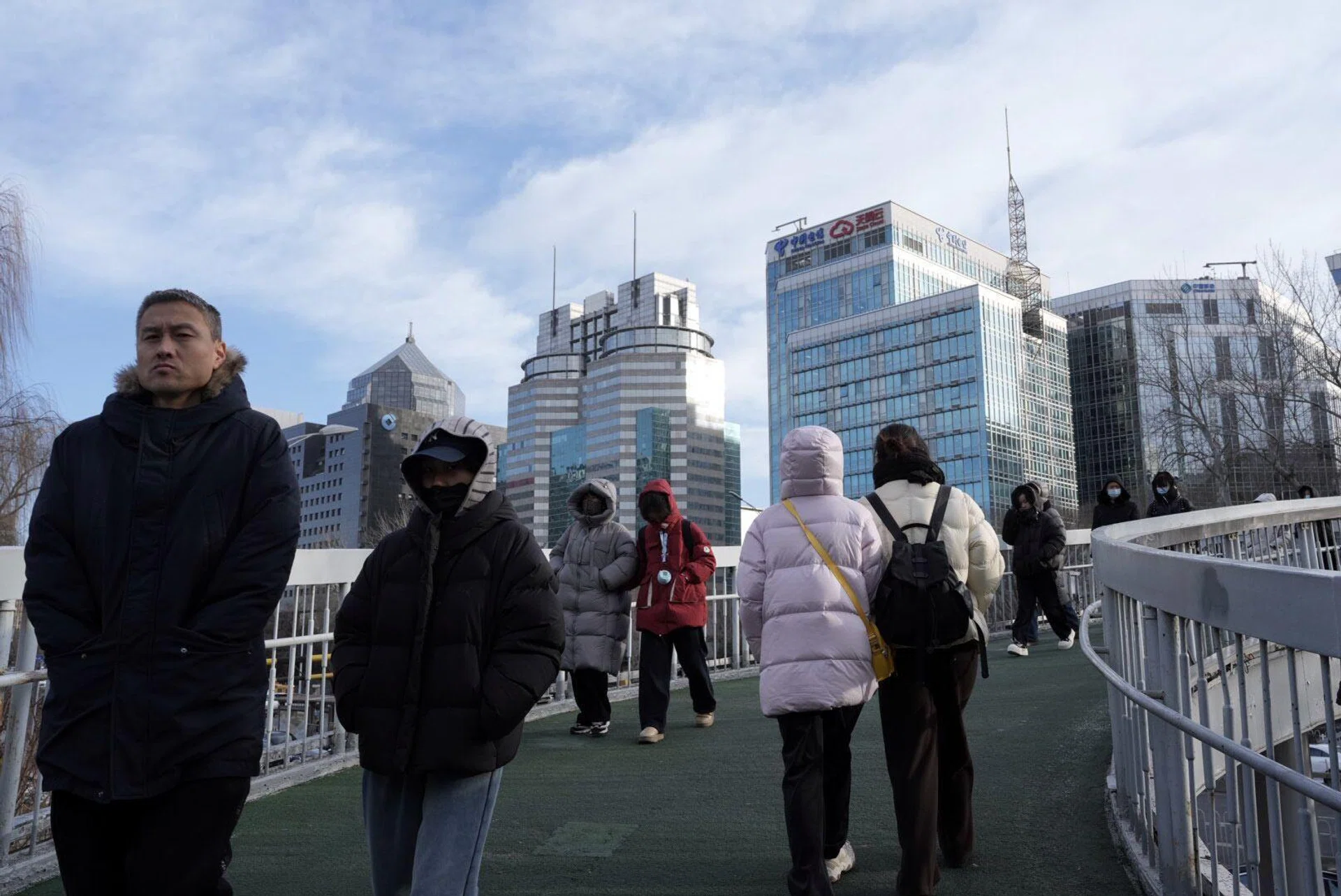
[BEIJING] China’s economy stumbled into the new year, bolstering the case for Beijing to ramp up policy support in coming weeks – as strong exports failed to offset weak domestic demand.
Official purchasing managers’ indices (PMIs) released over the weekend suggested an unexpected and broad slowdown in January, with activity in the non-manufacturing sector contracting at the worst pace since late 2022.
While a private gauge published on Monday (Feb 2) showed a more encouraging sign for export-oriented manufacturers in February, the data reflects a lopsided economy that is at risk of losing steam due to weak domestic demand.
“The message from the business survey calls for urgent policy support to stabilise sentiment and activity,” said Chang Shu and David Qu of Bloomberg Economics.
They identified late February as the first plausible window for a policy rate cut.
China experienced weakening momentum in the economy in recent months, with few signs of policymakers intending to unleash major stimulus, as they continued to battle risks tied to local government debt.
Navigate Asia in
a new global order
Get the insights delivered to your inbox.
Beijing may even reduce the national goal for the economy for the first time in four years, and President Xi Jinping has already signalled a greater tolerance for slower growth in some regions.
The weakness in China contrasted with expanding manufacturing activity elsewhere in Asia.
The PMIs for trade bellwether economies such as Taiwan and South Korea jumped to 51.7 and 51.2 respectively, with robust demand for artificial intelligence-related technology, semiconductors and cars boosting new exports.
Possibility of earlier easing
The data may result in a reduction in reserve requirements in the first quarter – likely so as to free more cash for banks to lend – as consumption remains sluggish, and exports are expected to slow after a record trade surplus in 2025.
A majority of economists expected the People’s Bank of China to cut the reserve requirement ratio in the first quarter, a Bloomberg survey showed in January. They also projected a reduction to the main policy rate in the final quarter of the year.
“The soft PMI adds to the possibility of earlier easing,” said Lynn Song, chief economist for Greater China at ING Bank.
He noted that while it will not be the only factor, it increases the likelihood of more stimulus measures to be announced after an annual parliamentary meeting in early March.
Insufficient underlying demand
The economy’s rocky start was notably reflected in the official sub-indices for demand. New orders tumbled to 49.2, below the 50 threshold for expansion, while export orders declined deeper into contraction at 47.8.
The sub-index for production expectations fell by 2.9 percentage points, the largest one-month drop in more than four years, highlighting businesses’ lack of confidence.
While Beijing has attempted to jump-start consumption with 62.5 billion yuan (S$11.4 billion) in subsidies, they have shown little impact. The PMI for consumer goods eased to 48.3 from 50.4.
“The significant miss in both manufacturing and non-manufacturing PMIs suggests insufficient underlying demand,” said Lu Ting, investment bank Nomura’s chief China economist. “Consumption is facing clear headwinds from the scaled-back trade-in stimulus programme this year.”
A key paradox remains the divergence between export strength and factory health. While high-tech manufacturing stayed in expansion at 52, the broader manufacturing sector is being weighed down by a persistent investment slump.
The gap between the official manufacturing PMI and the private RatingDog survey, which hit 50.3, highlights this divide.
RatingDog’s sample is more skewed towards coastal, export-oriented private companies, producing results that have mostly been stronger than those from the official poll in recent months.
“The key for China is to boost domestic demand. A revival of the housing market is badly needed,” said Raymond Yeung, chief economist for Greater China at ANZ Bank.
The official construction PMI declined from 52.8 to 48.8, its lowest level on record outside the pandemic.
Price indicators provided a rare silver lining, as both input and output prices rose slightly on higher commodity costs. It suggests that an official “anti-involution” campaign aimed at stopping cut-throat price wars has had some effect, which may improve corporate margins.
Zhi Xiaojia, chief China economist of Credit Agricole Corporate and Investment Bank, said policymakers will need further data before making a move – but more measures in the coming months are likely.
“It’s necessary for China to further step up policy easing in 2026 if China would like to keep its gross domestic product growth at a decent pace,” she said. BLOOMBERG
Decoding Asia newsletter: your guide to navigating Asia in a new global order. Sign up here to get Decoding Asia newsletter. Delivered to your inbox. Free.