
Remember me








Updated February 4, 2026 — 2:51pm,first published 12:06pm
SaveYou have reached your maximum number of saved items.
Remove items from your saved list to add more.
Save this article for later
Add articles to your saved list and come back to them anytime.
Got itAAA
More than 100,000 native fish have died at Lake Menindee in western NSW after last week’s heatwave, the first big fish kill on the lake since 2023.
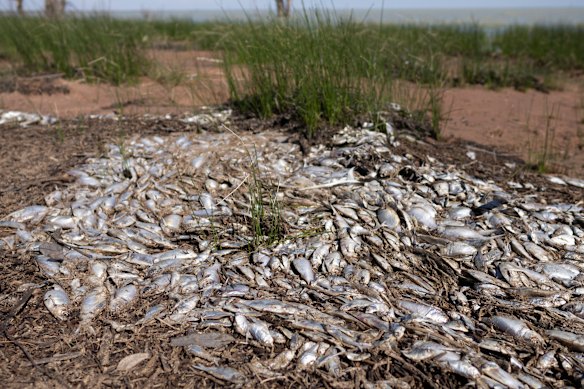
Luke Driscoll, chief executive of Barkandji Native Title Group Aboriginal Corporation, said at least 100,000 bony bream had washed up dead on the banks of Lake Menindee, near homes on Sunset Strip. He expected many more fish would have died and sunk to the bottom of the lake.
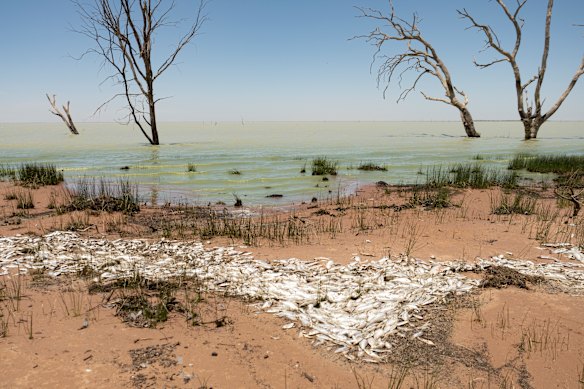 About 100,000 native freshwater bony bream washed up along the shores of Lake Menindee this week.Dan Schulz
“It’s a really bad smell for those that live in [the town of] Sunset Strip,” Driscoll said. “Even from Menindee caravan park, a good three kilometres from Sunset as the crow flies, it smells pretty bad.”
Menindee is one of nine lakes that make up the Menindee Lakes, south-east of Broken Hill.
The Menindee Lakes and the Darling-Baaka River were the sites of mass fish kills in 2019 and 2023, with tens of millions of fish dying because they were unable to escape overly shallow, warm water.
The Barkandji rangers were on high alert throughout the heatwave last week after finding dead fish in the Darling-Baaka River, downstream from the lake. Over four days last week they found 400 to 500 dead fish, mostly introduced carp, Driscoll said, but by the weekend the crisis seemed to have passed.
“I thought we dodged the bullet,” he said. On Saturday morning there were no dead fish at the boat ramp at Sunset Strip, but over the weekend the situation changed dramatically.
Driscoll said the native, freshwater bony bream could not cope with the sudden change in temperature. After an extreme heatwave all week, there was a storm and sudden cool change on Saturday night.
In Broken Hill, where Driscoll was, it was 40 degrees at 8.30pm on Saturday, then it dropped to 22 degrees in less than an hour.
Professor Fran Sheldon, a Wentworth Group member and head of school for environment and science at Griffith University, said bony bream were particularly susceptible to heat, but the big reason behind mass fish kills was lack of oxygen.
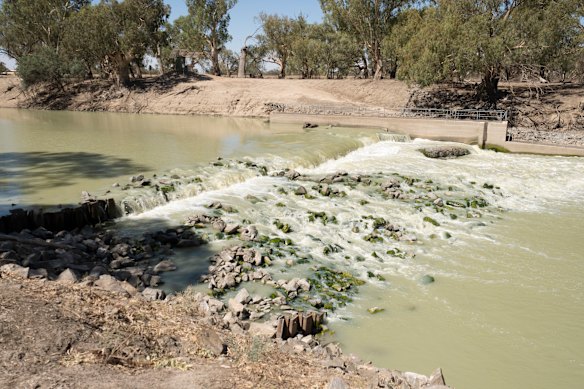 The main stretch of the Baaka-Darling River at Weir 32, downstream of Lake Menindee. Dan Schulz
“There’s been relatively good flows in the Lower Darling and out into [the] Menindee Lakes over the past few years, so the fish have bred up,” Sheldon said.
“They’ve got bigger numbers, and as the river dries down – and it’s drying because inflows have decreased – the fish just get concentrated back down into those smaller volumes of water, and you end up with too many fish for what the water body can hold.”
Water NSW also issued a red alert for blue-green algae in Lake Menindee in January, based on satellite imagery and later confirmed by water testing. Sheldon said the algal bloom would suck the oxygen out of the water at night, further stressing the fish.
Related Article
Sheldon, who sat on a government inquiry about the 2019 fish kill, said the Commonwealth water holder had been sending more environmental flows into the lakes and river in the past few years, but it was unclear whether it was enough to keep the river healthy during a prolonged dry spell.
Driscoll said the Menindee rangers were working with the local council and government agencies to clean up around the lake shore, and he also had rangers from Wilcannia and Wentworth on standby.
A spokesperson for the NSW Environment Protection Authority said it was supporting the clean-up and expected it could bring in a specialist clean-up contractor to begin work on Thursday.
Once the immediate clean-up work was done, the rangers would go out in a boat to test the water quality, Driscoll said.
“The river and lakes have been sick for a long time, and we’ve been seeing the effects of it over the last eight years,” Driscoll said.
“It’s sad because the rivers and the lakes are big part of Barkandji cultural history. Barkandji means ‘people of the river’, and it’s their mother, it’s their lifeblood, so seeing their fish die – and bony bream is a totemic species – really hurts those that live in the community and the whole Barkandji nation.”
 “The river and lakes have been sick for a long time, and we’ve been seeing the effects,” said Luke Driscoll, chief executive of Barkandji Native Title Group Aboriginal Corporation.Dan Schulz
Fish kills most commonly occur in lakes and rivers during heatwaves or droughts, but they can also occur in the ocean, especially in aquaculture settings. More than four million salmon died in Tasmanian fish farms in 2025, based on mandatory reporting to the state’s EPA, as a marine heatwave stressed the fish and made them more susceptible to disease.
Mass kills of wild fish are less common in the ocean because the fish are less crowded, but in January 2025 about 30,000 dead fish, including mackerel, bream, emperor, cod, wrasse, and pufferfish, washed up on the Pilbara coast in Western Australia after a prolonged marine heatwave.
More recently, in March 2025 in Ballina, hundreds of thousands of fish, including bream, flathead, and whiting, died after the flooding from ex-Tropical Cyclone Alfred.
Get to the heart of what’s happening with climate change and the environment. Sign up for our fortnightly Environment newsletter.
SaveYou have reached your maximum number of saved items.
Remove items from your saved list to add more.
 Caitlin Fitzsimmons is the environment and climate reporter for The Sydney Morning Herald. She was previously the social affairs reporter and the Money editor.Connect via email.From our partners