
Remember me






Updated February 4, 2026 — 1:31pm,first published January 30, 2026 — 1:04pm
SaveYou have reached your maximum number of saved items.
Remove items from your saved list to add more.
Save this article for later
Add articles to your saved list and come back to them anytime.
Got itAAA
Key pointsOPERA: Victorian Opera puts on a joyous staging of The Pirates of Penzance MUSIC: Nick Cave and the Bad Seeds perform at Alexandra GardensDANCE: Garabari at Midsumma is enjoyable – and participating is non-negotiableJAZZ: The Necks deliver a five-star performance at Melbourne Recital CentreTHEATRE: The Placeholder at fortyfivedownstairs wades into thorny territoryOPERA
The Pirates of Penzance ★★★★
Victorian Opera, Palais Theatre, until February 6
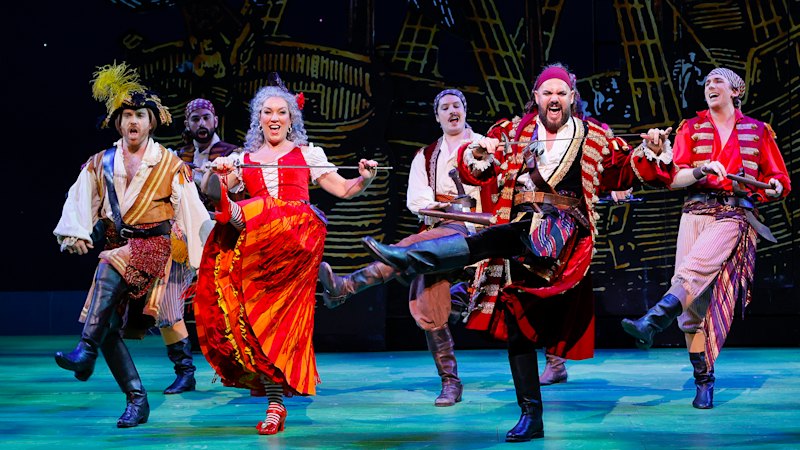
If The Pirates of Penzance proves one point, it’s that silliness is timeless. Raucously popular for almost 150 years, a good Pirates is still a guaranteed money-spinner. This staging, originally by Opera Australia, has been met with laughter and acclaim wherever she sails. Victorian Opera is now at the helm, but audience reaction will be no different.
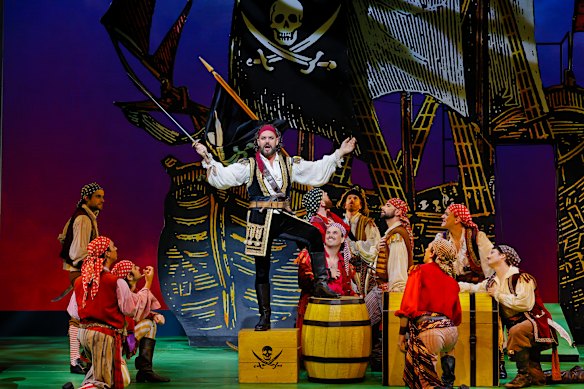 Ben Mingay as The Pirate King.Jeff Busby
With comedic plots of clever rhymes sung at rapid-fire pace to catchy melodies, Gilbert & Sullivan is a style unto itself. Pirates is the most joyous piece in the G&S canon, with innumerable proliferations across popular culture, including perhaps the most parodied song in the English language, I Am the Very Model of a Modern Major-General.
VO artistic director Stuart Maunder has fashioned this production with a lifetime’s worth of devoted insight. There’s thought behind the tiniest details; he has squeezed as much funny out as is possible.
Ben Mingay’s much-lauded Pirate King is charismatic and wonderfully riotous, always scene-stealing. He gels naturally with Nicholas Jones, a VCA graduate turned Paris Opera principal artist, as Frederic. Jones deploys his full bag of tricks for this role: effortless operatic tenor, impeccable comedic timing, notably un-wussy sword fighting, even some ballet.
Opposite him are emerging and seasoned opera darlings (respectively) Nina Korbe and Antoinette Halloran. Korbe’s coloratura hits every mark perfectly, and while Halloran’s cockney Ruth might conjure up her recent turn as Mrs Lovett, she’s reliably excellent, as is tenor Douglas Kelly as the pirate Samuel.
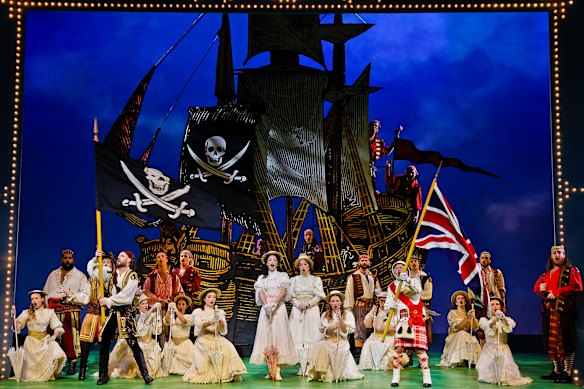 This is just about the best version of Pirates of Penzance you can see. Jeff Busby
Stage stalwart Richard Piper (Major-General Stanley) appears more at home with comedy than music. He somehow, on opening night, managed to get ahead of the orchestra during his famous number, though he still landed the laughs. Conductor James Pratt does an otherwise superb job of keeping everyone and everything together, bringing requisite buoyancy to Orchestra Victoria’s playing of the score.
One omission sorely missed is surtitles. Though sung in English, diction in the chorus numbers tended towards unintelligibility. Any real pitfalls are those present in the work itself (and some are very dated). With that in mind, is this production just about the best version of Pirates that you could see? Aye aye!
Reviewed by Bridget Davies
MUSIC
Nick Cave and the Bad Seeds ★★★★★
Alexandra Gardens, January 30
Across his decades-long career, Nick Cave’s work has always courted darkness: his lyrics reverberate with images of biblical violence, with the ache of loneliness and grief, with the kind of love that goes hand in hand with death. Yet equally, he is attuned to beauty and salvation; to the distant, longed-for possibility of redemption. It is in the tension between these two impulses, never quite reconciled, that the strength of his artistry lies.
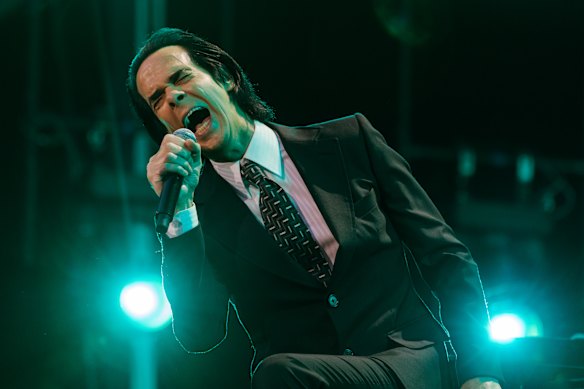 Nick Cave and The Bad Seeds at Alexandra Gardens on Friday.Richard Clifford
This artistry was on full display at Melbourne’s Alexandra Gardens, where an electrifying 2½-hour set somehow didn’t seem long enough.
It’s been nine years since Cave last toured with the full complement of the Bad Seeds, and the band seems determined to make up for lost time. Every person on stage comes to the performance with absolute conviction: from Warren Ellis working his unruly magic with the violin, to the gorgeous textures of the gospel-inflected backing choir, and the magnetic, visceral energy of Cave himself.
“It seems like we’ve been on a great odyssey across this country to get to Melbourne,” he says, to roars of approval. This is a show for the home crowd.
The set deftly balances work from the band’s 2024 album, Wild God, with cherry-picked tracks from its extensive back catalogue. An early highlight is a searching performance of O Children from the 2004 album, Abattoir Blues/The Lyre of Orpheus, while Cave’s darker impulses are on full display in the seductively menacing groove of Red Right Hand and the apocalyptic bombast of The Mercy Seat.
 Nick Cave’s artistry was on full display at Melbourne’s Alexandra Gardens, where an electrifying 2½-hour set somehow doesn’t seem long enoughRichard Clifford
While the show contains its moments of pain, rage and despair, these days, joy is perhaps Cave’s primary register. It’s there in the naive lyrics of Frogs, in his open-hearted tribute to former bandmate and collaborator Anita Lane in O Wow O Wow (How Wonderful She Is), and most defiantly in Joy, in which Cave conjures up a ghostly child visitor with a message of hope amid the tragedy of the everyday: “We’ve all had too much sorrow, now is the time for joy.”
A generous, six-song encore showcases some of the band’s best work: from an elemental rendition of The Weeping Song to a sensitive cover of Young Charlatans’ Shiver (perhaps the world’s most accomplished love song ever to have been written by a 16-year-old). A luminous performance of Into My Arms brings the evening to a close: tender, plainspoken, the darkness tempered always by light.
Reviewed by Nadia Bailey
DANCE
MIDSUMMA | Garabari ★★★
Meat Market, North Melbourne, until January 31
Garabari is billed as a participatory event, so there’s no excuse for not playing along. Forewarned is fair warning: you’ve bought a ticket, so you’ve got to help out. It’s not going to work if you don’t bring your dancing shoes.
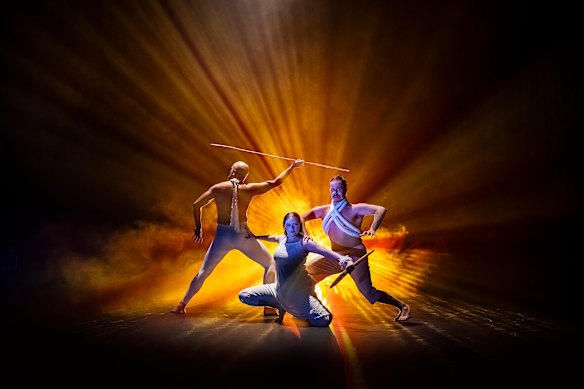 Garabari at Midsumma Festival fits the community mood and travels well.Courtesy of Sydney Festival
Yes, at first, it’s awkward. People meander through the large, dark space, drifting aimlessly and smiling apologetically. The soundscape is a disconcerting mix of creakings and scrapings. We’re warming up to the room and to each other.
Of course, it’s all part of a larger narrative. We’re already inside a re-visioning of the story of the Murrumbidgee River’s creation. This first part is a time of drought, we’re told, a time of dust and heat and general suffering.
The performers circulate through the crowd and little dances begin to appear: fragmentary routines for two or three or four. Crowds gather and disperse. It’s as if something is bubbling away, building up. Eventually, there’s a short but effective narrative dance showing the liberation of the waters by the youngest and bravest of the goanna women. Huge shadows loom against a curtain as the earth cracks open and land is quenched.
After that, the party begins in earnest. Everyone has to dance. The performers keep it moving, calling people in, co-ordinating mass choreography, whooping and hollering and carrying on. It’s diverting – even if it feels a little forced.
It almost recalls the compulsory jollity of cruise ship entertainment or theatre for children, with the performers policing participation, albeit with endless grinning and an ultimately tolerant attitude to refusal.
As a celebration of the stories and rituals from the Wiradjuri community around Wagga Wagga and the Riverina, where the show was developed, Garabari is enjoyable, for all its goofiness and happy-clappy enthusiasm. It’s a fun homage to the institution of corroboree.
Whether it becomes anything like a true rite of passage, leaving participants altered, is another question. That’s a tall order for such a brief performance – little over an hour. But at Midsumma Festival, it fits the community mood and travels well.
Reviewed by Andrew Fuhrmann
JAZZ
The Necks ★★★★★
Melbourne Recital Centre, January 29
At first glance, the three members of The Necks are mere musicians. But Chris Abrahams, Lloyd Swanton and Tony Buck are also magicians. How else to explain the way they pull invisible threads of sound from the ether and fashion them – instinctively, intuitively and moment-by-moment – into perfectly formed musical tales?
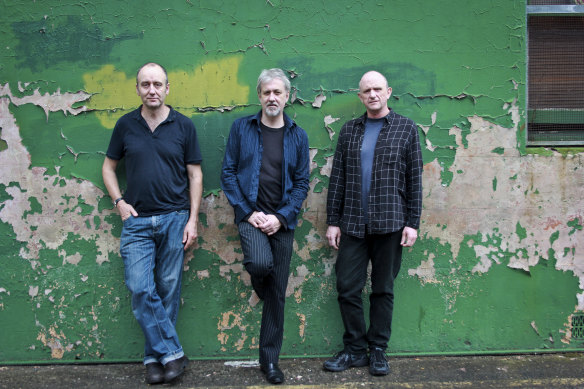 The Necks - Lloyd Swanton, Tony Buck and Chris Abrahams.Camille Walsh Photography
 Now in their 39th year together, the trio has developed the kind of creative communion that makes each fully improvised journey feel both thrillingly unpredictable and somehow inevitable.
Thursday night marked the start of the band’s annual Australian tour, and an air of hushed anticipation greeted the trio’s arrival on stage. Sparsely lit and heads bowed, they waited in silence. When Swanton began plucking his bass – slowly, deliberately – it felt more like a prayer than a series of notes. Buck’s touch on cymbals was equally spare and reverential, as was Abrahams’ glistening piano.
Infinitesimal variations in tone and texture were explored, drawing us deep into this meditative realm as the mood gradually darkened.
Related Article
Swanton’s bass morphed into an insistent buzz, its vibrations merging with Abrahams’ open-pedal piano clusters and Buck’s briskly whisked cymbals. Tranquility gave way to tension, the blood-red stage lights echoing the sense of high drama that was as menacing as it was enthralling.
The second set opened in a pool of limpid beauty: exquisitely lyrical piano motifs, reverberant bass and lightly padding toms. Serene, drifting, lovely. Again, the music beckoned and disarmed us, luring us in as the restful sway turned into a more full-bodied swell and then a churning sea.
This time, the roiling waves seemed majestic rather than forbidding. Perhaps by now we’d surrendered – no longer caught in the current but letting ourselves be swept along by it, just as the musicians were. Buck’s torso rocked back and forth, embodying the restless energy that coursed through the music. Agitation and abstraction; hallucinatory spirals of sound; and then, as if by magic, the waves subsided and we found ourselves gently carried back to shore.
Reviewed by Jessica Nicholas
THEATRE
The Placeholder ★★★
fortyfivedownstairs, until February 8
The shared experience of grief has culminated in many an incisive theatre piece centred on chosen families navigating existential questions of loss, friendship and mortality – Domenica Feraud’s off-Broadway play Someone Spectacular and, closer to home, Ash Flanders’ Malthouse production This Is Living among them.
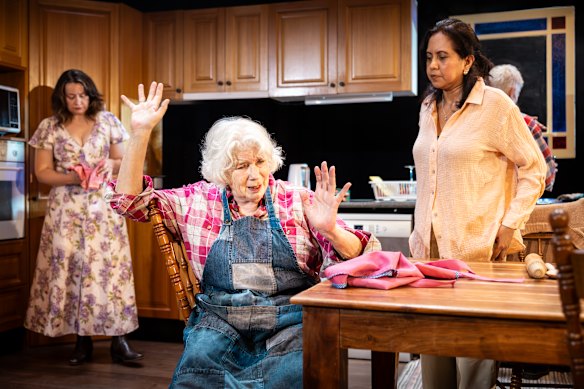 The kitchen of matriarch Pat (Meredith Rogers, centre) becomes the focal point of The Placeholder.Darren Gill
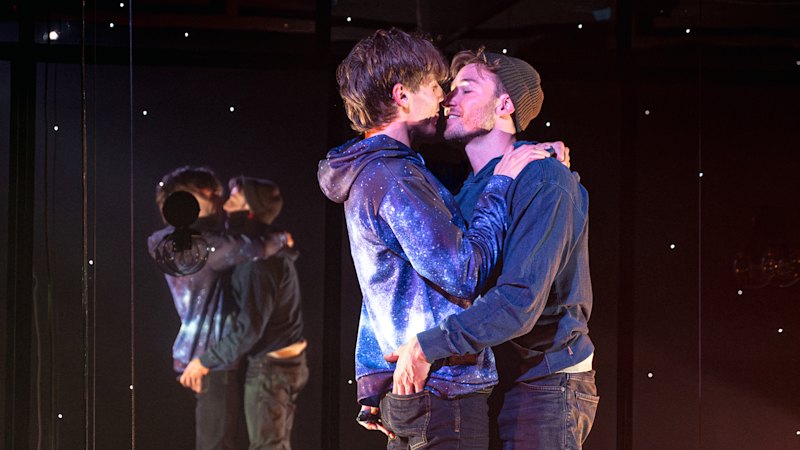
Ben MacEllen’s The Placeholder is the latest play to wade into thorny territory. We’re plunged headfirst into 2017, notably the year queer communities were subjected to a postal survey on marriage equality. It’s a devastating time, illustrated by clips of real-life interviews and news segments showcasing the bigotry that was allowed to flourish.
United by virtue of Barb’s Bosom Buddies – a fundraising collective dedicated to honouring the memory of namesake Barb, who died of breast cancer – five disparate people in the fictional rural town of South Bend find themselves meeting monthly to brainstorm badges, banners, cookies and muffins.
Related Article
Matriarch Pat (Meredith Rogers) is a soft-spoken retiree whose kitchen becomes the focal point of the play, brilliantly materialised by Bethany J. Fellows’ set design. Helen (Michelle Perera) is a widow with a heart of gold and a penchant for baking. A proud lesbian, Keira (Rebecca Bower) self-medicates with alcohol to withstand living in a cloistered town. Barb’s niece Jo (Brigid Gallacher) is the conservative black sheep of the group. And sporty Nic (Oliver Ayres) used to go by Nicole, until they announce they’re transitioning into a man.
The reprisal is swift. The elder members of the group, Pat and Helen, paradoxically take it in their stride, but Keira is incensed by the perceived loss of a lesbian peer, and Jo insists it’s all just a phase. The remainder of the play details the fallout of Nic continuously insisting on his personhood against bad-faith arguments and a gulf of miscomprehensions.
As the kindest, most level-headed character, Helen is who most audiences will project themselves onto. But Perera, so brilliant in This Is Living, is also the strongest of the ensemble. Her comedic timing is impeccable as she expertly oscillates between empathetic displays of allyship and perfectly executed moments of humour that imbue the play with levity at key junctures.
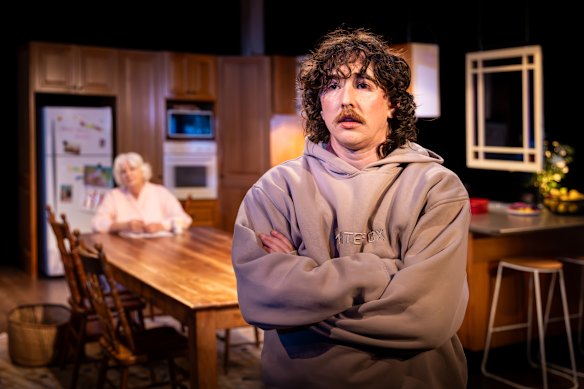 Pat (Meredith Rogers) and Nic (Oliver Ayres) in The Placeholder.Darren Gill
Functioning like a time capsule by virtue of being set nearly a decade in the past, The Placeholder provides a stage for various expressions of acceptance and opposition as the group muddles through supporting Nic. A cookie-cutter bigot, Jo’s views cover well-trodden, odious ground. But it’s Keira’s see-sawing between solidarity and gender essentialism and a self-victimisation that’s impervious to the marginalisation of others that’s harder to stomach – and altogether more interesting.
MacEllen presents thought-provoking contrasts between desired gender-affirming care and unwanted life-saving surgery, gender and sexuality, mental deterioration and newly prized lucidity. But at close to three hours, The Placeholder is simply too long. MacEllen’s script retreads familiar ground in the play’s second act, which drags lugubriously to its emotional climax(es).
Related Article
The tenuous connecting thread of a makeshift charity doesn’t explain why these characters are so invested in one another, and why they tolerate unconscionable behaviour – particularly from Jo. As a result, the emotional payoffs are muted, hampered further by unnatural, dialogue-heavy exposition and uneven acting during key dramatic reveals.
Much is left unresolved by close. Keira’s alcohol addiction continues to be the butt of jokes, Pat’s clear descent into dementia is unremarked upon. String-heavy interludes between scenes are peppered with a greatest hits compilation of what happened in the intervening years – good, bad, ridiculous. But the cacophony, so effective initially in illustrating the overwhelm of the marriage equality vote, overpowers the play by the end.
Reviewed by Sonia Nair
The Booklist is a weekly newsletter for book lovers from Jason Steger. Get it delivered every Friday.
SaveYou have reached your maximum number of saved items.
Remove items from your saved list to add more.
 Bridget Davies is an award-winning mezzo-soprano and journalist.
 Nadia Bailey is a writer, editor, and critic from Melbourne.
 Andrew Fuhrmann is a dance critic for The Age.
 Jessica Nicholas is an arts and music writer, specialising in contemporary jazz and world music.
 Sonia Nair is a contributor to The Age and Good Food.From our partners