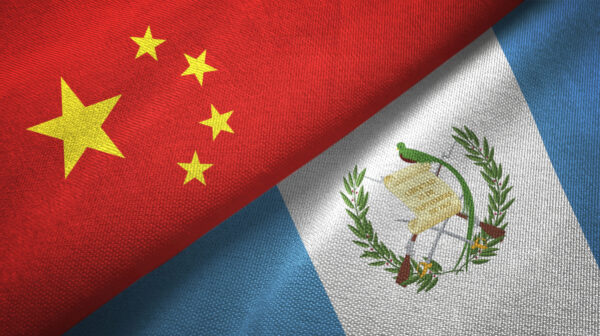
Since 2016, Beijing has steadily reduced Taipei’s diplomatic space in Central America and the Caribbean, reinforcing the perception that recognition, once granted, locks in long-term alignment with China. Now Honduras has complicated that assumption. After recognizing the People’s Republic of China (PRC) in 2023, Honduras has become the only country in the region to openly reassess its China alignment – not because of ideological reconsideration, but because structural and economic constraints have reasserted themselves.
The Honduran case highlights a recurring but underappreciated dynamic in Latin America’s engagement with China. A government might grant recognition to the PRC, but strategic alignment remains conditional as long as trade access, migration patterns, and domestic political stability are still anchored to the United States.
Beijing’s pitch to Honduras followed a familiar pattern: promises of expanded exports, infrastructure investment, and economic diversification away from traditional partners. The trade data suggest a more limited outcome. According to figures from the Central Bank of Honduras, imports from China rose sharply from approximately $2.0 billion in 2023 to $2.63 billion in 2025. Honduran exports to China increased as well, but from a very low base, rising from $12.9 million to $44.7 million. The asymmetry reinforced concerns that the relationship primarily benefited Chinese exporters rather than Honduras’ productive sectors.
At the same time, the diplomatic rupture with Taiwan produced immediate losses. Honduran exports to Taiwan fell to just $26.4 million through October 2025, a sharp decline for sectors that had relied on preferential access. Shrimp producers were among the hardest hit, turning what had been framed as a geopolitical decision into a concentrated domestic economic problem. The persistence of these sectoral losses ensured that the China decision remained politically salient rather than fading into the background.
These dynamics help explain why the issue resurfaced during the presidential campaign. President Nasry Asfura pledged to restore ties with Taiwan while attempting to preserve commercial relations with China, an approach that has proven difficult across Central America. While such pledges are often dismissed as electoral positioning, the fact that the debate has continued after the election suggests unresolved structural pressures rather than symbolic politics.
For now, China’s position appears stable. Ambassador Yu Bo attended Asfura’s inauguration, and Beijing’s official messaging reaffirmed cooperation under the One China principle.
Inside Honduras, the interpretation was more restrained. No sudden diplomatic shift was expected during the transition period, but the new administration has been reviewing agreements signed by its predecessor.
In addition, the absence of an invitation for a representative from Taiwan to attend the inauguration was seen as a procedural choice to avoid unnecessary friction while institutional control was consolidated. After all, the former’s administration ambassador, Salvador Moncada, had left his post in Beijing just one day earlier.
That Asfura still intends to restore ties with Taiwan was confirmed recently by the Honduran presidential designate (vice president), Maria Antonieta Mejia. She said that the restoration of ties with Taiwan will happen slowly, giving time for the new administration to review the agreements that the previous administration signed with the government of the People’s Republic China.
The most consequential signals in favor of Taiwan have come not from ceremonial diplomacy, but from how the Asfura administration has framed Honduras’ external vulnerabilities. In a national television interview, the new president explicitly linked foreign policy choices to exposure points that cannot be offset elsewhere: access to the U.S. market, migration policy, remittances, and employment tied to U.S.-oriented manufacturing.
Asfura pointed to the roughly 55,000 Hondurans living in the United States under Temporary Protected Status (TPS), who have been U.S. residents since Hurricane Mitch devastated Honduras in 1998. He emphasized that nearly 2 million Hondurans based in the United States send remittances to their families in Honduras, an amount equivalent to approximately 26 percent of national income, and highlighted the more than 200,000 manufacturing jobs linked directly to exports to the U.S. market. These figures outline the boundaries within which Honduran diplomacy must operate.
Trade policy reinforces this constraint. Honduras currently faces a 10 percent tariff on several exports to the U.S. and 25 percent in the automobile industry. Any friction in Honduras-U.S. ties would have immediate employment and investment consequences, dwarfing the gains promised by alternative partners.
These priorities are already being reflected in Honduran diplomacy. In mid-January, Asfura traveled to Washington and met senior officials, including Secretary of State Marco Rubio, and other important figures of the Trump administration. Shortly afterward, the United States announced plans to open discussions on reducing tariffs imposed on Honduran exports.
The economic stakes are substantial. Bilateral trade between Honduras and the United States reached $15.8 billion in 2024, an almost 5 percent increase from the previous year. Asfura met U.S. President Donald Trump on February 7, where he also requested relief from the imposed tariffs. Given that Trump specifically endorsed Asfura just three days before the presidential election, it is likely that the new president’s efforts will succeed in some form.
Within the framework of China-U.S. competition in Latin America, Taiwan functions as an indicator of compatibility. For Honduras, Taiwan’s relevance lies in its alignment with U.S. preferences rather than in historical ties.
Taipei has reiterated that it maintains an open attitude toward engagement with Honduras and would set no preconditions for dialogue, provided exchanges expand Taiwan’s international space. This position reflects an understanding that diplomatic reversals in Central America rarely occur through persuasion alone. They occur when external constraints become binding and when alignment with Washington appears less costly than alternatives.
Honduras’ experience carries broader implications for Latin America. China’s diplomatic gains remain significant, but they are not immune to reversal in countries where migration exposure, trade concentration, and financial stability are structurally linked to the United States. Regional countries may recognize the PRC, but relations with China cannot be insulated from asymmetric dependence on the United States.
For regional policymakers, the Honduran case underscores the limits of hedging strategies that assume diplomatic diversification can substitute for economic fundamentals. For Beijing, it highlights the difficulty of converting recognition into durable influence where Washington retains control over the levers that matter most. And for the United States, it illustrates how power in the hemisphere is exercised less through overt pressure than through the quiet enforcement of structural constraints.
Honduras may ultimately maintain relations with China, restore ties with Taiwan, or prolong ambiguity. But the parameters of that choice are increasingly defined not in Tegucigalpa, Beijing, or Taipei, but in Washington, and this time, they seem to be running on Taipei’s side.