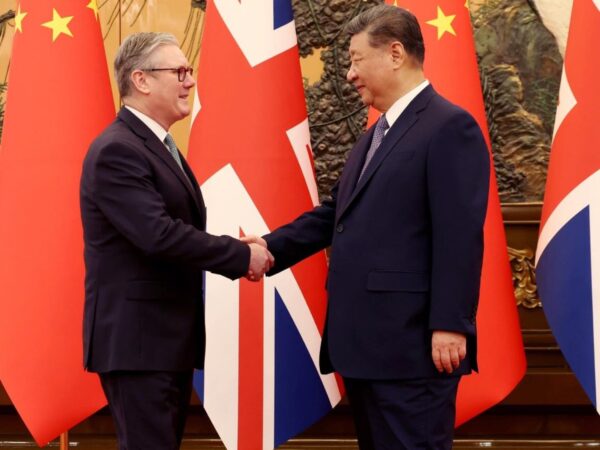
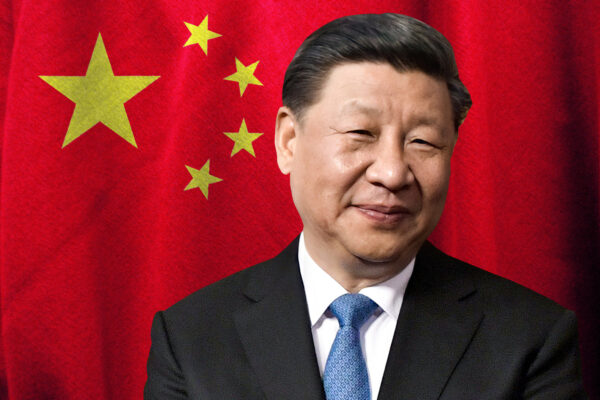
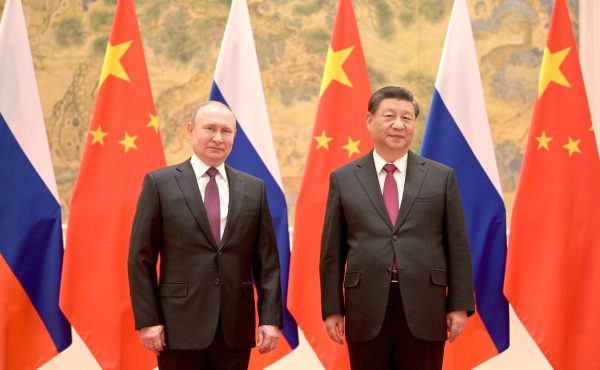
Just about two weeks before Hong Kong pro-democracy media mogul Jimmy Lai was handed a 20-year prison sentence, the harshest under the city’s National Security Law, U.K. Prime Minister Keir Starmer visited Beijing. He walked the red carpet at Beijing’s Great Hall of the People, met President Xi Jinping, and attended a lavish welcome ceremony. It was widely hailed as a “break-the-ice” visit, the first by a British prime minister in six years, aimed at normalizing relations with China.
The timing, however, spoke volumes. On the eve of Lai’s sentencing, Starmer signaled that British diplomacy was prioritizing friendship with Beijing over the fate of a British citizen, Jimmy Lai. The message was unmistakable: no matter how China treats Jimmy Lai, the normalization of China-U.K. relations will carry on.
Starmer later told reporters he had raised Lai’s case with Xi, but offered no details, leaving the public to wonder if Beijing even blinked. The answer came swiftly: Lai, 78, was sentenced to what is effectively a life term. To put it bluntly, this is almost a death sentence. Lai now faces a fate akin to Liu Xiaobo, a Nobel Peace Prize laureate, who perished in detention.
The severity of the sentence shocked observers. Compared with the 2024 trial of 47 pro-democracy activists, Lai’s 20-year term is twice as long as that handed to Benny Tai, who was accused of masterminding the 2020 primary legislative election. Editors, publishers, and editorial writers involved in Lai’s publications were regarded by the court as masterminds and handed sentences of up to 10 years, punished for simply doing their jobs as journalists.
Ironically, the imposition of such harsh sentences has unfolded against a backdrop of Western governments seeking to normalize relations with China. The reshaping of global politics under U.S. President Donald Trump has nudged allies to engage China. Over the past year, Western leaders who once condemned Beijing for human rights abuses – from France to Germany, Canada to the U.K. – have queued to shake Xi’s hand, sign trade deals, and signal goodwill.
As international pressure eases, the Chinese Communist Party has intensified its crackdown on dissent, acting with a level of impunity not seen in previous years. Beijing’s calculation is clear: if Western powers are eager to deepen economic ties, the diplomatic price of jailing dissidents has all but disappeared. .
Thirty years ago, Western policymakers commonly believed that integrating China into the global economy, with the resulting economic liberalization and international engagement, would eventually liberalize its politics. That blind optimism has been shattered. China has moved in the opposite direction, entrenching an authoritarian state that brooks no opposition.
The West’s response, however, has not been principled resistance, but a bleak realism: deal with China, no matter its brutality, because national interest demands it. Such short-term, self-interested calculations may safeguard commercial deals, but they offer little reassurance to a free world confronting the growing threat of authoritarianism. The consequences are stark for human right defenders living under the rule of the CCP.
Now Jimmy Lai and countless others in China are paying the price for a West too eager to compromise principles for profit. Their suffering is a mirror reflecting the cost of a diplomacy that prioritizes access to China’s market and money over freedom, human rights, and justice.