
Remember me

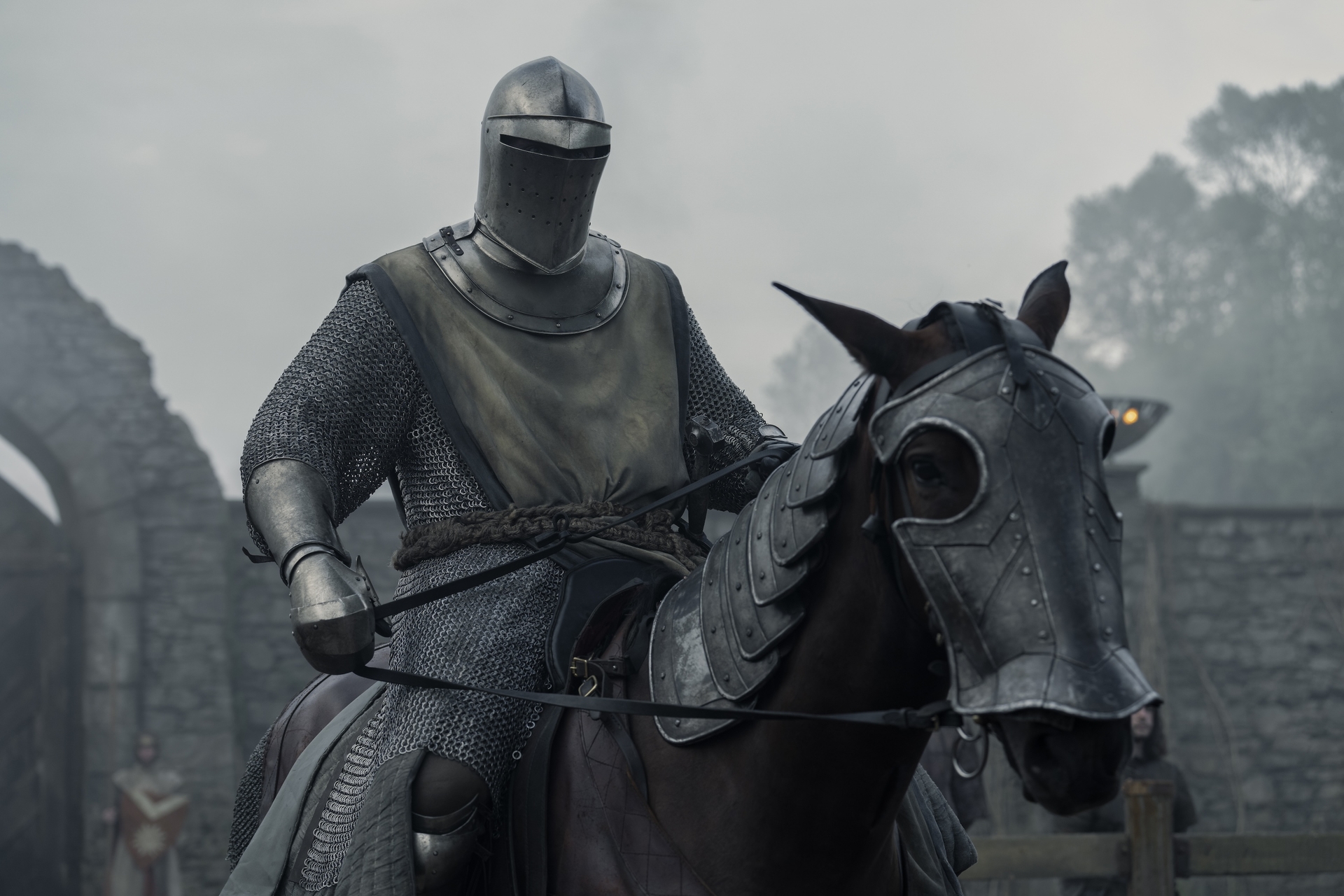
The penultimate episode of the season premiered on Sunday night and, as with the original Game of Thrones television show, it’s always that second-to-last installment that hits viewers with a shocking twist. For those who had not previously read The Hedge Knight, I can only assume that this episode fulfilled that grim promise. Let’s dive in…
The Title“In the Name of the Mother” is a direct quote of Ser Arlan’s invocation when he saves Dunk from Alester and his crony in Flea Bottom, and, as such, is also part of his chivalric vows. Martin has never actually laid out the entirety of the Seven’s anointing prayer. We know that knights are charged in the name of the Father to be just, in the name of the Warrior to be brave, in the name of the Maid to protect all women, and in the name of the Mother to protect the young and innocent. We’ve never actually heard what they are charged to do in the name of the Smith, the Crone, or the Stranger.
But that charge to protect the young and innocent is all over this episode. Ser Arlan risks life and limb to save Dunk from Alester. Dunk is in this mess because he did the same for Tanselle. Prince Baelor gives his life this episode to save Dunk from his family. It’s a part of the vow that Martin often shows his knights ignoring as an indictment of the system that made them.
It’s also fitting because the Mother (and mothers in general) are very much absent in this series. Both Game of Thrones and House of the Dragon are awash in mothers who fiercely defend their children for better or for worse—Catelyn Stark, Cersei Lannister, Alicent Hightower, and even Daenerys Targaryen, who is called mother by the freed people of Ghis and calls herself the Mother of Dragons. In the hyper-macho boys club of ‘90s epic fantasy novels, Martin’s focus on mothers was a pretty progressive change of pace at the time. And the specific focus on mothers as bastions of mercy is central to Martin’s moral compass. When mothers lack mercy, the universe is out of joint for Martin; for example, it’s central to the horror of the undead avenging angel Lady Stoneheart that she is all justice and no mercy precisely because Catelyn Stark died mistakenly believing that all her children were dead.
So here, in this series, mercy is a quality that is continually strained because all the mothers are absent. It’s a story about fathers and sons, about brothers, about comrades in arms, but the mothers are either dead, missing, or remain off-screen. Dunk wishes for his mother to return and find him even though she is probably dead. Baelor and Maekar’s mother, Queen Myriah, is never seen but she favored her eldest son and was distant from her youngest, who did not inherit her dark hair. There is even an echo of Catelyn Stark here where Rafe has her throat slit in roughly the same position as Cat does—though, in this case, the resulting fury is not her own but Dunk’s who has to watch it happen (more on that later).
So yeah, in much the same way that Twelfth Night is the rare Shakespearean comedy where controlling parents are entirely absent but still central to the plot, AKot7K is the rare Song of Ice and Fire series that features no mothers but treats that absence as a driving force.
Flashbacks Credit: Steffan Hill/HBO
The show gives us an extended flashback in this episode. It’s a welcome relief from the original show’s (nonsensical and needlessly limiting) “no flashbacks” rule (which the showrunners later broke, though never for particularly important reasons). We learn very little about Dunk’s childhood (especially his childhood before meeting Ser Arlan) in the novellas, and none of it in The Hedge Knight. In general, the flashback in this episode does not contradict anything Martin has written but expands upon it greatly.
Rafe, child-Dunk’s accomplice, is mentioned (alongside Ferret and Pudding, who are also mentioned in this episode) as three childhood friends of Dunk’s in the third A Knight of the Seven Kingdoms novella, The Mystery Knight. Rafe has no canonical gender in that book (though Rafe is typically a man’s name and it’s pretty heavily implied that the character is a boy). But the relationship portrayed on the show and Rafe’s death at the hands of the corrupt city watchman, Alester, are completely new inventions. It all works pretty well, however. A friend of mine pointed out that Rafe’s death really works as an inciting trauma for the moment in which Dunk later throws himself at Aerion so recklessly. The show filmed Aerion threatening Tanselle and Alester threatening Rafe from similar angles, with Dunk similarly held back at first. The actress playing Rafe (Chloe Lea, who has previously appeared on Foundation and Dune: Prophecy) even has similar coloring to Tanselle (Tanzyn Crawford), if not similar features, further underscoring the connection.
Flea BottomOddly enough, the Song of Ice and Fire TV shows have not explored Flea Bottom much. The crime-addled slums of King’s Landing are shown briefly during Arya’s time living on the streets during season one of the original series, and we see what may be part of it in the fourth episode of season one of House of the Dragon when Rhaenyra and Daemon have their forbidden tryst. The neighborhood features prominently throughout the entire book series and so it is a bit surprising that this may be the longest sequence set in Flea Bottom so far.
Like Tom-All-Alone’s in Dickens’ Bleak House, Flea Bottom is, to my mind, one of the great literary slums—a place that is haunted, violently and virulently, by the poverty it represents. Part of what I love about how it’s represented here is its extreme claustrophobia. That may, in part, be a result of building a smaller set, since it’s one of the few built sets in this show that is not a part of Ashford and the surrounding environs. But there’s also a very intentional lack of space here that captures the feel of Martin’s Flea Bottom better than previous depictions. An alleyway full of pigs erupts outside a winesink’s front parlor; there’s no delineation between businesses and homesteads and public streets—barely even a difference between what’s inside and outside.
The fight between Ser Arlan and Alester is rough and dirty, with Ser Arlan’s sword hitting a lantern because there isn’t enough room for a full swing. I hope that if we return to Flea Bottom on House of the Dragon that we get scenes a bit more like this, in order to drive home just how awful the place is.
The Other Side of The Mountain Credit: Steffan Hill/HBO
In HBO’s Game of Thrones (and in Martin’s A Storm of Swords), one of the most iconic and upsetting fights is the trial by combat between Oberyn Martell and Gregor Clegane, “the Mountain that Rides.” Clegane’s massive size is continually brought up as a point of horror: He’s just so big and monstrous that nothing can stop him. Even after Oberyn has poisoned him, he still finds the strength to rise and murder his opponent with his bare hands. The horror, of course, continues even beyond the horrendous violence of the duel, when the Mountain is brought back from the dead to serve as a terrifying guardian for Cersei Lannister.
This episode gives us the reverse of that dynamic here in Dunk’s knock-down, drag-out fight with Aerion. Game of Thrones taught us to dread a big man who refuses to die even when horribly injured—but here, of course, it’s a cause for celebration. There isn’t a David and Goliath component to this fight, at least in terms of the relative size of the contenders: Dunk is bigger and stronger and stubborn enough to keep going. It almost feels like it shouldn’t work, but it really does.
The fight is also great because it captures how deeply unromantic medieval combat is. Armored men fighting with melee weapons is often an endurance test that ends in death by a thousand blows. It also captures Martin’s prose rather perfectly:
“He [Aerion] could vanquish Ser Duncan the Tall, but not Dunk of Flea Bottom. The old man had taught him jousting and swordplay, but this sort of fighting he had learned earlier, in the shadowy wynds and crooked alleys behind the city’s winesinks.”
It’s brutal, and is made all the more brutal for the way it does not allow us to pretend that these combatants’ deaths come swiftly or easily. As grotesque as other deaths in the earlier A Song of Ice and Fire TV series may be, the ones in combat are often depicted as happening relatively quickly. Here we are forced to witness all the stomach-churning agony of two heavily armored men slowly killing one another. We really feel that sword blow to Aerion’s thigh (an injury added for the show) and Dunk pulling that shattered lance from his side. Add to that the complete chaos of horses riding past on all sides and lances shattering all around them and you have one of the great action scenes across all three series.
The Inevitable Martin Twist Credit: Steffan Hill/HBO
Of course, it is not Dunk or Aerion that dies in the trial, but Baelor. This might be a kinder, gentler Westeros in some regards, but it’s still Westeros, and there are no happy endings without sacrifice. Daeron the Drunkard’s prophecy comes true as a dragon—Prince Baelor—falls on Dunk, but Dunk survives and the Dragon dies instead. The scene of the prince’s death is one of the more memorably distressing ones in Martin’s books. Baelor seems fine after the combat but once his helmet is removed, his shattered skull comes away with it. It’s described more gruesomely in Martin’s text, with half the skull missing and blood and brain matter gushing forth. The scene here is quieter and more restrained but no less horrible for all that. And while Martin’s novella focuses on Baelor’s slurring speech in the buildup, here we get the Prince’s eerie calm, with Pate and Raymun realizing what’s happened as Baelor himself slowly comes to realize he’s a dead man walking.
But it’s not only a classic Martin twist in terms of its grotesque body horror or its sudden, unexpected cruelty; it works as a part of Baelor’s dedication to realpolitik as well. Baelor Targaryen was on the path to becoming one of the great kings of Westeros. He’s the steady, diplomatic, Dornish-featured war hero, beloved by the smallfolk, who might have solidified the tenuous peace in the wake of the Blackfyre Rebellion. And now the realm will never experiencewhat might have been the golden age he ushered in because of a set of tragic circumstances that only occurred because an orphan-turned-Hedge Knight stood up for his chivalric vows.
I contend that Martin doesn’t punish his characters for being moral or kind. If you look at a show like The Walking Dead, you can see a clear case being made for decency being punished as weakness. But in Martin’s worlds, the decent die both because the system is bad and because the world is not cruel but indifferent. Aerion loses his trial and withdraws his accusation. Good does actually carry the day, here. But Dunk is unfairly saddled with the legacy of having unintentionally brought about a good prince’s death, and the realm is robbed of a potentially great ruler and the peace he might have ensured because the right thing is also the hard thing.
Odds & Ends Credit: Steffan Hill/HBO
Those shots of the battle through Dunk’s visor are incredible. Just cinematographically magical.
I believe the dying knight that Dunk and Rafe chance upon in the aftermath of the battle is a Frey. The show seems to be carrying on Martin’s tradition of having the ancestors of detestable Houses be capable of nobility and vice versa.
There is a House Stokeworth knight on the Kingsroad as Dunk and Rafe return to King’s Landing. He’s carrying the corpse of what I assume is another slain Stokeworth knight back home to be buried. While this is a lonely travail and affecting image of postwar grief, it also mirrors Dunk and Rafe scavenging the battlefield—returning home with corpses in tow.
Rafe stealing Alester’s dagger in one smooth motion recalls Arya’s trick with her dagger that she uses on Brienne and eventually on the Night King. It’s a nice little cinematic lineage of using dirty tricks to subvert impossibly strong opponents.
“Alester” is entirely an invention of the show, but Martin seems to reserve the name (and its variants) for traitors of various sorts. There is Alester Florent, Stannis Baratheon’s uncle-in-law who is jailed for trying to make peace with the Lannisters, and, of course, Alliser Thorne, the master-at-arms at Castle Black who makes Jon Snow’s life miserable.
I’m not sure why they have Ser Arlan singing in Dothraki but between this, the continual slapping, the giant penis, and the half-mad charges into battle while vomiting, the show has managed to make him into a legendary, larger-than-life figure. He’s got a lot in common with Ser Robin Rhysling, another mad knight in Westeros living his best life by eschewing every social norm.
Great to have Red be the first to cheer for Dunk in the combat. This solidarity and the parallels drawn between hedge knights and sex workers earlier in the season continues, and continues to be powerful.
In Conclusion
Credit: Steffan Hill/HBO
Those shots of the battle through Dunk’s visor are incredible. Just cinematographically magical.
I believe the dying knight that Dunk and Rafe chance upon in the aftermath of the battle is a Frey. The show seems to be carrying on Martin’s tradition of having the ancestors of detestable Houses be capable of nobility and vice versa.
There is a House Stokeworth knight on the Kingsroad as Dunk and Rafe return to King’s Landing. He’s carrying the corpse of what I assume is another slain Stokeworth knight back home to be buried. While this is a lonely travail and affecting image of postwar grief, it also mirrors Dunk and Rafe scavenging the battlefield—returning home with corpses in tow.
Rafe stealing Alester’s dagger in one smooth motion recalls Arya’s trick with her dagger that she uses on Brienne and eventually on the Night King. It’s a nice little cinematic lineage of using dirty tricks to subvert impossibly strong opponents.
“Alester” is entirely an invention of the show, but Martin seems to reserve the name (and its variants) for traitors of various sorts. There is Alester Florent, Stannis Baratheon’s uncle-in-law who is jailed for trying to make peace with the Lannisters, and, of course, Alliser Thorne, the master-at-arms at Castle Black who makes Jon Snow’s life miserable.
I’m not sure why they have Ser Arlan singing in Dothraki but between this, the continual slapping, the giant penis, and the half-mad charges into battle while vomiting, the show has managed to make him into a legendary, larger-than-life figure. He’s got a lot in common with Ser Robin Rhysling, another mad knight in Westeros living his best life by eschewing every social norm.
Great to have Red be the first to cheer for Dunk in the combat. This solidarity and the parallels drawn between hedge knights and sex workers earlier in the season continues, and continues to be powerful.
In Conclusion
So what did you think? Baelor’s death is The Hedge Knight’s Red Wedding in miniature—a shocking, game-changing moment on both a personal and political level. Did you find it affecting? How did you feel about the flashback and all the new material it brought into the Knight of the Seven Kingdoms’ canon? Can you believe with everything that happens in this episode it’s barely over a half an hour? Are you excited for next week’s finale? Let me know in the comments! icon-paragraph-end
Comments (0)