
Remember me
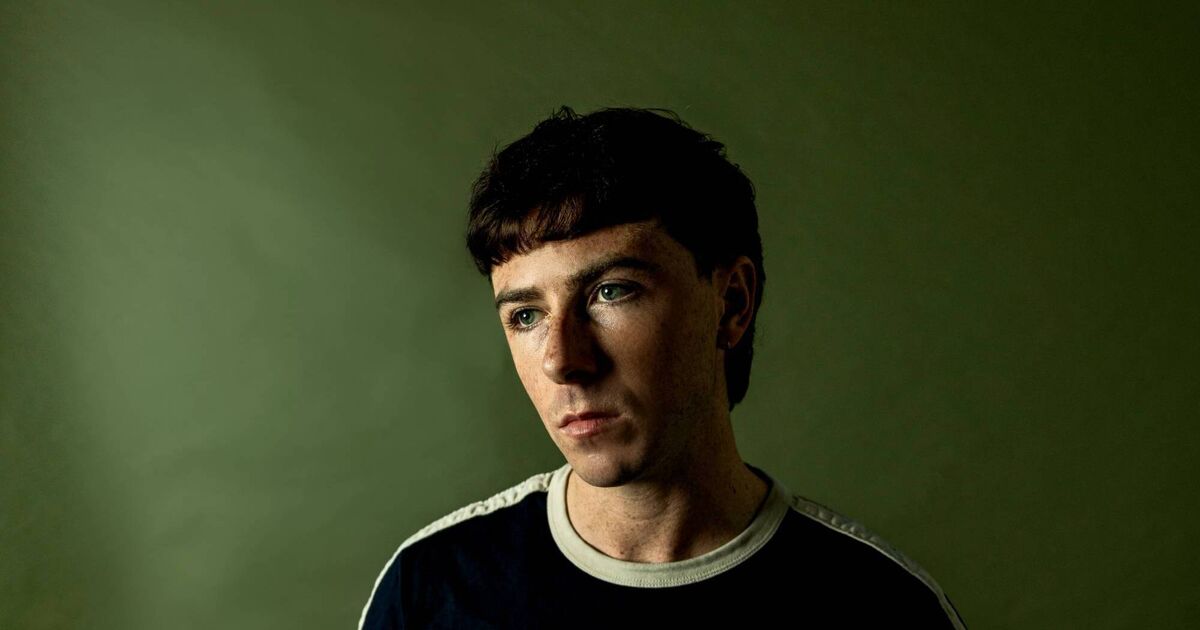
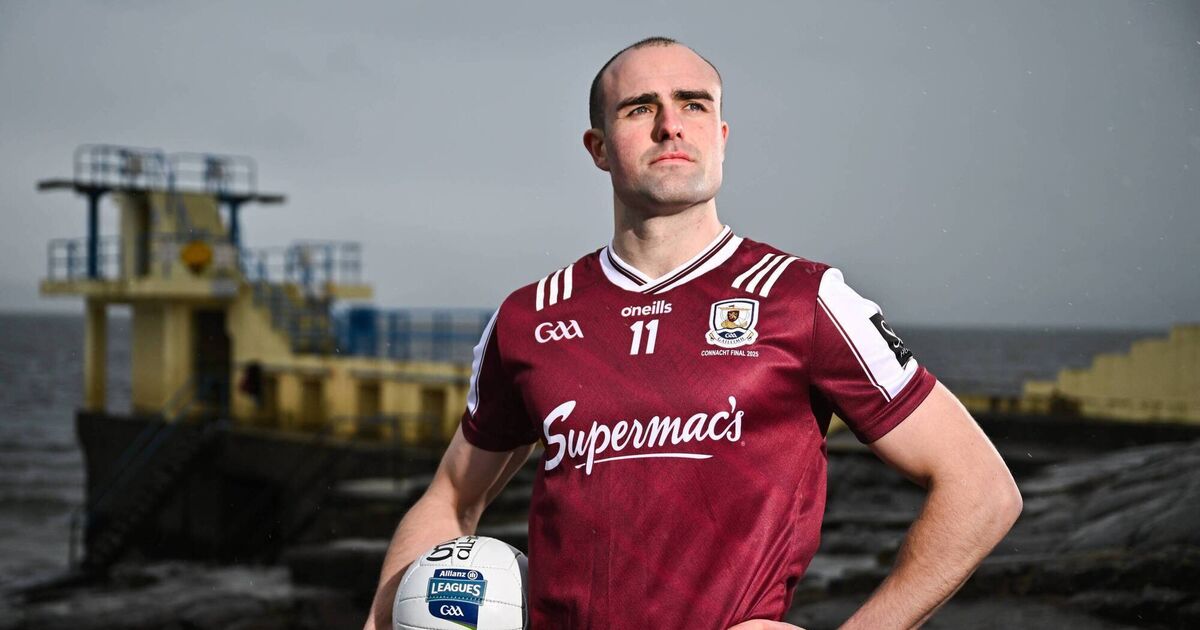
He’s moved on. Just like Cork have from him and he used to move on from whatever happened when he played for them, good or bad.
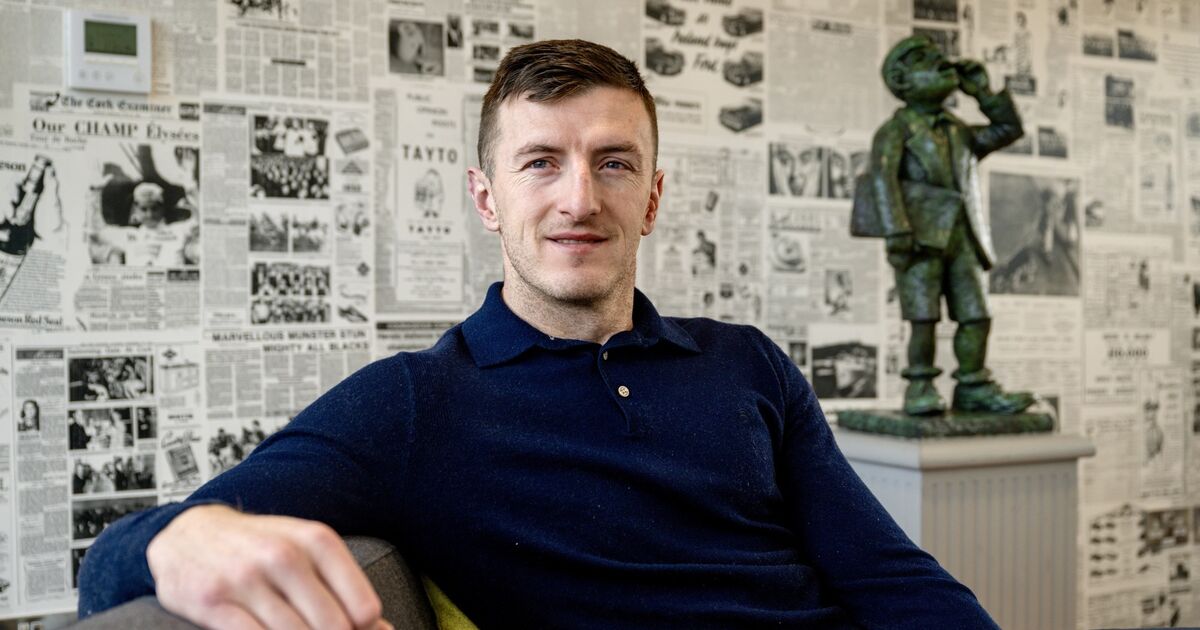
We’re meeting Patrick Horgan on a midweek morning over a coffee as the city’s Marina Market is waking up, just a few pucks – at least for him – away from the ground where he sported and played and made shake against Limerick a couple of summers ago.
Inevitably the conversation comes round to that May night and what went through his mind when Shane Kingston was hauled down by Kyle Hayes and referee Seán Stack stretched out his arms.
“The first thing I decided anyway was not to get involved in any argy-bargy,” he says. “There was a bit of pushing and shoving and complaining going on but I just took myself out of that. I just didn’t want anything to distract me from what I wanted to do.”
That was to take that penalty. An alternative never arose.
“If I’m on the field, I’m like, ‘I want it.’ I didn’t want to be anywhere else and I didn’t want anyone else to be taking it.”
That Cork’s season and Pat Ryan’s tenure was on the line only made it all the more appealing, not daunting. This is what he had practised for. That week, just like most nights in with Cork, himself and Patrick Collins would stay out after collective training and face-off against one another. “I’d take five penalties on him. Whoever got to three first, won.” That week he beat Collins, providing him with the bullet-proof confidence to then beat Nickie Quaid.
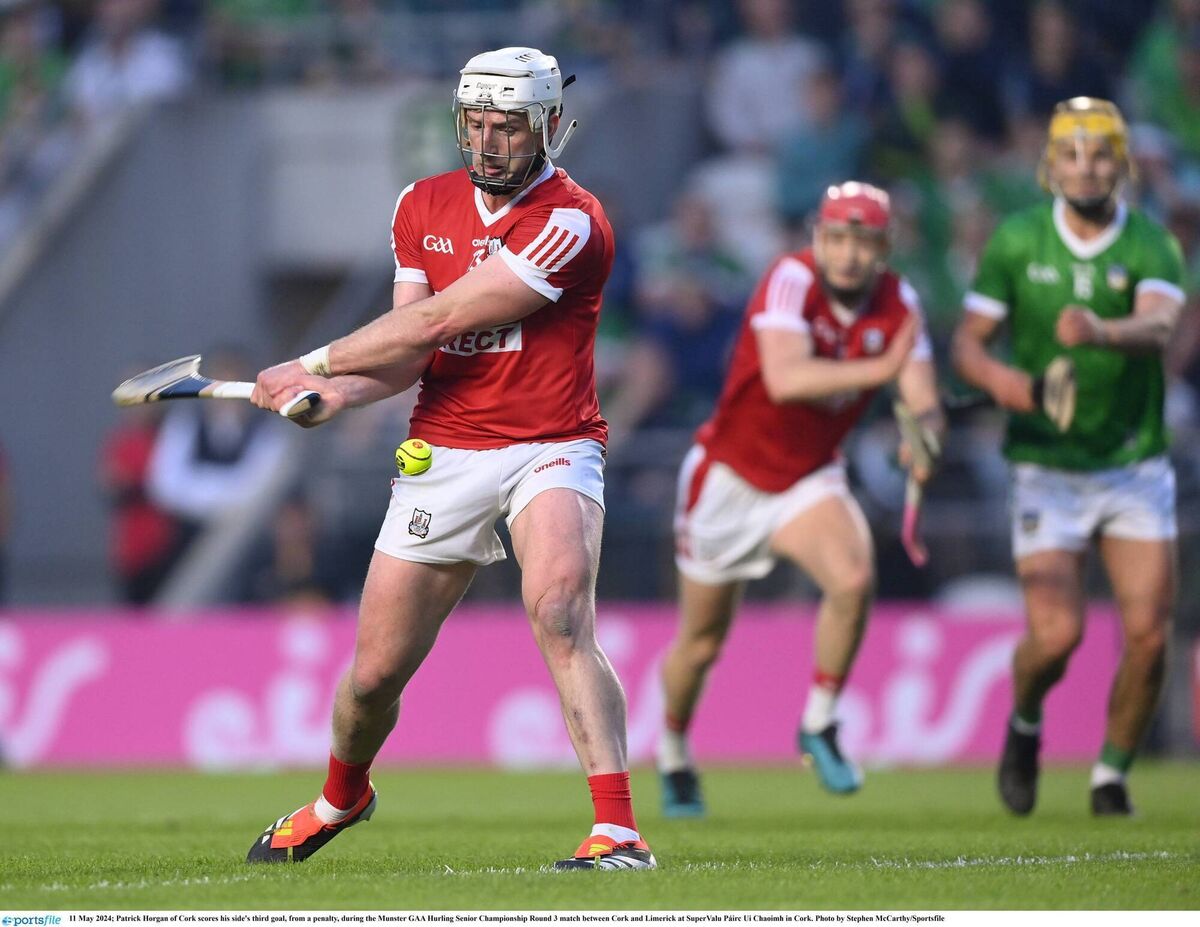 Patrick Horgan scores a crucial penalty for Cork during the 2024 Munster SHC against Limerick. Pic: Stephen McCarthy/Sportsfile
What was it like to be Patrick Horgan that night? “Well, whatever about what it was like being me, it was probably the best feeling as a group we’ve ever had, even over some of the days when we’ve won a trophy.”
Yet he didn’t go out that night. He has no memory of doing so anyway. “Even after a big game like that with a full stadium roaring, you still eventually go to your car. And then you go home. I’d be sitting in front of the telly with a cup of tea within an hour or two.” That possibly explains why he played for his county as long as he did. He wouldn’t get too high after the highs and too low after the lows. “The way I’d see it, there’s always another session, another game. Good or bad, you just move on.”
Last year’s All-Ireland final was definitely bad. For him, his team, his county.
Straight after the throw-in for the second half, Tim O’Mahony won a free that could have put Cork seven up. For a freetaker of Horgan’s standards, it was relatively straightforward, certainly compared to a dead ball over by the touchline 12 months earlier that he nailed to bring the All-Ireland final against Clare to extra time. Yet that free against Tipp went wide. Be it either causation or correlation, it marked a turning point. Tipperary went down the field and scored the next 1-5 of the game, 3-14 of its last 3-16.
Some Cork players that week headed away on sun holidays, trying to escape the cloud that had descended over the county. That Thursday Horgan and the Downey brothers, Eoin and Robert, were back training with Glen Rovers.
“It was hard, of course. Losing every year hurts for a couple of weeks and that one might have been even worse. But you just have to feel it, you know. Like, if you don’t go training that night, you’re only putting off the feeling of that first night back. So we just said we’d go.
“We do it every year. That’s the one thing about the boys. Anytime Cork aren’t training, they’re in the Glen. As long as I can remember, it’s always been that way for any Glen player that’s in with Cork.”
And now, at this remove, how does he look back on that day? How should Cork? He knows what the conventional and clichéd response to that question should be. That they need to pore over it and take the learnings from it. But to Horgan just because it seemed a catastrophe as the time doesn’t mean Cork should catastrophise it.
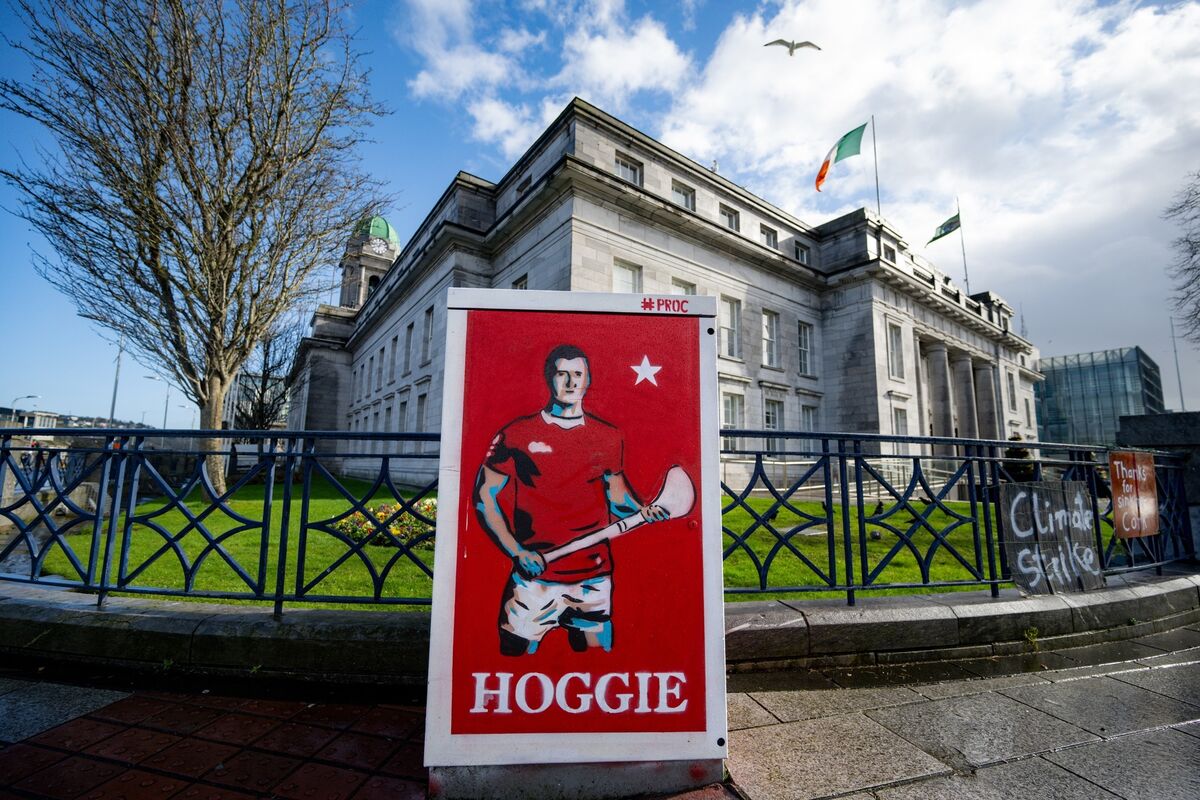 A creatively decorated homage to ex-Cork hurler Patrick Horgan stands proudly in from of the City Hall in Cork City. Pic: Chani Anderson
“There’s no learnings in it. It was just one of those things where loads of things went well for Tipp in succession. It was like one thing after the next and next. We just kept hitting the post; in one sequence of play Fitzy [Darragh Fitzgibbon] had two shots that somehow didn’t go over, while everything was working for them. They get a few scores, then a penalty and a man is sent off and the game is effectively over.
“Sometimes there’s nothing you can do about it. That’s hurling. It’s a game of runs. It happened to Tipp earlier in the year against us. We did it to them [in the league final and Munster championship]. For awhile they were well in the game and then five minutes later it was all over. The reverse happened in the All-Ireland.”
And so he’s at peace with it. With not winning that final. With not ever winning that medal. And with finishing up with a county he gave 18 years of senior service. There will not be another game or training session with them. But there will be for them. And there will be for him with the Glen. Tomás Mulcahy has been able to recruit two of Pat Ryan’s setup, S&C Ian Jones and coach Donal O’Rourke, and Horgan is enjoying extending his collaboration with them.
“I’m the fittest I’ve probably ever been. I’m still fast, still well able. But when does it stop, like? It had to stop some time. I’m not missing it. There were other things I wanted to do. I’m not saying I didn’t enjoy training, because it was probably the best part of it for me, but you know, it’d have been another hard graft for three, four, five months. Another three, four, five months of having to be somewhere at a certain time. So I said: No, that’s it.”
And so, as his way, he’s moved on. He’s just started a new job with the energy brokers firm, Procure. This Saturday night he will make his debut as an analyst with RTÉ, covering Limerick-Tipp along with Henry Shefflin. Next Saturday then he begins a regular hurling analysis column with the Irish Examiner. Will it be at all difficult talking about and possibly criticising Cork so soon after coming out of their setup? “I don’t mind it,” he says. “When I’m gone, I’m gone.”
He only needs look to Donal Óg Cusack on that score. Not only will they both be on The Sunday Game this summer but they’ve already teamed up as selectors to Noel Furlong’s Cork U20 panel. Cusack has continued to speak his mind on the air while allowing a Horgan to pick it.
“I love talking to him about hurling because he gets it. A few weeks ago he rang me at 10 o’clock at night. ‘There’s a few video clips there we should have a look at.’ It was 1.30 in the morning by the time we got off the phone! That’s what he was like and I wasn’t exactly in a rush to go. I love being involved with the 20s and heading to Castlelyons [their base].”
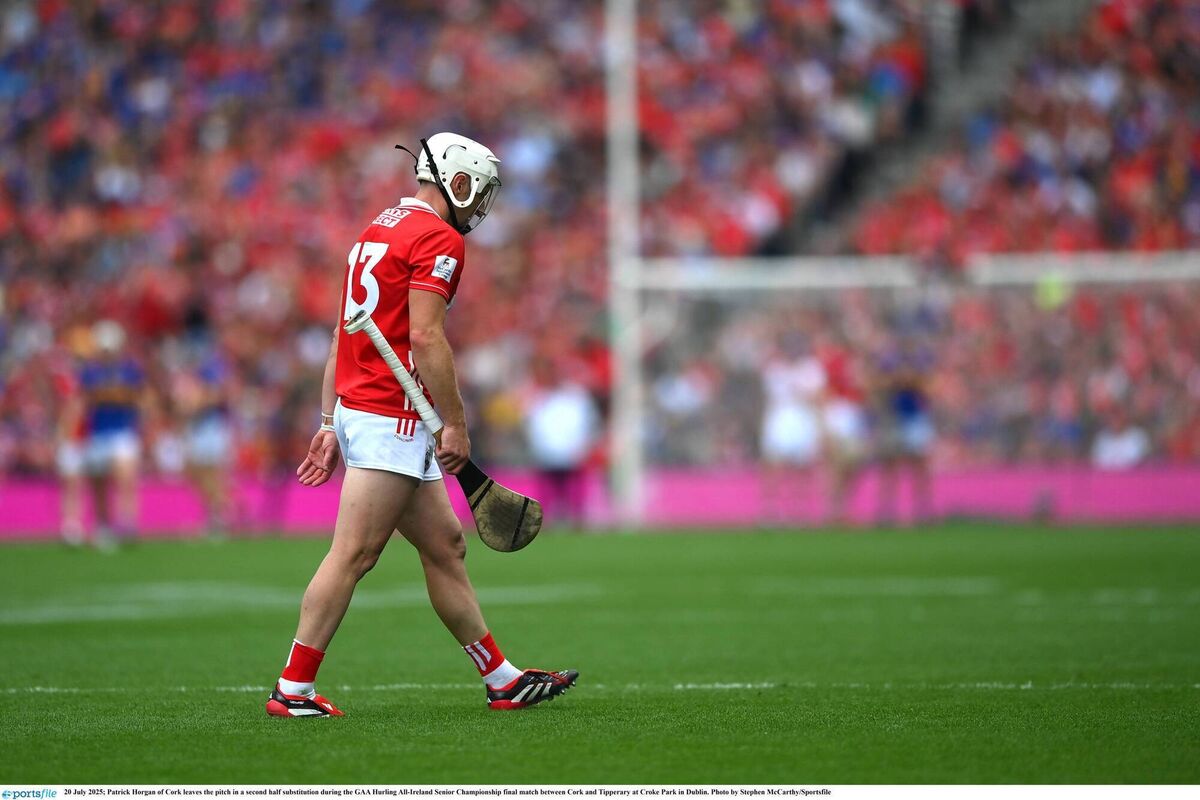 Patrick Horgan leaves the pitch during the 2025 All-Ireland final defeat to Tipperary, his final game for Cork. Pic: Stephen McCarthy/Sportsfile
What he’s trying to offer those players is what he hopes to offer Examiner readers. Insights. Nuggets. About how the best prepare and the game there is within the game. The NBA great Kobe Bryant, before his death, was contributing online pieces for ESPN called Details, breaking down the nuances of the game. Horgan wants to bring something like that to the sport that he has similarly adored and adorned. Like the hurley a player might use. How he creates separation from his marker. The cues he’s picking up from his teammate on the ball and how a Horgan would move differently to seeing a Mark Coleman in possession rather than a ball-carrier like Tim O’Mahony.
“Every county player is at home every day thinking about how can he get better in his position. And I’d like to reflect that, the thought fellas and teams are putting into the game.”
When Horgan first started out with Cork he was joining a team who prided themselves on their preparation to the point they’d fight and strike for it; they saw themselves as operating in high performance, before the term even existed in the Irish sporting lexicon. “They had brought it to levels that hadn’t seen up to then,” says Horgan. “But if you compare that to what the lads are doing now, it’s night and day.”
The old Cork teams would reassemble the Tuesday after a game. This squad meet up on the Monday: recovery, gym, video, then hit the field on the Tuesday. If training is at seven o’clock that night, almost all the players will be there by five. Horgan will be credited with helping establish that extras culture, much like Eric Cantona is lauded as cultivating one at Manchester United, but Horgan himself will point out that while he might have been the last to leave he wasn’t always the first to arrive.
“Luke Meade would be there before me, even.” They wouldn’t loiter either. “You’d go straight in, get the ankle strapped, put on your pants and jumper to stay warm and out with the bands. Then you’d go out onto the field, taking shots, the maybe after awhile get someone to strike it into you or get a defender on you, nothing too intense or hectic, but to make it more game-like and feel and work out what to do next.”
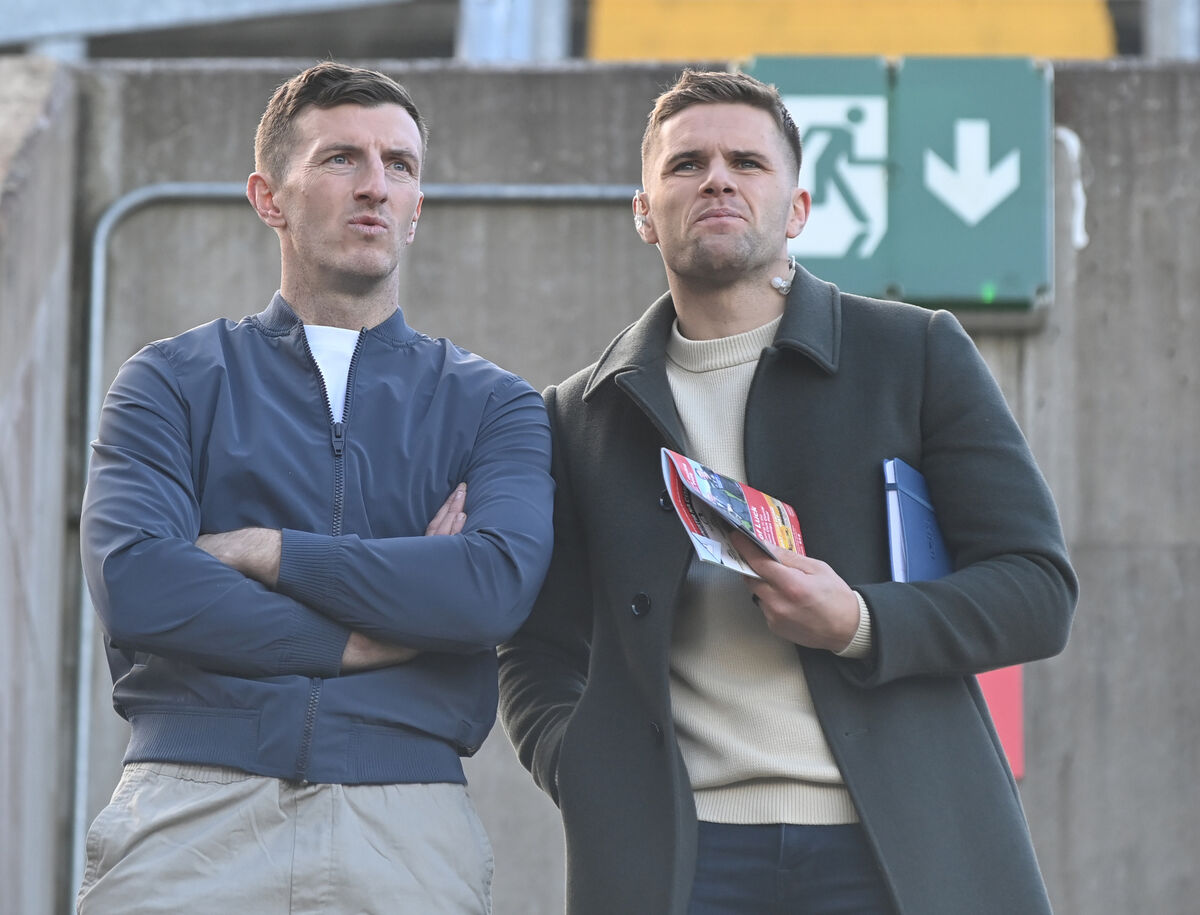 Former Cork hurlers Patrick Horgan and Alan Cadogan watching Sarsfields against Midleton during the C0-Op Superstores Premier SHC final at SuperValu Páirc Uí Chaoimh. Pic: Eddie O'Hare
He still loved working out on his own. Wednesdays were meant to be his night off but instead he’d just spend them in the Glen, either on the field or in the gym or the alley. “It was every day. It had to be. It had to be a way you just live or else you just don’t choose it. It never felt like a chore.” Sometimes he’d wander up to the alley in Rochestown, and spot Justin McCarthy, a lion in autumn, still whipping a ball around his favourite haunt since he was a child. So it has been and forever will be with Horgan up in the Glen and the alley there.
“You could have 10 to 15 us up there, no joke. And we’d be all there to compete, win. There was no one saying, ‘Oh, there’s too many here.’ Everybody was in.”
Roy Keane’s capacity to take a ball and turn is somewhat attributed to the footwork he’d have developed from dabbling at boxing. Horgan, another child and icon of the northside, only laced a pair of gloves during one off-season with Cork when Billy Walsh oversaw some padwork and sparring. His exceptional footwork and stickwork was instead honed from how he’d to organise and move himself to return shots against the likes of the Downeys in the alley.
Horgan would not be a student of Christy Ring the way his friend Cusack from down Cloyne way would be, quoting passages from Val Dorgan’s and Tim Horgan’s books on the great man like a preacher citing scripture; it’s more through osmosis that he has come to know and even embody what Ring represented.
But he is familiar with one of Ring’s best-known lines. “Hurling has always been a way of life with me. It was never my ambition to play the game for the sake of winning All Ireland medals or breaking records but to perfect the art as well as possible.” And it resonates with him.
“It makes a lot of sense. I’ve said it before but while everyone’s dream is to win All-Irelands, if you’re only playing for that then you’re going to have a very disappointing career. Like, if you won one All-Ireland in an 18-year career, does that mean the other 17 years were failures or unenjoyable?
“I had a great run at it. I mean, the support Cork are getting in recent years is something that has never been seen before, not in hurling anyway. And to have been part of that, to have experienced that, a night down in the Páirc or a summer’s day in Thurles or Croke Park when the stadium is full and you’re out on the field, sure it’s magic.”
In his Irish Examiner column, Patrick Horgan wants to break down the nuances in hurling. “Every county player is at home every day thinking about how can he get better in his position. And I’d like to reflect that, the thought fellas and teams are putting into the game.” Pic: Picture Chani Anderson
He can live without Cork now. Watching the team play Galway in Salthill a few weeks ago, no part of him wished to be up there.“That’d have been hard. Conditions are hard. The travelling even harder, being in the bus for so long. The weather up there doesn’t help either. That’s a nasty fixture now. Though of course if you were still in there, you’d go through it, just trying to get the timing into the legs.”
But summer nights up in the Glen? That he couldn’t do without. As a kid he lived up there; straight after school in the North Mon, he and some buddies would head for there where they’d be joined by his father Patrick, always willing to be either a coach, ball retriever or goalkeeper, whatever the young lads wanted or the situation demanded.
“We still go up there, me and my buddies most nights. We all go to the gym together and train together. And I know when the sun comes out again now, we’ll bring our young fellas down there. My lad Jack will be four, same as the others, and we’ll let them play away while we’ll have a puckaround there ourselves. That’s just the way we are. That’s the way we’ve always been.”
Hurling as a way of life.
*Patrick Horgan joins a growing group of high-profile inter-county stars already working with Procure, including Cork legend Seán Óg Ó hAilpín. With offices in Cork and Dublin, Procure helps businesses across Ireland reduce and manage high energy costs. For more, visit www.procure.ie.
Comments (0)