
Remember me

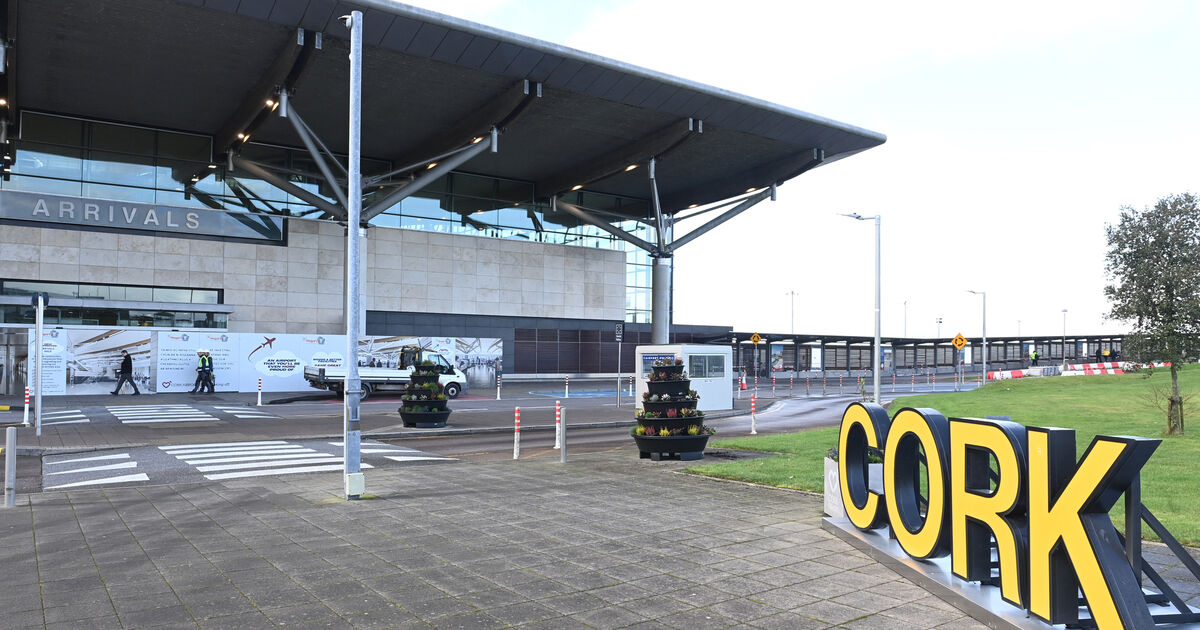


It's lunchtime on a Thursday, and the good-natured whoops and hollers coming from the departures lounge at Cork Airport signal the excitement of a group preparing for a midweek getaway.
Meanwhile, there’s a relative calm in the arrivals hall as it awaits an afternoon wave of commercial flights from Birmingham, Manchester, London, Alicante, Tenerife, and two from Paris, all in 60 minutes.
The passengers going in and out haven’t particularly noticed, but work on the €200m Capital Development Plan at the airport is in full swing.
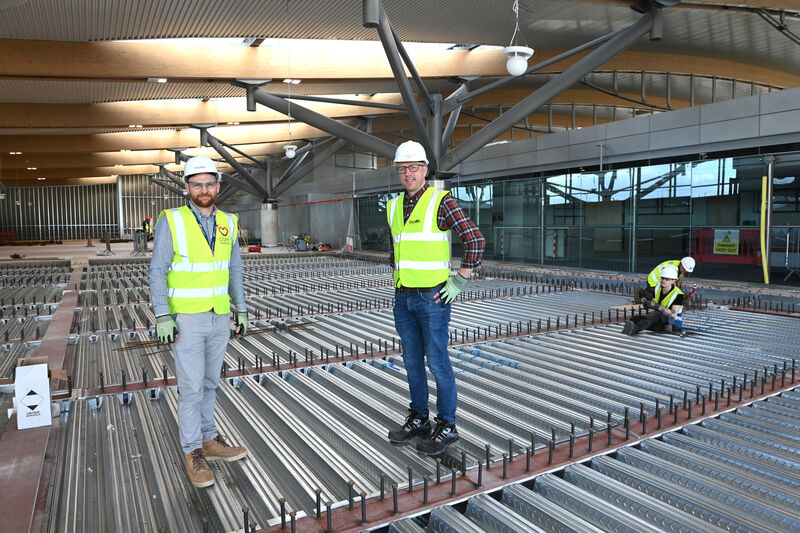 Project engineers Shane Donohue (left), DAA and Feidhlim O'Neill (right), Senior Project manager, DAA overseeing the work by Hegarty Building contractors at Cork Airport. Picture: Larry Cummins
The biggest of the projects to get underway is also perhaps the most impressive. The new mezzanine project was awarded to contractors PJ Hegarty in August and sees a whole new floor created above the existing arrivals areas.
Work started in September, creating a steel frame reinforced floor, and the mezzanine will be in operation after it is finished in December 2026. The project has seen 200 tonnes of steel columns and beams erected, with around 250 cubes (roughly 32 full truckloads) of concrete poured so far.
“We’re pouring 500 cubes of concrete in total," said Feidhlim O’Neill, DAA senior project manager, who is leading the construction. “The next 250 cubes will be poured on February 26, so we're still on target to have all our concrete deck in place by the end of February. That allows us then to start organic fill outs and start preparing the area, finish with the demolition, and get ready for delivery of the C3 (CAT) scanners in mid-June.”
The C3 EDS scanners will eliminate the need to remove liquids, gels, pastes and large electronic items from passengers’ cabin baggage. The new security area will incorporate a new fast-track lane.
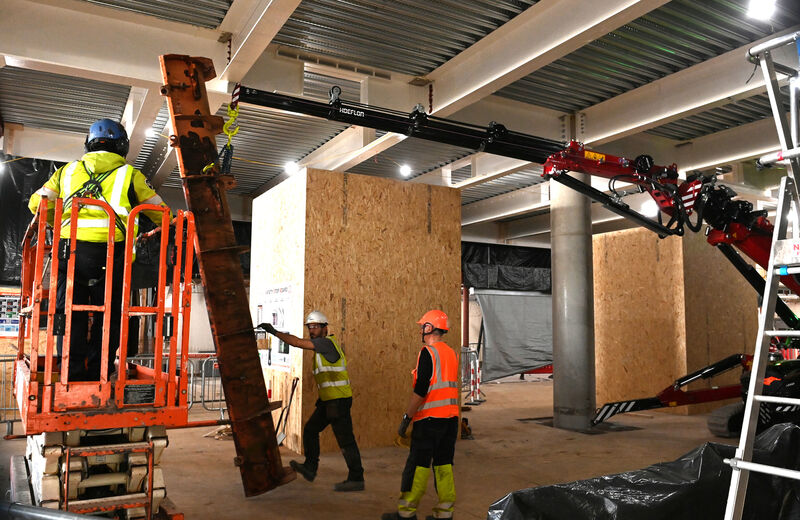 Hegarty Building contractors prepare to pour a concrete pillar in the ground floor area of the terminal building at Cork Airport. Picture: Larry Cummins
“The C3 machines are susceptible to three key things: dust, noise and light. So we need to make sure we create an environment suitable for them. The scanners are 17m long. There are five of them, and they weigh 2.5 tonnes each, so you’re talking an additional 12 and a half tonnes dead load, and with the live load of all the passengers, the extent of reinforcement and steel is for that reason.”
With dozens of construction workers on site, it would be an exaggeration to say the ambitious plans are quietly taking place. But considering the scale of the project, the lack of serious disruption to passengers is impressive. A din of construction continues on the site, but behind the hoarding, the general public continue on their journey relatively unhindered.
"Half of the skill is ensuring the continuity of operations, while running a live airport,” said airport general manager Niall MacCarthy.
Construction staff have been working sometimes through the night. Cranes were brought on site at 2am to minimise passenger disruption.
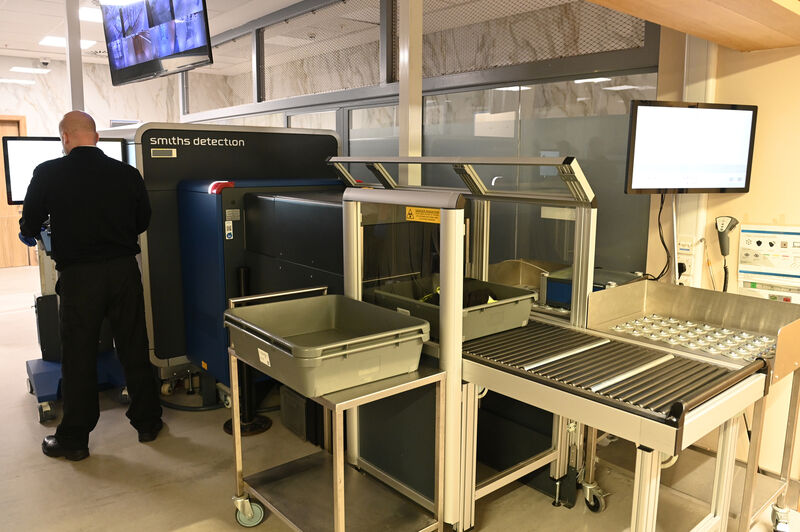 A new C3 scanner for staff security checks at Gate 19 in the building. Picture: Larry Cummins
Cork Airport carried 2.07 million passengers in 2015. A decade later, it hit a record 3.4 million passengers in 2025. The development plan, launched in May 2025, is laying the groundwork for its continued expansion to five million passengers and beyond.
The plan envisages the construction of the new mezzanine floor with a new passenger security screening area; a new expanded duty-free shop; a new executive lounge; additional boarding gates; a new solar farm; increased car parking, and a new pier with boarding gates and parking stands.
And there’s the old terminal building, which will eventually become new boarding gates. It looks so small and quaint now, but it still stirs emotions in older generations of Cork flyers. The trailblazing TV chef Keith Floyd, who made Belgooly his home in the 1990s, famously called Cork Airport “the pub with a runway”.
Many people recall welcoming home uncles, aunts, brothers, and sisters through the old gates. In the days of city centre pubs shutting on Good Friday, others still made their way to the upstairs bar to try to blag a drink.
Others recall teary goodbyes: even outgoing DAA chief executive Kenny Jacobs recalled his own experience of emigrating to London through it. But the building, including its Wild Geese bar, has not aged well, and is now a block on further development.
“There's a complete misapprehension of the old terminal. Modern jets are bigger than they were in the 1960s. There’s a new aircraft coming from Ryanair with in excess of 200 passengers.
“The old terminal is tying up a ton of the apron where we should be able to park aircraft. It's actually cutting off the development of that whole piece of the apron," he said.
“It's redundant as a building, and everything is defunct in it. The roof is leaking, the baggage systems are non-compliant, and the lifts are non-compliant. So to keep it, you would end up having to actually knock it and rebuild it, and you wouldn't rebuild it in that spot because you can't park any aircraft in front of it.”
So the old terminal will depart, but there’s plenty to do before then. The new €1.4m airbridge built by TKE in Gijon and transported from Spain to Cork in recent weeks is now in place at Gate 6 and will be up and running in March.
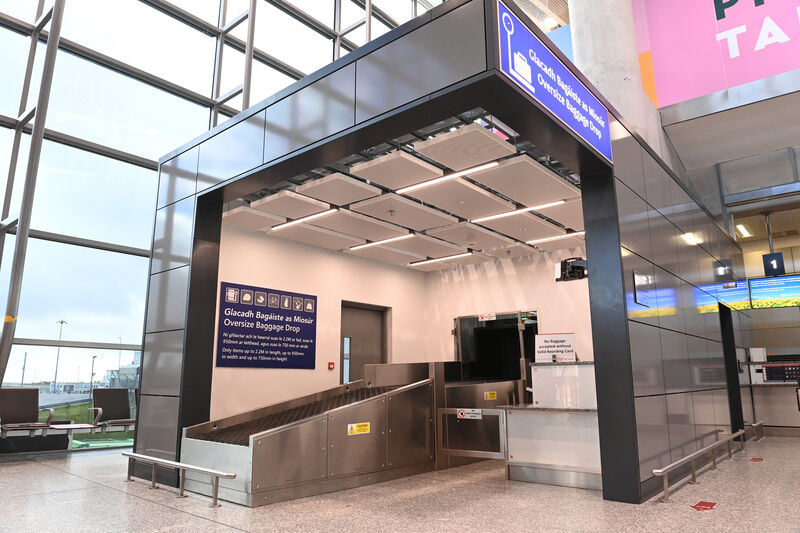 Newly installed oversize baggage drop-off at Cork Airport. Picture: Larry Cummins
The €2.5m oversized baggage security screening facility, used for larger items from golf clubs to skis, buggies to bicycles, began use shortly before Christmas. It required the demolition of the old oversized baggage screening area, to be replaced by a larger, heavier, hospital-grade CAT scanner.
A new security screening area at Gate 19 is also complete, used for staff screening as well as deliveries and goods inwards, including food prepared off-site. Beside the Gate 19 screening area is a new executive lounge for dignitaries.
The old VIP lounge hosted visitors from Paul McCartney to the Gallagher brothers. The new one will be quickly used for events during Ireland’s EU presidency, says Cork Airport communications manager Barry Holland.
“The official portrait photograph of President Catherine Connolly is coming from Áras an Uachtaráin, so that’ll be going up here,” he explained.
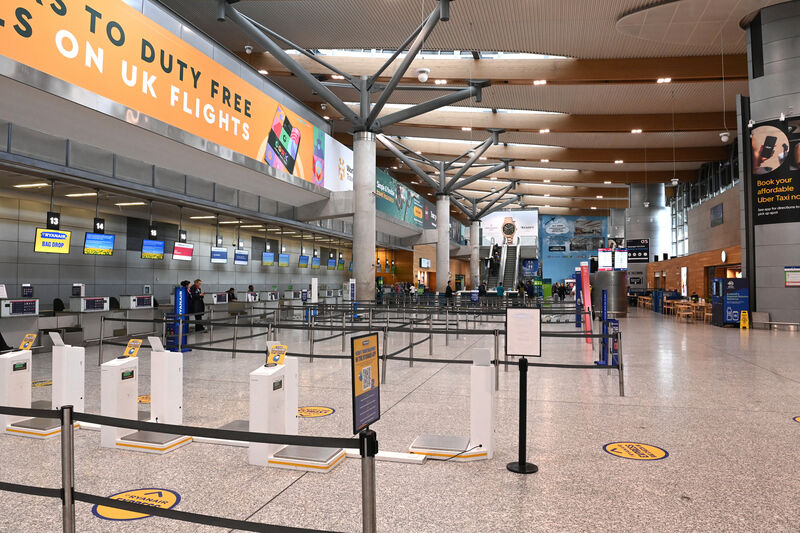
When the mezzanine is complete, work will begin on the new duty-free shop, extending into what is currently the existing passenger security screening area. Work is likely to begin in December and be completed in August, with the outlet 30% bigger than the current duty-free shop. A temporary shop will be in place during construction.
On the airside, a Swissport cargo hangar will be transformed into two passenger gates, each capable of catering for 250,000 passengers, with connecting walkways to the main building. Commissioning will take place later this year.
The capital development programme will conclude with the demolition and replacement of the old terminal and old control tower with a new pier and additional aircraft parking stands to significantly increase overall airside capacity.
When the new terminal was designed for the 21st century, opening in 2005, it was planned to deal with 3.5 million passengers. Mr MacCarthy said the airport is now investing “ahead of time, based on science, and it's targeted investment”.
“I think we tolerate infrastructure projects going on for years and years and being late and we as society need to be tougher on that,” said Mr MacCarthy.
“With our projects, the day we announce them, we put the completion date on the hoarding. So in our projects there isn’t a vague date, and then a delay here and the date is moved out again. We're serious about delivering projects on time.”
The airport already has over 12,000 passengers daily in summer and catered for 34,000 passengers over the St Brigid’s Bank Holiday weekend at the start of February. “We almost ran out of car park space during the summer,” remarked Mr MacCarthy.
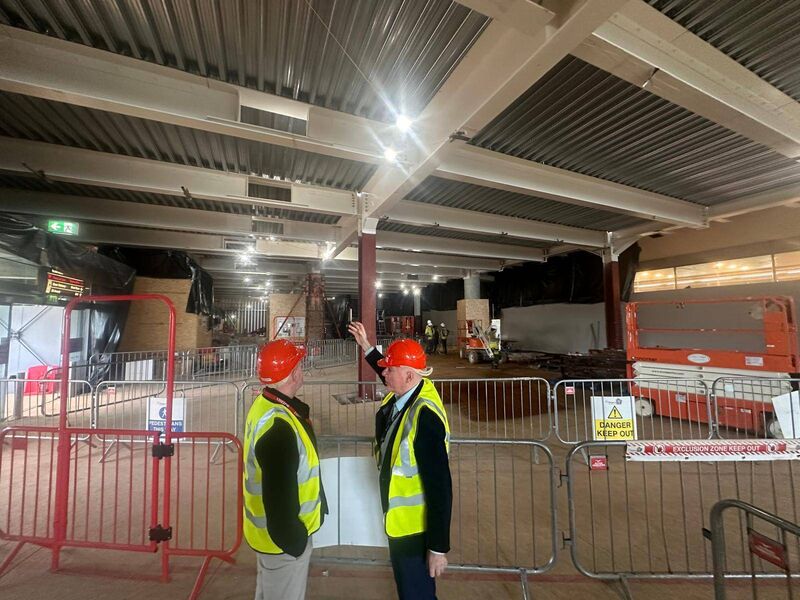 Cork Airport general manager Niall MacCarthy (right) shows Irish Examiner deputy business editor Martin Claffey the vast steel skeleton structure in the construction area below the new mezzanine at Cork Airport.
Planning was granted for an additional 669 spaces to the Holiday Blue Long-Term Car Park at Cork Airport, increasing the number of spaces on that site by almost one third.
Meanwhile, a new, 1.7Mw solar farm will be constructed over part of the existing Holiday Blue car park, which will provide for over 20% of the airport’s electricity needs into the future.
The solar panels, which will be mounted on steel frames, will provide a canopy over parked vehicles. This will be another step towards the airport meeting obligations to reduce its carbon footprint by 50% by 2030.
The contract for the solar farm will be announced next month, with the project to be completed by February 2027.
Mr MacCarthy says that with the increased passenger numbers and development ongoing, it is key that the infrastructure around the airport also develops and modernises in tandem.
“Car parking is great, but we really want public transport. We're a rural area, and at the moment we're absolutely inadequately served by public transport,” he said.
“We've route 225, 226, but they don't go all day. Our busiest period of the day is 6am. People are checking in at 4am. There are no public transport services serving us at this time.
“We're huge advocates of public transport. But how can we as a society say we want to encourage people to use public transport if we don't have a service? The airport needs a 3.30am service, we need a 4.30am service, we need a 5.30am service.”
Mr MacCarthy also pressed the case for a bus lane from the airport into the city from the Kinsale road. “It's a single lane and needs to be widened to create a bus lane all the way down the hill.
“It’s taking 14 minutes at the moment to get from the terminal down to the former Bull McCabes when the traffic lights are on. It needs a second lane. It probably needs a redesign with a pedestrian walkway to cross the road.” He said he has made the case to the National Transport Authority.
Mr MacCarthy also backed plans to safeguard land for the Southern Distributor Relief (SDR) road spur, which would potentially provide enhanced connectivity to Cork Airport. The SDR is part of the NTA’s Proposed Road Network 2040 plans for Cork.
And critically, he has pushed the case for a spur of the proposed Cork Luas network to link to the airport, noting how the initial Luas public consultation feedback had significantly backed an airport Luas spur. Transport Infrastructure Ireland will undertake a second round of public consultation on the Cork Luas project in Q2 2026.
"We would urge TII to start planning for the airport link. Pick your route and safeguard it so that other stuff isn’t built on it. Because once it's built, it's built.”
In 2030 and beyond, as Cork Airport continues targeted expansion and hits five million passengers, the next stage could push it towards seven million passengers. Preparation for meeting those targets, and the hub of the future, starts now.
“Master planning is how you need to know what this place looks like in 20, 30, and 40 years. That's a good challenge to any organisation which runs an infrastructure.
“Generally, technology refines what you're doing. Hydrogen is being experimented on. Electric aircraft are coming and the impact for us is we need to electrify our grid. We need to plan now to ensure that we have charging facilities on the air side because aircraft have to plug in.
“We're mindful of new technologies and safeguarding for them. Small VTOL (vertical take-off and landing) aircraft could take people to and from the city, like taxis. You must design for that, where it could go, where to could handle it.
“You must have an overall master plan that takes it into account. But you shouldn't be changing fundamentals about where aircraft are parked, where cars are parked, where piers are. The rest are all nuances.
“You need to know your game, and we know our game."
Around 250 people work directly for Cork Airport, with a further 750 working at Cork Airport for related companies, from car hire to shops. Around 12,000 people working in companies in the south of Ireland are indirectly linked to the airport through trade, commerce, and tourism.
It contributes over €1bn to the economy every year. Cork now handles 28 flights a week to London; 21 a week to Amsterdam, six to Frankfurt, 10 to Paris, two a week to Zurich. Flights to destinations like Spain, the Canary Islands, and beyond bring thousands of holidaymakers to the sun each week.
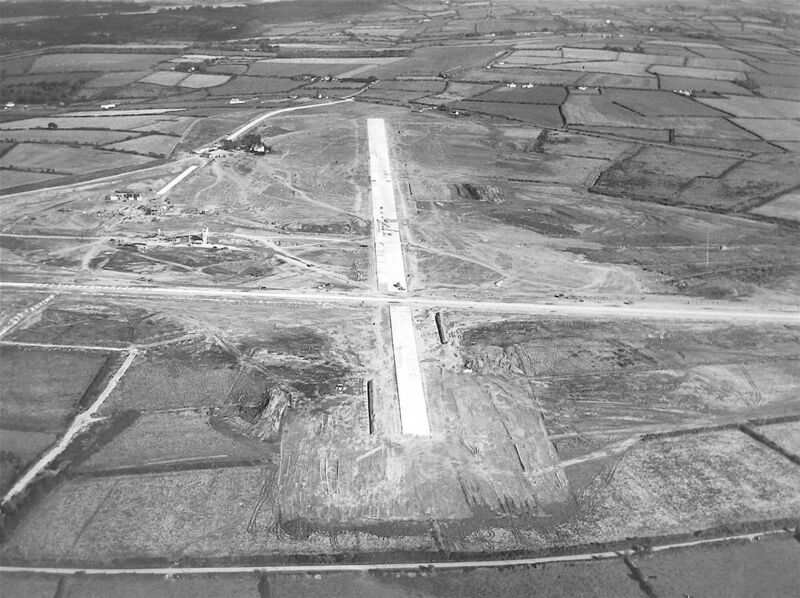 The two runways and terminal buildings under construction in October 1960.
Cork was named Best Airport in Europe under five million passengers at the Airport Council International Europe Awards in 2025. Keeping the ‘friendly’ airport feel is paramount, but Mr MacCarthy says convenience is about more than being small.
“Size doesn't dictate quality. The airport is like a village. It's down to the design, the team, the infrastructure, the staff, the ability, the vision.”
As Cork Airport looks to the future, so do its regional competitors. Shannon Airport is undergoing its own €40m investment drive in 2026, with construction getting underway on a €15m upgrade of the Shannon Airport terminal building.
Meanwhile, Waterford Airport is set to begin a runway extension, which could see commercial flights return to the South-East in 2027. In the Kingdom, Ryanair alone has seven routes planned this summer from Kerry Airport.
“There’s competition with every airport that your hinterland overlaps,” said Mr MacCarthy. “Waterford is very much our hinterland. You’ll take some of the Cork market and some of the Dublin market.
"But we're not against it; we welcome competition. It will eat into some of our market, but let the market decide what it wants.”
With regard to Shannon, Ryanair shifted one of its aircraft from Cork to the Midwest for its winter schedule, with chief executive Michael O’Leary citing lower costs. But Mr MacCarthy expressed confidence in the continued expansion of the Cork route network and noted that Cork’s annual passenger numbers are more than a million higher than Shannon.
Cork Airport continues to diversify from its reliance on Ryanair and Aer Lingus — KLM now flies 200,000 passengers to Amsterdam annually from Cork, some for on-board long-haul travel.
Mr McCarthy hopes that Cork itself can re-enter the transatlantic market. "With transatlantic, we have two airports in Ireland, Dublin and Shannon, serving transatlantic flights, for about seven million people on the island.
"There are about five airports serving transatlantic in the UK for 55 million people. So the carriers are not convinced that a third airport in Ireland will grow the market, rather than just redistribute the market.
“There's a misconception that transatlantic and Cork is determined by the runway. It's not. It's about convincing carriers that putting an extra service into an extra aircraft will increase their profits. Shannon has a long history of transatlantic, and they do transatlantic well.
"The existing airlines are served by Dublin and Shannon. Short haul, we have very good connectivity from Cork, but we're working hard to get transatlantic.
“We're probably not going to do the US west coast, but I think Boston, New York, and Toronto would be our specific targets. I'd hope to have one of those three, at least, in the next five years.”
Comments (0)