This is a rush transcript. Copy may not be in its final form.
AMY GOODMAN: This is Democracy Now!, Democracynow.org. I’m Amy Goodman with Juan González.
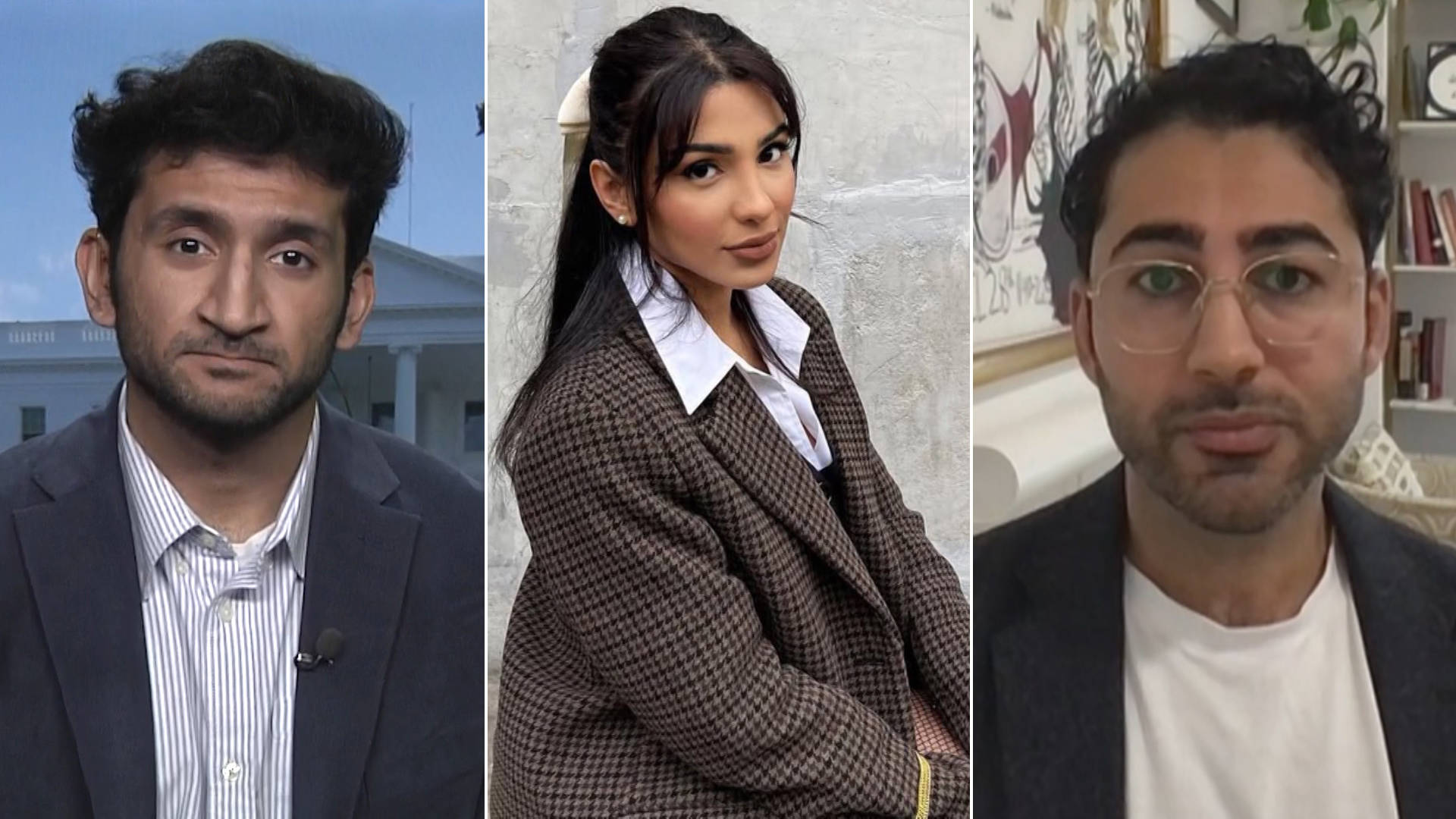
Here in New York City, a Columbia undergraduate student was detained by ICE agents early Thursday morning at her off-campus residence. The agents gained entry to the residential building by pretending to be police looking for a missing child. The student, Elmina Aghayeva, posted about her arrest early in the morning on Instagram saying, ”DHS illegally arrested me.
Please help.”
She was released just hours later following a meeting between New York Mayor Zohran Mamdani and President Trump. Mamdani posted on social media, “Just got off the phone with President Trump. In our meeting earlier, I shared my concerns about Columbia student Elina Aghayeva, who was detained by ICE this morning. He has just informed me that she will be released imminently.” During Mamdani’s meeting with Trump, he also requested four other cases in New York be dropped, those of Mahmoud Khalil, Yunseo Chung, Mohsen Mahdawi, and Leqaa Kordia. This is Columbia University President Claire Shipman.
CLAIRE SHIPMAN: We are all so relieved that our student Ellie Aghayeva has been released from federal custody. Let me give you some details about what happened this morning. Shortly after 6:00 a.m., five federal agents from the Department of Homeland Security, without any kind of warrant, entered in off-campus Columbia residential building. The agents gained entry by stating they were police searching for a missing child. They made their way to the apartment of the student they were targeting with the same story. Our security cameras captured the agents in the hallway showing pictures of the alleged missing child. Once inside the apartment, it became clear they had misrepresented themselves. A public safety officer arrived, asked multiple times for a warrant which was not produced, and asked for time to call his boss, which was not given.
The agents took our student. This was a frightening and fast-moving situation and utterly unacceptable for our students and staff. We started work immediately to gain her release. We are so grateful for the help and support we got from the mayor and the governor. Let me be clear: Misrepresenting identity and other facts to gain access to a residential building is a breach of protocol. All law enforcement agencies are obligated to follow established legal, ethical standards. Let me also add, nobody in our administration has ever provided any assistance to DHS or ICE as regards arresting or taking any of our students. Quite the opposite. We have labored often intensively behind the scenes to see them supported.
AMY GOODMAN: That was Columbia president Claire Shipman responding to the arrest of Ellie Aghayeva, the detention of her. She didn’t release a video talking about Mayor Mamdani’s request for the four other students to have their cases dropped. We’re going to speak with Columbia graduate Mohsen Mahdawi. One of the people who wasn’t a Columbia student, Leqaa Kordia, is still in detention almost a year after participating in pro-Palestinian protests at Columbia.
First we’re going to Washington D.C. where we are joined by Prem Thakker, political correspondent and columnist for Zeteo News. On Thursday, he reported on the dizzying sequence of events in the arrest and the release of Ellie. Prem, can you respond to what took place yesterday? Using false pretenses, saying they were New York Police, apparently—this is ICE—to get into Columbia’s residential housing? And using a picture of a five-year-old child to say they were looking for a missing person?
PREM THAKKER: Thank you both for having me. Yes, when you lay it out it’s as shocking as it sounds. And I will tell you what—when I was first made aware of it, I was getting flashbacks to when I was first flagged of Mahmoud Khalil’s taking, almost a year ago. As you say, the sort of dizzying nature of it was descriptive of it.
At first it was very clear to me based on different accounts from sources that something awry had gone on with how DHS had sought to breach this Columbia building. Claire Shipman, the president, very quickly, as she announced it, had said that there were some false pretenses being had and how the agents had tried to get in. And even over the course of the following hours, before Shipman made that subsequent announcement in the evening as you described, many sources were describing to me the sense that something was wrong, that the agents had impersonated officers, that they were there pretending to be doing something they weren’t.
And I just want to underscore something that is important I think for viewers to understand. Right now the Department of Homeland Security’s budget—its very bloated budget—is at stake because of massive public horror at its acts including the killings of Renee Good and Alex Pretti. In that time, this is how DHS is choosing to behave. They allegedly are impersonating officers, pretending to be looking for a missing child, all to get into a university building to detain someone. And then, I might add, apparently lying about it. Because when we asked DHS about this, they explicitly said, “Our agents did not and would never impersonate NYPD officers.” And yet Claire Shipman, the president of Columbia, is saying, and based on security camera footage, that these agents did in fact impersonate police. So this is how DHS is behaving even while their budget is at stake. And if that is the case, what does that tell you as an American about how DHS takes your concerns?
JUAN GONZÁLEZ: Prem, what can you tell us in terms of this involvement of Mayor Mamdani in getting Trump to release Ellie Aghayeva?
PREM THAKKER: Yes. One thing that should be underscored—and I’m sure this will be talked about more with Mohsen as well—is that yesterday was a remarkable expression from city officials, from city council folks to members of Congress in New York City to of course Zohran Mamdani, that was very concerted, very synchronized in expressing condemnation to this arrest. And that also included of course Columbia’s strong response. They were very outwardly insistent on how they were legally supporting Ellie, something that they didn’t always express with previous detentions.
And so all of that culminated in Zohran Mamdani’s surprise afternoon visit to Washington, D.C.— which coincided with this arrest, funnily enough I suppose—where he was visiting Donald Trump to pitch a housing project, a very ambitious housing project that he could request Donald Trump’s support in. During that meeting is when Zohran Mamdani also expressed his concerns about the arrest of Ellie, as well as, as you mentioned, the ongoing cases against Mahmoud Khalil, Yunseo Chung, Leqaa Kordia—who is of course still in detention—and then Mohsen Mahdawi.
Minutes later after that meeting, Mamdani gets a phone call from Trump saying that Ellie will be imminently released. And then moments after that, Ellie posts on her Instagram story saying she is freed. And so that instantaneous reaction by Donald Trump to go ahead and make a phone call to release Ellie is remarkable not just because of how quickly that was able to be done, but because it really puts a thumb in the face of DHS, who lied in order to breach a Columbia University campus building to detain someone. And all for that decision to be quickly flipped is remarkable because it shows the power of opposition but also how loose and flippant these arrests are and how maybe unnecessary they are.
AMY GOODMAN: Let’s go to one of the people who Mayor Mamdani raised. In addition to calling for the release of Ellie, which happened immediately, Mayor Mamdani called for the dismissal of cases against the Columbia student—now graduate—Mahmoud Khalil, Yunseo Chung, Mohsen Mahdawi— who like Yunseo Chung and Mahmoud Khalil and Leqaa Kordia was involved with pro-Palestinian protests at Columbia, were all jailed. The question is, did Columbia intervene in those cases?
Mohsen Mahdawi is now a graduate student at Columbia’s School of International Affairs, SIPA. Mohsen, if you can talk about your response to what happened yesterday—there was mass protest, Hundreds of people came out to protest Ellie’s arrest—and the shock of that? But also who President Shipman is willing to talk about and intervene on behalf of and who she isn’t.
*MOHSEN MAHDAWI: Good morning, Amy, and thank you for having me. This highlights the serious hypocrisy and discrimination that Columbia University has. I am glad that the president, Claire Shipman, has shared that she is thrilled and relieved for the release of Ellie, as she should. And she should also check on her, meet with her, offer her with the support legally—legal support, psychological support and financial support after this terror.
But let’s be clear—Columbia has participated in allowing this to happen and that’s because they have failed to stand up for their students. For me, for Mahmoud, for Yunseo, and for Ranjani and for Leqaa as well. And this, what we see—DHS coming back to Columbia residential—because Columbia University administration did not have the backbone in fact to file any lawsuits against the Trump administration for violating basic rights. And now, yes, she is free, but will Columbia University file a lawsuit based on this scam that DHS has done? Where is the accountability in this?
In addition to this, Amy, I want the viewers to ask the question why students are protesting at the streets, not inside campus. And the reason is because the university administration itself has participated in destroying and in deteriorating the democratic practices here, free speech. They chilled the speech on campus to the point that the students feel more safe being under the risk of being detained or attacked by ICE or police outside of campus. Because the university has cracked down against the pro-Palestine movements and has made an example of more than 100 students between suspension and expulsion. This is the chilling effect that the university administration and the dirty work that it is doing.
I love my university and that’s the reason why I chose to come to Columbia. But what the senior administration is doing and the hypocrisy that we are seeing—when I was released, there was not a video. There was not a word that says, “I’m thrilled and relieved.” And there has not been any attempt to reach out to me and to offer me direct support by the senior administration. This is an issue you might see like a micro issue, but this is actually what the Trump administration intended to do, which is to fracture liberal institutions and turn the administrations against their students. And they have succeeded, because the Columbia administration and many other administrations have capitulated and have made deals with the Trump administration.
JUAN GONZÁLEZ: The impact on the student body, especially the graduate students, given that such a large percentage—I’ve heard as many as 40% of graduate students at Columbia are international students from other countries—the impact of this continued repression of Columbia against dissent by students?
*MOHSEN MAHDAWI: The impact is huge. When we talk about 40%, it is more than one third of the university. We are talking about 14,000 students roughly. I was in D.C. yesterday and the shockwave of this, or the wave shock of this terror that ICE has brought to campus, triggering so many students who were here when many other students were detained on campus, has actually chilled—it has scared many students. My phone was literally tens of messages that are coming to me from international students and from actually students who are citizens, either checking on me if I am okay—because they have not disclosed the name first—or asking for legal resources because they are afraid to leave their apartments and campus as international students.
The chilling effect is real because I see it in classes. Even when I speak—especially when I speak with my fellow students who are international about their mind, about their way of thinking, they are afraid to write their beliefs on papers because they don’t trust the university that it would keep those papers and their thoughts away from the government. This is chilling speech.
AMY GOODMAN: Mohsen Mahdawi, we want to thank you for being with us. He is a Columbia University graduate student today. He was jailed when he was a Columbia undergraduate student. Came from the occupied West Bank. As was Mahmoud Khalil, who also graduated but was jailed after pro-Palestinian protests. And Leqaa Kordia still is in jail. She’s not a student but she protested the policies of Columbia University at the encampment and she remains in a Texas ICE jail after almost a year. I want to thank you, Mohsen, for being with us, and Prem Thakker,
political correspondent and columnist for Zeteo News.
Up next, we go to Buffalo where a Burmese refugee legally here was left by immigration agents in the cold and died. His family did not know where he was. Back in 20 seconds.
[MUSIC BREAK]

Comments (0)