
Remember me


Staring at the words on his computer screen, Brian Hannan felt a heart-stopping jolt bring him up short.
It was like in the movies, when the hero realises they have stumbled across something big.
‘When I saw it, my eyes popped out of my head,’ he recalled. ‘I thought, “You’ve got to be kidding – how does this even exist? How does nobody know about it?” It’s a Fort Knox of gold, just sitting there waiting for somebody to make something of it.’
For months, the author and film historian had been trawling through an ocean of documents in search of priceless nuggets for his new book about Scots thriller writer Alistair MacLean’s extraordinary Hollywood career.
The vast archive he was mining had belonged to Elliot Kastner, the ebullient American producer who helped transform MacLean the bestselling novelist – of HMS Ulysses, Ice Station Zebra and The Guns of Navarone fame – into MacLean the brilliant screenwriter.
Such was the writer’s international appeal he earned the unprecedented accolade of seeing his name appear above the title of blockbusters such as Where Eagles Dare, When Eight Bells Toll, Breakheart Pass and Fear Is The Key.
For a period of time, it seemed everything he wrote flew straight off his typewriter and into movie theatres around the world.
A total of 14 movies and four films-for-television were made from his books and the MacLean brand was pure box office – except for the one time the magic formula failed.

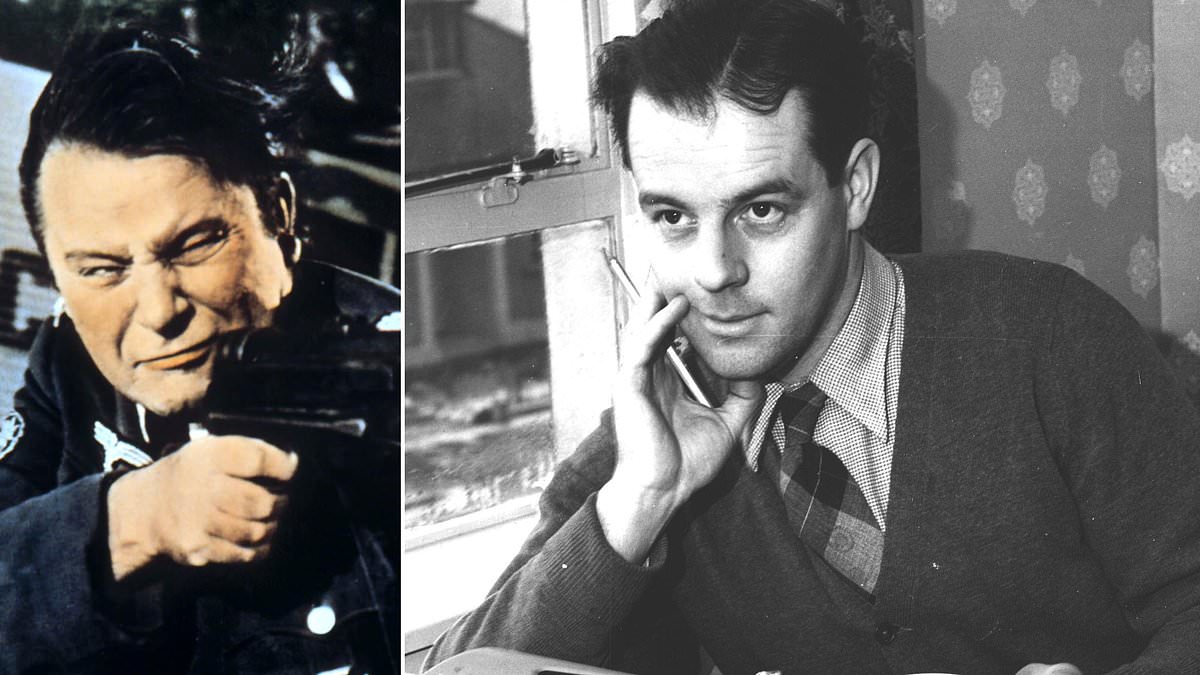
Richard Burton starring in the 1968 screen adaptation of Alistair MacLean’s book Where Eagles Dare
Mr Hannan stumbled upon it by chance after Kastner’s son, Dillon, heard about his project and emailed over his father’s entire store of papers, in the hope it might offer up something new.
There, buried in an innocuous file marked ‘Pirates’ which Mr Hannan had ignored for weeks, he found treasure – a high seas adventure filled with swashbuckling heroes and buccaneering brigands written at the peak of his powers by the ‘king of the action thrillers’.
He said: ‘It is a genuine lost manuscript by Alistair MacLean and, as far as I’m aware, nobody else knows it exists, which means it could be extremely valuable.
‘MacLean died in 1987 so this could be his first work in at least 40 years.
‘Anyone familiar with MacLean’s work can see his hand. It’s just unbelievable to get your hands on raw material by someone of his stature which no-one has ever seen before.
‘But such is the continuing popularity of MacLean around the world, the script could easily be worth £1million if it was novelised into a hardback book and another £1million for the paperback.
‘It could make a beautiful film. You would have to add some proper sword fights but the story is great and it could make a commercially viable film.
‘It’s got a light tone and a lot of humour – like the Pirates of the Caribbean franchise and they are making another of those – so it’s not as if there isn’t an appetite for pirate movies. The female character is terrific, someone with smarts who can deal with the man on her own terms.
‘Sandra Bullock, in her younger days, or someone like Sydney Sweeney would be perfect for the role.’
Mr Hannan said it had become common for famous authors such as Wilbur Smith, Dick Francis and Lee Child to keep their names to the fore by having someone else write their books.
Last year, he wrote to Child asking if he would be interested in novelising the script. ‘He said it was fantastic but he was retired and that was that,’ he said.
‘I know James Paterson finished off a Michael Crighton novel so it has been done and if you put someone like that and MacLean together, it would be terrific.’
The unlikely story of how MacLean came to write about pirates is revealed in Mr Hannan’s new book – King of the Action Thriller: Films from the Mind of Alistair MacLean.
In it, he explains the key role played by Kastner, an American agent who moved to the UK with ambitions to be a leading movie producer.

Scots thriller writer Alistair MacLean became an international best-selling novelist
Kastner was familiar with MacLean’s books and was desperate to make a movie with him. The only problem was that the film rights to every book he had written were already sold.
Born the third of four sons of a Church of Scotland minister on April 21, 1922, in Glasgow, MacLean grew up to be a literary sensation.
Raised in a manse at Daviot, near Inverness, he spoke only Gaelic until the age of six.
After studying English at Glasgow University, he initially worked as a teacher in Rutherglen but found his voice after winning a newspaper short story competition in March 1954. That led to Scottish publisher William Collins offering a £1,000 advance for his first novel.
MacLean duly obliged and battered out a book, drawing vividly on his wartime service in the Arctic Convoys. The book, HMS Ulysses, proved a word-of-mouth sensation, shifting 250,000 hardback copies in the UK alone and outselling Gone With The Wind by five to one. He was an instant hit.
His next book, The Guns of Navarone, was another bestseller and, at MacLean’s peak in the 1960s, one of his tales was snapped up every 18 seconds, every day of the year.
In time, he would outsell Ian Fleming and, for a season, even Agatha Christie. It wasn’t long before Hollywood came calling.
‘He wrote books very fast. The actual writing would take four or five weeks and all the books he wrote were sold to the movies as soon as he wrote them as they were cinematic and he told great stories,’ said Mr Hannan.
That might have put a dent in Kastner’s hopes of working with MacLean. Undaunted, he doorstepped MacLean in October 1965 and persuaded him to write him an original screenplay.
‘He said to MacLean, “I want a film like Guns of Navarone, I want women in it, and I want action”,’ said Mr Hannan.
‘MacLean said, “I’ll write you a screenplay on one condition – you pay me for the screenplay and I keep the rights to novelise it afterwards”.’
Normally the producer would keep those rights, but wily MacLean changed the system, cutting out the publisher. Mr Kastner struck the deal, giving MacLean $200,000, a half-share of the profits and the book rights.
Within weeks, MacLean brought him a screenplay. It bore the rather insipid title of The Eagle’s Castle (soon changed to Where Eagles Dare), but the script packed a real punch.
‘Pretty much what he wrote appeared on screen with a few minor cuts,’ said Mr Hannan. ‘MacLean grasped the art of screenwriting very quickly.’
Kastner shrewdly bought up When Eight Bells Toll, which was his next book, pre- publication and commissioned two more screenplays.
One was ostensibly a Western, Breakheart Pass, and the other was a pirate-themed script, then known only as Caribbean and later titled The Swashbuckler. However, these slightly leftfield choices put him at odds with his publisher.

Paisley book shop owner Brian Hannah has written a book about the action adventure author
‘Because MacLean was known for writing a certain type of thriller, Collins weren’t keen on him writing Westerns or pirate films.’
For MacLean it was not so unusual, said Mr Hannan, as he liked to find inspiration in unusual settings. ‘He always wanted to try something new.
‘All his books are set in what in those days might be considered strange locales. Not like Graham Greene, who goes and finds a trouble zone, there’s no trouble zone in the Arctic unless MacLean creates one in Ice Station Zebra.
‘He tended to look for places which were different, where he could bring something new to the table – and I think that’s what he was doing with Breakheart Pass and The Swashbuckler.’
Collins passed on Breakheart Pass, too, at least until Kastner put together the movie starring Charles Bronson more or less a decade later. The publisher then released a novelised version which became a huge bestseller.
But the same never happened for The Swashbuckler, which MacLean twice refined, tightened and shortened.
Despite his endeavours, none of the studios bit and nor did Collins.
‘I’m sure at the time I would have had the same reaction as Collins, “You’ve got to be kidding”,’ said Mr Hannan.
‘But I knew Breakheart Pass had worked as a Western as I had seen it at the movies.
‘When I started reading this one, there was lots of clever stuff and it has all the hallmarks of a MacLean – there is always somebody who is being blackmailed, or someone who goes undercover and so on. It’s such a brilliant story I would love to see it as a book and a film.’
The Swashbuckler follows the familiar MacLean template with the heroes battling huge odds, betrayals, breakneck plot twists and ending with a vast explosion, damnation for the baddies and sweet resolution for the good guys. To some extent the film world’s reluctance to touch The Swashbuckler was a surprise, given the author’s global appeal.
‘MacLean had cracked something most people didn’t realise and his sales abroad were just phenomenal. It was reckoned if you had Alistair MacLean’s name on a film, people would come and see it regardless of who was in it or what genre it was,’ said Mr Hannan.
‘Film-makers started putting MacLean’s name above the title, and in huge letters, which was unheard of for a screenwriter to get that kind of billing. They used MacLean’s name to advertise his next film, using the tag, “From the mind of Alistair MacLean”.’
The project’s timing was also a problem as Hollywood entered a period of financial turmoil in the late-1960s. ‘They just couldn’t get the money. This was around 1969-70 and the movie industry was in incredible trouble, and nobody was really wanting to finance a big-budget pirate picture.
‘They hadn’t made any since the heyday of Burt Lancaster.’
When Kastner’s film rights lapsed, others tried their hand at churning out a swashbuckling feature. A succession of other screenwriters – including a young Robert Ludlum – tried their hand at fashioning a script and a weird mishmash of a movie limped onto the big screen in 1976.
The Swashbuckler, starring Robert Shaw, was completely unrecognisable from the film envisaged by MacLean, whose name was, understandably, nowhere near it. It amounted to an act of movie-making piracy, said Mr Hannan. ‘It was garbage – done as a kind of spoof and it didn’t work at all. All MacLean’s clever stuff had gone.’
It was a rare blip in the MacLean conveyor belt of successes, although privately he was already suffering from the pressure of producing endless bestsellers.
It manifested itself in heavy drinking, which would eventually end his life.
Twice-divorced, he had reconciled with his first wife, Gisela, and was splitting his time between homes in Dubrovnik and Switzerland.

The ‘lost’ MacLean manuscript
In 1985, health scares had prompted MacLean to give up drinking but, in January 1987, he relapsed and went on a bender with an Irish hotel porter which triggered several strokes.
He lapsed into a coma from which he never awoke.
‘He was an alcoholic,’ said Mr Hannan. ‘I think he started drinking heavily early in his career. It’s a very sore subject with his family.’
So much so, Mr Hannan has had little cooperation from them in his quest to promote MacLean’s lost manuscript. ‘It means nobody knows this script exists, apart from me and those I have chosen to tell. Maybe someday soon, someone will come knocking on my door and ask, “Can you show us what you’ve found?”
‘Well, what I found was a million-pound manuscript.
‘It’s like if somebody found a lost novel by Graham Greene, or Boris Pasternak. Similarly, this would rocket off the shelves without question.’
A lost MacLean manuscript may be a moneyspinner, but for whom? MacLean’s surviving relatives? Kastner’s family? MacLean’s publisher? Mr Hannan? Ultimately, this mystery thriller may well end in a courtroom drama, where intellectual property lawyers cross swords for a cut of the prize.
‘It’s not really clear who has ownership of the manuscript, but someone could be sitting on a multi-million-pound bounty,’ said Mr Hannan.
Perhaps one day, it will lead to a new film hitting our screens with Alistair MacLean’s name above the title? ‘Or my name,’ he laughs, ‘Brian Hannan’s version of Alistair MacLean’s The Swashbuckler!’
■ King of the Action Thrillers: Films from the Mind of Alistair MacLean by Brian Hannan is out now, priced £28.