
Remember me

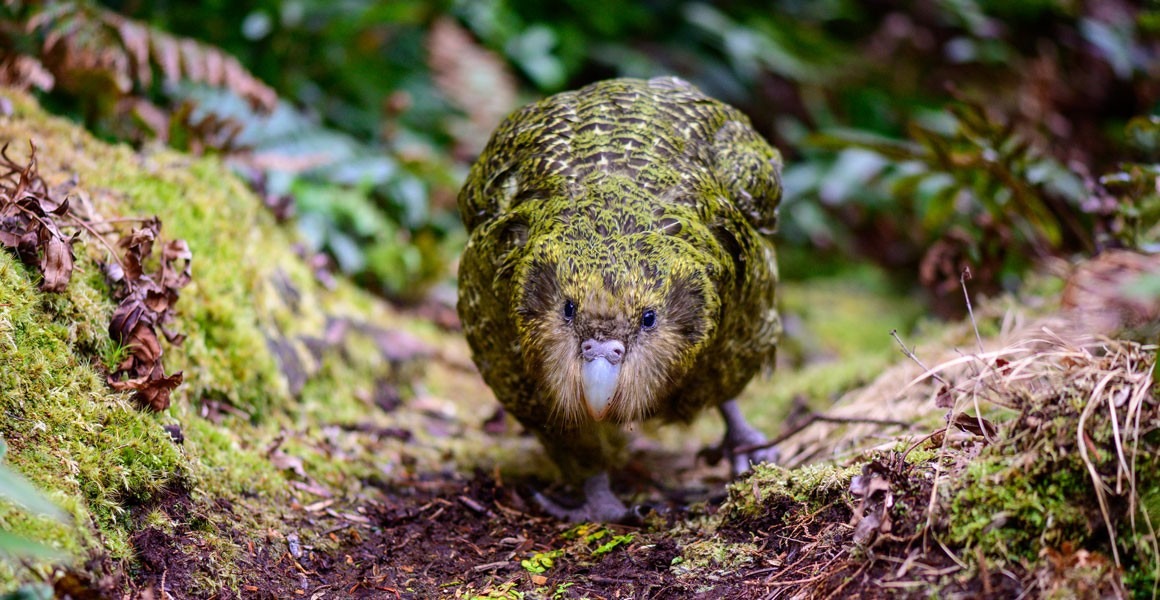





It doesn’t fly. It barely runs. It smells like honey and looks like a Muppet. And it might just outlive you. Meet the Kākāpō — the world’s most gloriously impractical bird.
 Photo © Jake Osborne
Native to New Zealand’s remote islands, the Kākāpō (also called the Owl Parrot) is a living masterpiece of evolutionary weirdness. It’s the heaviest parrot on Earth — up to 9 lbs — with brilliant jade-green feathers, owl-style forward-facing eyes, and blue feet. It’s also one of only two nocturnal parrots in the world.
 Lithograph by David Mitchell, 1845
A Bird That Defies the Rules
Lithograph by David Mitchell, 1845
A Bird That Defies the Rules
Can’t fly — but climbs trees with surprising skill. Doesn’t sing — but booms, producing a deep low-frequency call that carries for kilometers through the forest on still nights. And then there’s the smell.
The Kākāpō smells like honey and flowers — a warm, musty-sweet fragrance somewhere between papaya and aged timber. It’s the only bird in the world known for smelling genuinely, delightfully good.
 Photo: Andrew Digby / DOC
With a potential lifespan of up to 100 years, the Kākāpō is one of the longest-living birds anywhere on the planet. It’s friendly and curious, known to display genuine fondness for human company — perhaps because it evolved on islands with no natural predators and simply never learned to be afraid.
 Photo: Andrew Digby / New Zealand Department of Conservation
Critically Endangered — But Fighting Back
Photo: Andrew Digby / New Zealand Department of Conservation
Critically Endangered — But Fighting Back
Hunted to near-extinction and devastated by introduced predators, the Kākāpō’s story is one of heartbreak and hope. As of 2023, only 248 individuals are known to exist. Every single one has a name. Every single one is tracked.
“Kākāpō are large, ground-dwelling, flightless parrots that were once widespread across New Zealand but hunted to near extinction. Thanks to highly specialised conservation efforts, these unique birds are slowly bouncing back.”
— Natural History Museum UK
 Photo by Jake Osborne
Conservation teams work tirelessly — moving birds to predator-free islands, monitoring nesting, and hand-rearing chicks. The Kākāpō Recovery Programme is one of the most intensive wildlife rescue efforts in history, and it’s slowly, beautifully working.
 Photo by Andrew Digby
 Alisha & Sirocco — photo courtesy of the Kākāpō Recovery Programme
The Kākāpō is proof that evolution doesn’t always optimize for survival — sometimes it just goes for something truly, wonderfully original. Long may it boom through the forest.
You might also like: The Best Wildlife Photography of the Year, Curated • Astounding Animal Ecosystem Discovered 6 Miles Underwater • The Tortoise Who Won Hide and Seek for 30 Years
Discover more from Moss and FogSubscribe to get the latest posts sent to your email.
Comments (0)