
Remember me






It’s late February, it’s rain, it’s cobbles, it’s Belgian fields. We’re back.
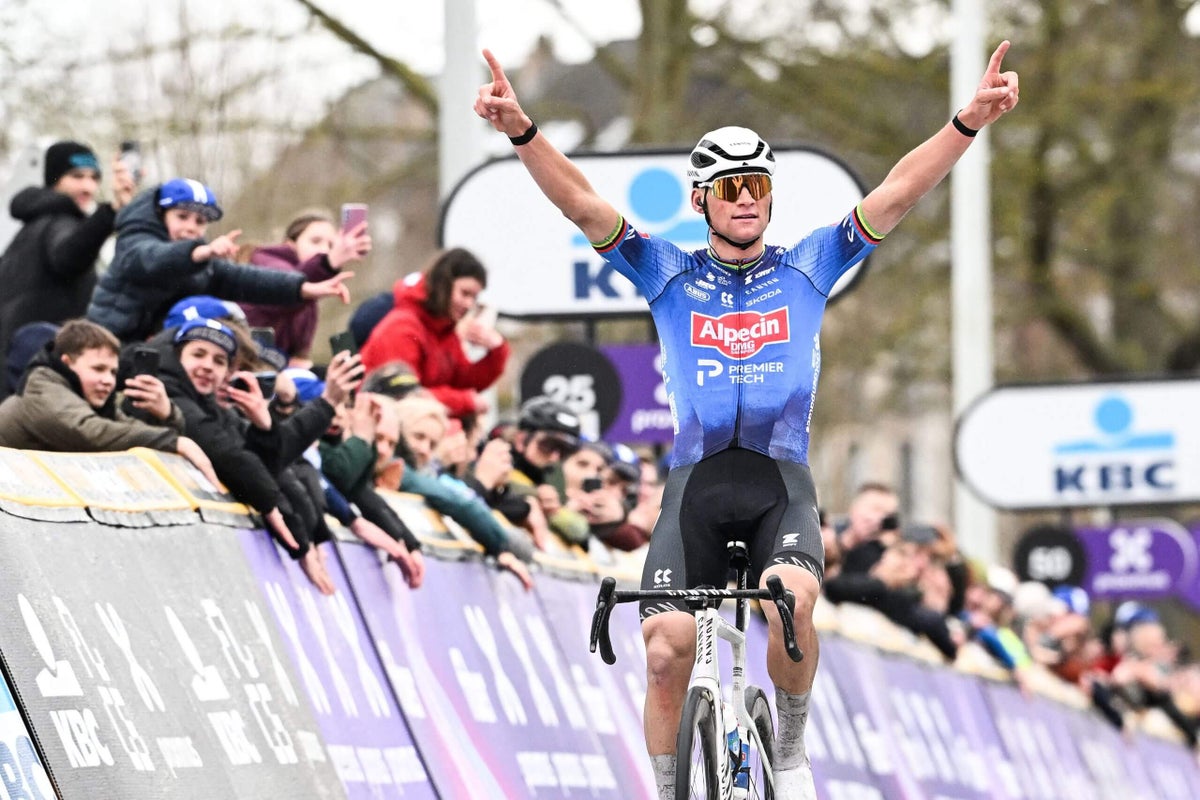
Mathieu van der Poel’s victory in Omloop Het Nieuwsblad on Saturday afternoon marked the beginning of the Spring Classics — and begins to tee up his upcoming clashes with Tadej Pogacar over the next two months. Demi Vollering, meanwhile, made it double Dutch in Belgium after winning a two-up sprint with Kasia Niewiadoma-Phinney.
Historic, storied races now fill every weekend until mid-April. Strade Bianche is only seven days away. This is what the Omloop taught us.
Cycling’s traditional curtain raiser foreshadows bigger races to comeThe Omloop is the beginning of the European cycling season proper — with several big-name riders kicking off their campaigns, including Mathieu van der Poel. But it is also a quirky race in its own regard — probably best thought of as a mini Tour of Flanders — filled with typically steep and cobbled Belgian climbs and usually carrying the murky, slippery weather of late February.
This can lead to surprise winners — nobody foresaw Uno-X’s Søren Wærenskjold taking victory last season. But unsurprisingly, the race is usually decided on the climbs — classic ascents such as the Molenberg, Muur van Geraardsbergen, and the Bosberg splintering the peloton.

Welcome to Belgium in late February (ELIAS ROM / BELGA MAG / Belga / AFP via Getty Images)
Yet despite this profile, winners of the Omloop have traditionally struggled at the Tour of Flanders — no rider has ever won both races in the same season. Perhaps Wout Van Aert, who was ruled out of the Omloop with illness this week, can take some small solace from this detail, given he is still missing the Tour of Flanders from his palmares.
With the peloton still searching for race sharpness, this is usually an attritional race — filled with crashes and mechanicals. It was no different this year, riders including Magnus Sheffield, Stefan Kung, Arnaud de Lie and Fred Wright going down, while sprinter Paul Magnier, last year’s runner-up, needed a bike change after his own snarl-up.\\
No debutant had won the race for 25 years. One man was seeking to change that…
Van der Poel kicks off Classics season with dominant winMathieu van der Poel flexed his abilities in last year’s Classics. He won two Monuments — Paris-Roubaix and Milan-San Remo — and was the only rider who looked capable of beating Tadej Pogacar. On early evidence, Van der Poel may be even better.
Making his first appearance at this race, Van der Poel’s physical ability to win the race was never in doubt — the 15-time Classics winner was the undoubted class of the field. But here, the key factor in his ride was race intelligence — positioning himself perfectly at the foot of the Molenberg, using his supreme bike-handling skills to avoid a crash, and pulling himself away into a six-man group with 40km to go. Surrounded by a number of solid professionals, but who lack both his star power and raw power, the race was virtually won by this point.
Van der Poel took the group with him until there were 16km remaining before attacking over the Muur van Geraardsbergen, blowing up the group with what felt like about eight revolutions of his pedals. By the time he reached the chapel at its top, he was utterly alone at the altar — putting 18 seconds into his chasers in just over two minutes of effort.

Van der Poel on the iconic climb of the Muur van Geraardsbergen (DAVID PINTENS / Belga / AFP via Getty Images) / Belgium OUT
Profiting from a tailwind over the next 10 kilometres, he navigated the Bosberg smoothly to lead by 22 seconds over the line, easing up over the final stretches.
“I honestly have no idea (how I stayed up on the Molenberg),” he said post-race. “First, I want to apologise to that Tudor rider (he hit in avoiding the crash). I couldn’t avoid him and I half-ran over him. I hope I didn’t hurt him.”
“I didn’t see what happened behind me, but I assume it was chaos there. There was a big gap with Florian Vermeersch above, and that was the moment of the race.”
Van der Poel’s great rival has traditionally been Van Aert, but as of last season’s, Pogacar’s incursion into the Classics has created a new nemesis. The Slovenian kicks off his own season next week at Strade Bianche, before the pair go head-to-head at Milan-Sanremo on March 21. A battle royale awaits.
It also marks the first WorldTour win for Alpecin-Premier Tech, in their new guise, having signed a co-naming deal with the manufacturing company over the winter — the struggle to find a co-sponsor had put the team’s long-term future in doubt.
How did the other top riders fare?Truthfully, few had a chance. Tom Pidcock raised his arms for the first time this season with a win at the Vuelta a Andalucía recently — but the British rider’s only real opportunity would have been to escape early and lead over the climbs. The opposite occurred — he was caught up in several crashes early and was dropped by the main peloton with 60km remaining.

Tom Pidcock finished the race in 48th place (DAVID PINTENS / BELGA MAG / Belga / AFP via Getty Images)
Another British hopeful, Matthew Brennan, looked strong initially, the 20-year-old phenom driving the pace in the lead group as the race approached its final third. Leading Visma Lease-a-Bike in Van Aert’s absence, he possibly lacked the support to keep him well-positioned, and missed Van der Poel’s decisive move. A late crash did not seem to lead to any serious injury.
Having already won at the Tour Down Under this season, Brennan’s first full-time year at the top-level promises more success.
“For Matthew, this is one big steep learning curve, and this (riding as sole leader) will add to that,” Visma CEO Richard Plugge told Cyclingnews. “But we don’t ask anything from him in the race itself; there’s no pressure from our side. Everything that he’s doing right now is our way to get him to learn some more.”
Vollering takes first Omloop win after dramatic sprintThe women’s race, finishing a few hours later, was a far more exciting affair. Vollering and Niewadoma-Phinney have their own rivalry, the Polish rider having pipped Vollering to the 2024 Tour de France Femmes by just four seconds.
Again, the Geraardsbergen proved the decisive slope — the peloton catching the breakaway trio on its lower slopes, before Vollering and Niewadoma-Phinney powered away over the top. Vollering was always likely to have the stronger finish — and led out the sprint from the front, with Niewadoma-Phinney never looking likely to come round her.
“It feels good,” said Vollering. “My own expectations were that I’d do it — but you still have to actually do it. I’m so proud of the team today. I almost didn’t do anything myself was my feeling.”
Like Van der Poel, Vollering will have hopes of doubling up the Omloop and Tour of Flanders — while she announced this week that she would race the Giro d’Italia for the first time in five years this May.
Comments (0)