
Remember me








Not for the first time, international travel is in turmoil – but on this occasion it's not down to a technology blip, a dust cloud or some other natural disaster.
It's far more serious than that. There is a war going on in the Middle East, with the Foreign Office telling British nationals in Bahrain, Qatar, Kuwait and the United Arab Emirates (UAE) to 'immediately shelter in place…remain indoors in a secure location, avoid all travel and follow instructions from the local authorities'.
Chaos on the ground; chaos in the air. The UAE, Bahrain, Iraq and Qatar have all closed their airspaces in response to the retaliatory attacks on Gulf states by Iran; airlines serving the Middle East have cancelled or diverted flights and thousands of passengers are left stranded at airports in the region.
Zayed International Airport (AUH) in Abu Dhabi and Dubai International Airport (DXB) in Dubai are two of the biggest airports in the world.
And, along with Doha airport in Qatar, these three serve as major hubs for onward connections to the east and to Australia and New Zealand.
Some 127 million passengers passed through Abu Dhabi and Dubai airports in 2025.
And the UAE remains one of the most popular hotspots for British holidaymakers.
Dubai welcomed nearly 20 million international visitors last year, including some 1.32million from Britain.

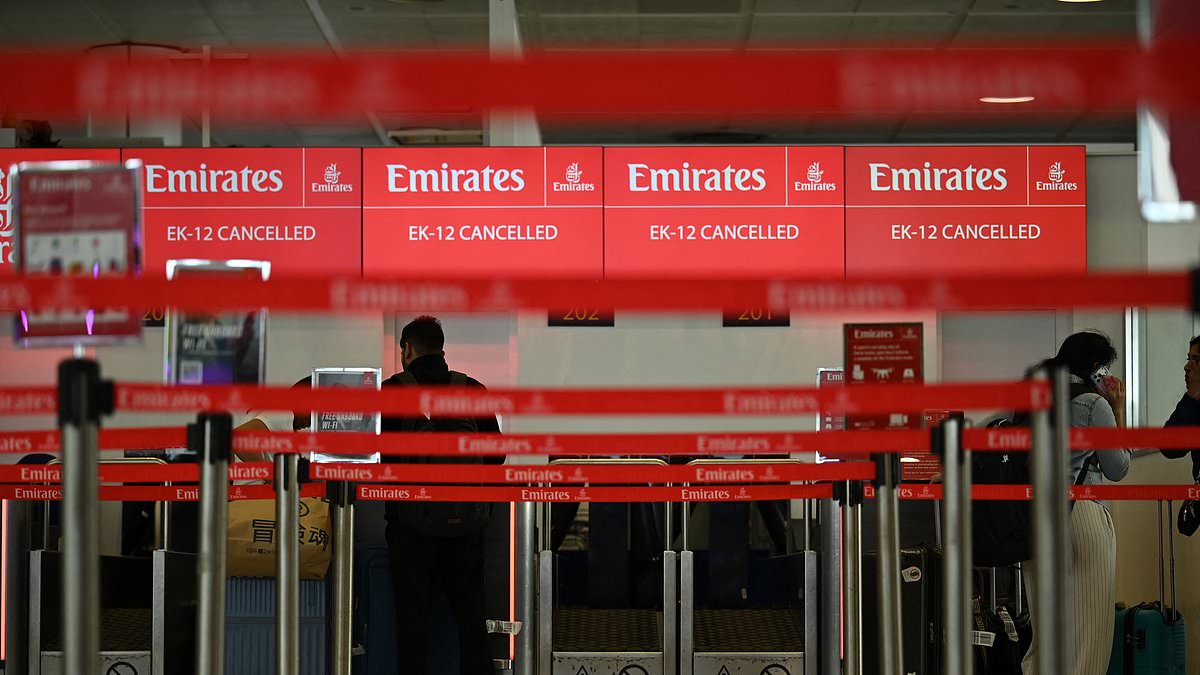
Information on cancelled Emirates flights at London Gatwick airport on Saturday after the US and Israel's strikes on Iran

Explosions from Israeli projectile interceptions over Tel Aviv on Saturday after the nation launched strikes against Iran with the US

Passengers stranded at the Rafic Hariri International Airport in Beirut, Lebanon, on Saturday after the missile attacks

Zayed International Airport (AUH) in Abu Dhabi and Dubai International Airport (DXB) in Dubai are two of the biggest airports in the world. Pictured: A passenger stranded at the airport in Beirut, Lebanon, on Saturday after the missile strikes

Passengers stranded at Rafic Hariri International Airport in Beirut, Lebanon, on Saturday after the missile strikes

A display board showing the cancellation of all flights at Ben Gurion International Airport near Tel Aviv, Israel, on Saturday
And thousands of Britons have moved to Dubai since Labour came to power, driven out of the country by rising taxes and lowering expectations.
In a statement last night, British Airways said: 'We are closely monitoring the situation and have cancelled a number of our flights to the Middle East.
'Safety is always our top priority, and we're contacting our customers to advise them of their travel options.'
Dubai is only 80 miles across the water from Iran, divided by Gulf of Oman and the Persian Gulf.
Those due to fly into the region have been advised to contact their airline to seek the latest guidance.
If their flight has been cancelled they will be due a full refund and the airline will be responsible for picking up any hotel bill or any other expenses associated with the disruption.
But it's not so clear-cut – once flights to the region have resumed – for those who want to cancel due to fears for their safety, because the Foreign Office has not officially advised against travel to the UAE. While that remains the case, airlines may not issue refunds.
Emirates, one of the major carriers in the region, has announced that it has temporarily suspended operations to and from Dubai, stating that they are 'actively monitoring the situation and engaging with relevant authorities'.
Wizz Air has announced that it will be suspending all flights to and from Israel, Dubai, Abu Dhabi, and Amman, with immediate effect until March 7.
Virgin Atlantic is also rerouting flights to avoid Iraqi airspace and cancelled its London to Dubai service.
Nigel Rawlence, a retired businessman from the Isle of Wight, was on holiday with his wife in Abu Dhabi. 'We managed to get out on Friday before the attacks started.
'You would never have known that something like this was about to happen. We consider ourselves fortunate and won't be going back in a hurry.'