
Remember me







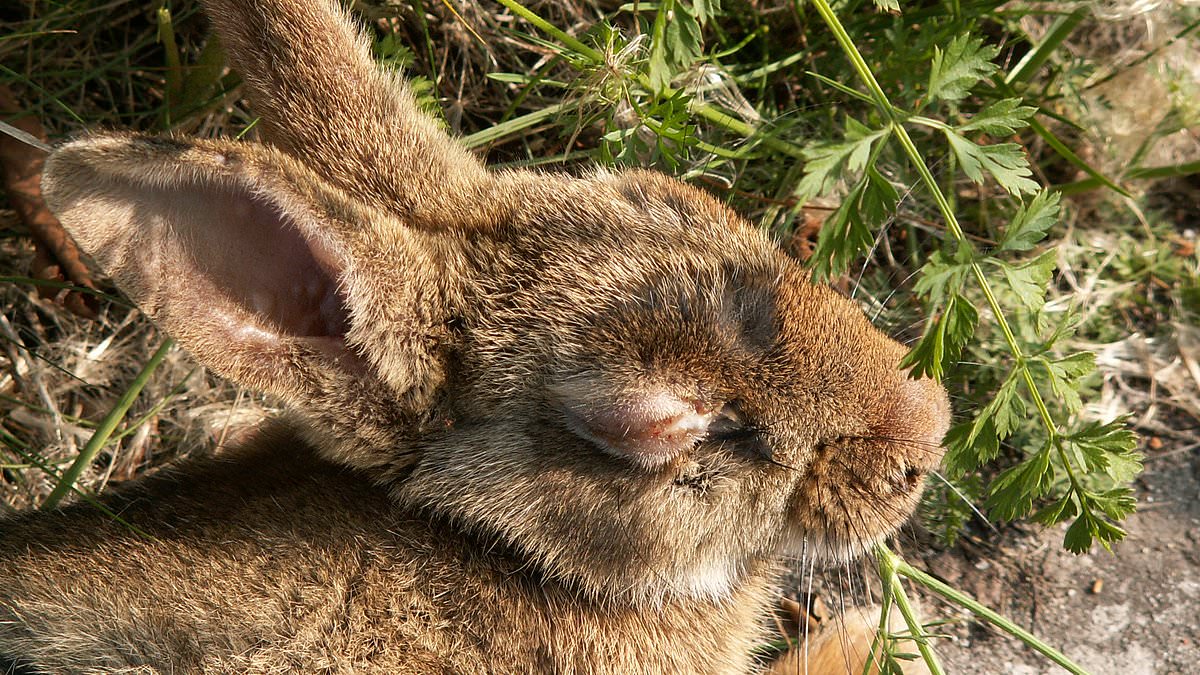


A rabbit plague from China will wipe out 90 per cent on the wild UK population, an expert has said.
An aggressive virus, Rabbit Hemorrhagic Disease (RHD), has seized bunnies across the globe and has been silently decimating British populations for over a decade, but now a new, more virulent and deadly variant is thought to have reached UK shores.
RHD kills rabbits in just two days, causing massive internal bleeding that seeps through their noses and bottoms. It is very contagious and there is no cure.
It comes after another viral disease, Myxomatosis, ravaged rabbit populations in the 1950s.
Richard Saunders, vet advisor for the Rabbit Welfare Association and Fund (RWAF), told The Daily Mail: 'Myxomatosis wiped out around 90 per cent of the rabbits in the UK, but then that population has snuck back up.
'I would say RHD will do a similar thing, but I don't see the population coming back up again.'
The deadlier strain is called High-Virulence RHD2. Mr Saunders warned: 'If we haven't got the high virulence form in the UK already, we're going to get it. It's only a matter of time.'
Testing is not yet accurate enough to distinguish between new and old strains so there is uncertainty about its presence in the UK. RHD was initially detected in China in the 1980s. It came to the UK in 2013 and has been killing rabbits ever since, but the new variant would accelerate the population decline, Mr Saunders said.

Pest controller Lance (pictured) noticed the number of rabbits dropping massively where he lives in Kent

Lance used to take 100 to 150 rabbits a night when going out on a lamping shoot, now he's lucky if he gets six
It's not just experts who have noticed the massive decline in rabbit populations, as farmer Lance, who did not give his last name, has seen during rabbit shoots over the years.
Lance told the Daily Mail: 'I do a lot of shooting and we used to think nothing of getting 100 to 150 rabbits on one night of lamping eight to ten years ago. Now you're lucky if you get six.'
He added: 'I can think back when we used to cut grass for hay and silage, and around the hedges in the fields there was hardly any grass because the rabbits used to graze it like a lawn.
'Now you can cut right up to the hedgerows because there aren't any.'
Lance believes the disappearance of rabbits could have serious knock-on effects - pushing hungry foxes to attack farm animals more due to the scarcity of one of their main food supplies.
He has said he has stopped shooting and eating rabbits due to low population numbers. He does not think overhunting is the problem because rabbits are usually such prolific breeders, and Mr Saunders agrees with him.
The vet advisor pointed out that 'people have been trying to hunt them with the intention of wiping them out in certain areas, and haven't come close over decades.'
Mr Saunders explained why the virus is a much more comprehensive killer than hunters. He said: 'Even if they do develop immunity, the virus may be able to get one step ahead and develop a new strain.

Richard Saunders, vet advisor for the Rabbit Welfare Association and Fund, said RHD will kill 90 per cent of the UK wild rabbit population and numbers won't rise for the foreseeable future

Myxomatosis killed around 90 per cent of rabbits in the UK and RHD will do the same, Mr Saunders said. Myxomatosis came to the UK in the 1950s. Infected rabbits had painful swelling around the eyes and genitals (pictured) and quickly died
'So I think it's fair to say that some form of RHD will be here for the foreseeable future, and that it's going to drop rabbit populations and keep them quite low.
'As soon as rabbits get over a certain population density, it'll spread more easily. Possibly their only defence is being scattered enough in numbers and distribution to avoid spreading the virus until they develop some sort of immunity.'
Humans cannot catch the illness, but Lance said he has stopped eating rabbits because of it. However, the disease is a deadly threat to domestic rabbits.
There is a vaccine developed on the continent now available to domestic bunnies in the UK. While this could be an effective counter for human-kept rabbits, vaccinating wildlife is riddled with practical and ethical difficulties, Mr Saunders said.
RHD is an incredibly robust virus and, in ideal steadily cold conditions without UV light, it can live for up to eight months without a host body.
Its survivability has been instrumental to its spread across the globe. Mr Saunders said: 'The original form of RHD1 came from China in the 80s, and it was just tracked across the globe on car tyres and shipping containers.
'It's just another one of these awful ways in which human intervention has caused the death on a population scale of animals out there.'
He continued: 'It's everywhere. It's been identified on tiny, rocky islands with only seabirds living on them. It's been identified in places that don't even have rabbits as predators bring back their infected prey.'
With fear of the new high virulence variant reaching the UK, testing is vital in the battle against RHD, Mr Saunders said. The RWAF are involved in developing more accurate tests for the new variant, but it is proving a difficult task and Mr Saunders has called for more funding to be put towards this global rabbit pandemic.
The loss of the rabbit population will have a real effect on people too. Mr Saunders believes that farmers will miss the presence of rabbits. He said: 'In terms of biodiversity, rabbits are actually quite good in UK farmland because they dig around and they scatter seeds and they get rid of some of the more dominant plants.
'So I almost could see a situation where farmers were quite sad to see them go to encourage them to come back.'
In the animal kingdom, Mr Saunders believes that predator populations - like foxes, and birds of prey - will likely be lowered because of heavy depletion of the rabbits as a significant food source. He believes that because of this, farmers should be safe from increased attacks on their livestock from hungry foxes, contrary to Lance's warnings.
As a closing message, Mr Saunders added: 'It would be lovely if we got some financial assistance with developing testing. It would be lovely if people knew about this so that they can make sure at least the domestic pet rabbits were vaccinated.'