This is a rush transcript. Copy may not be in its final form.
AMY GOODMAN: This is Democracy Now! I’m Amy Goodman.
The United States and Israel are facing global condemnation for launching unilateral attacks on Iran without seeking approval of the U.N. Security Council.
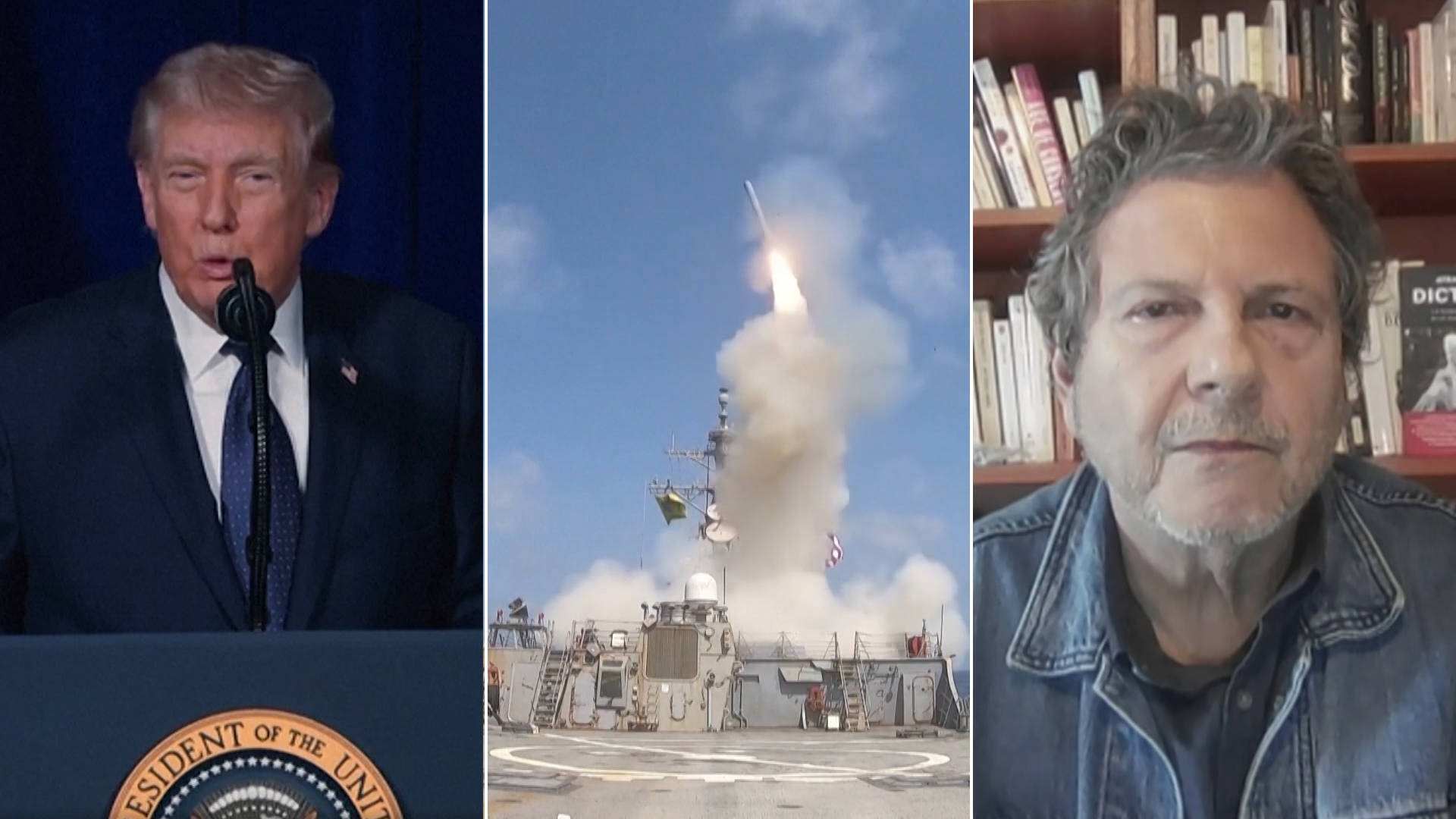
We go now to France, where we’re joined by Reed Brody, longtime war crimes prosecutor, member of the International Commission of Jurists, author of To Catch a Dictator.
Reed, if you can respond to what has taken place, the U.S.-Israeli attacks on Iran, and then Iran retaliating by sending missiles and drones throughout the Gulf and against Israel?
REED BRODY: Sure, Amy. I mean, look, whatever you think of the theocratic dictatorship in Iran, these attacks by the U.S. and Israel are a clear violation of the foundational principle of the postwar legal order, which is the nonuse of force. So, the U.N. Charter is not ambiguous. Article 2, Section 4 prohibits the use of force against the territorial integrity or the political independence of any state. And there are only two exceptions: one, if the Security Council authorizes it, which obviously nobody saw here, or self-defense. And that means self-defense in response to an actual or an imminent armed attack. And here, there was no — it’s obvious there was no such imminent attack. President Trump even said last year that he had obliterated Iran’s nuclear capacity. As you’ve reported, both sides had just concluded the most intensive round of nuclear talks. So there was no immediate threat here. And so, President Trump has presumptively committed the crime, the international crime, of aggression, as he did in Venezuela and as — and just as Vladimir Putin did in Ukraine. And at the Nuremberg trials, the supreme international crime was considered to be aggression, crimes against peace.
It’s also important to remember that under U.S. law, as you’ve put it, the Constitution gives Congress, not the president, the power to declare war. And this is not some quaint historical debate. The framers were very cognizant that executives, that kings start war, and that war is the most consequential decision that a nation can take, and it should not be left to a single person’s judgment. The framers had seen the alternative, the royal prerogative of bringing a war, and that was precisely the kind of tyranny they wanted to avoid, that one person, on a whim, or for whatever — I mean, obviously, they had — I don’t think the founders ever imagined that they would have a president who would launch a war because he was dropping in the polls or because he wanted to divert from the Epstein files or because he had — he didn’t get the Nobel Peace Prize. But, you know, it is a foundational principle here that the president cannot just declare, decide to go to war. He can do it in an emergency. And that’s why the Constitution says — doesn’t say that only the Congress can make war, because they allow the president in the case of an emergency, but not to declare war and keep a war going.
AMY GOODMAN: We have 10 seconds. President Trump now told The Atlantic magazine, “They want to talk, and I’ve agreed to talk, so I’ll be talking to them,” as the U.S. and Israel strikes Iran hundreds of times, and apparently the Pentagon, the president is saying, this will go on for weeks.
REED BRODY: Well, you know, I mean, we’re shifting — I mean, this shows that there was no plan here. The whole reason — I mean, one of the main reasons to have, you know, this constitutional provision is so that a war can be deliberated, so you understand what a war is about. You go to the people, you go to the Congress —
AMY GOODMAN: Five seconds.
REED BRODY: — you deliberate, and you decide as a nation there should be a war or there shouldn’t be.
AMY GOODMAN: Reed Brody, war crimes prosecutor, member of the International Commission of Jurists. That does it for our show. I’m Amy Goodman. Thanks so much for joining us.