Crystal shops popping up on every corner show that surrounding ourselves with beautiful-looking rocks has become more mainstream in recent years, moving away from a niche “New Age” passion.
Evidence from archaeological sites proves that the fascination with crystals started thousands of years ago. Found alongside hominin remains as long as 780,000 years ago, crystals raise the question of why they were so important, since there was no indication these rocks were used for tools, weapons, or jewelry.
To understand the roots of our obsession with crystals, researchers from Spain observed chimpanzees after handing them different kinds of crystals to explore which properties may have sparked the interest of early hominins in a recent study published in Frontiers in Psychology.
“We were pleasantly surprised by how strong and seemingly natural the chimpanzees’ attraction to crystals was. This suggests that sensitivity to such objects may have deep evolutionary roots,” said study lead author Juan Manuel García-Ruiz, professor of crystallography at the Donostia International Physics Center in San Sebastián, in a press release.
Chimpanzees Prefer Crystals Over Rocks
Since chimpanzees are humans’ closest living relatives, studying their behavior gives us a good idea of our own origins. To understand the underlying factors behind our fascination with crystals, the research team gave nine encultured chimpanzees (raised by humans and exposed to human environments) a range of different crystals, rocks, and pebbles.
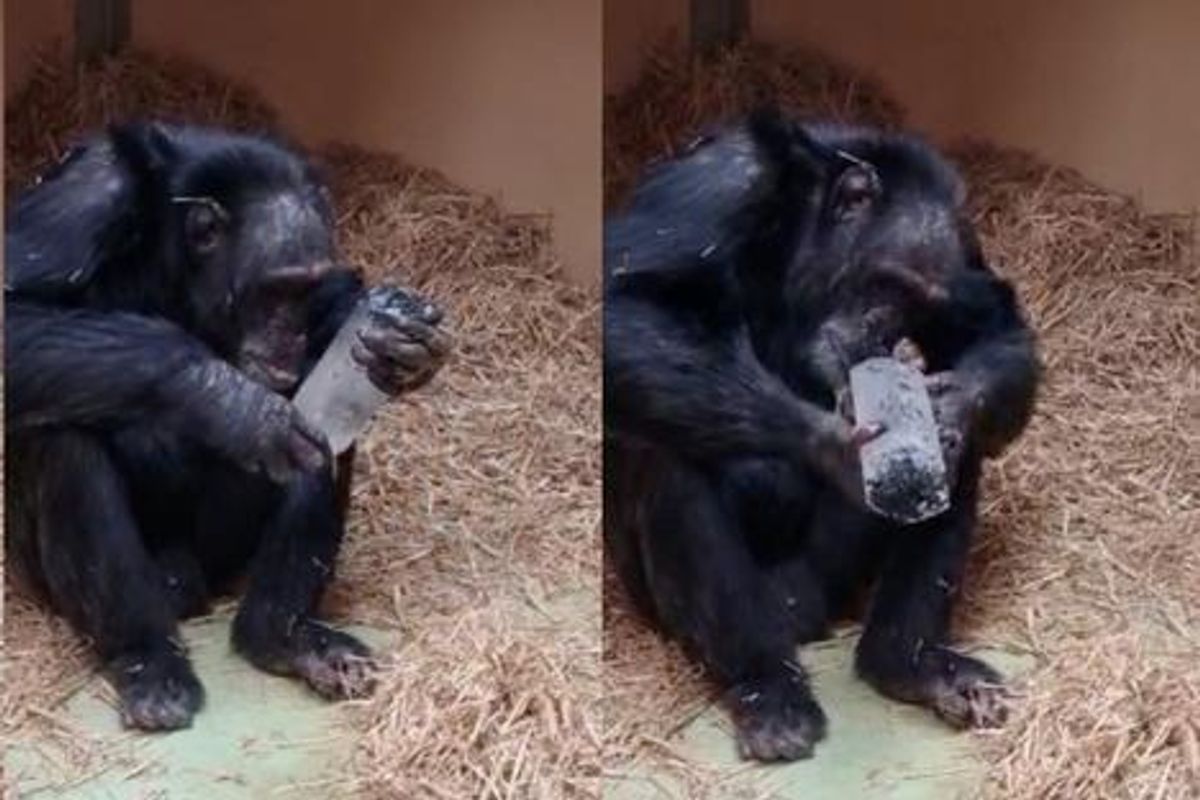
The first experiment introduced a large transparent quartz crystal alongside a similarly sized rock placed on a platform. Observations showed that the chimps preferred the crystal over the rock, inspecting it closely, with some even carrying it to their dormitories.
While interest declined over time, this lines up with human behavior in response to unfamiliar objects. Overall observations showed the chimps handled the crystal with care for several days, requiring the team hours of negotiation with favored foods (bananas and yoghurt) to retrieve it, suggesting the crystal was highly valued.
Read More: A Baby Macaque Has Gone Viral with His Plushie — What Punch Tells Us About Social Hierarchies
A Collection of Crystals Kept Chimps Busy for Hours
The follow-up experiment investigated whether chimpanzees could differentiate multiple crystals from other stones and how important the crystals’ shape and transparency were. The apes could identify and pick out different types of crystals (quartz, pyrite, and calcite) from a pile of 20 pebbles in just a few seconds.
“The chimpanzees began to study the crystals’ transparency with extreme curiosity, holding them up to eye level and looking through them,” said García-Ruiz.
Many chimpanzees were occupied with the crystals for hours. One ape, Sandy, transported crystals and pebbles in her mouth to sort them on a platform, which is unusual, as chimps are not often observed carrying objects that way, highlighting the preciousness of the items.
“She separated the three crystal types, which themselves differed in transparency, symmetry, and luster, from all the pebbles. This ability to recognize crystals despite their differences amazed us,” added García-Ruiz in the release.
Understanding Evolutionary Roots of Aesthetics
To further understand their motivations, the researchers emphasized that in future studies, chimps’ personalities should be taken into consideration.
“There are Don Quixotes and Sanchos: idealists and pragmatists. Some may find the transparency of crystals fascinating, while others are interested in their smell and whether they’re edible,” said García-Ruiz.
Additionally, the experiments should be repeated with wild apes, as encultured chimpanzees are frequently exposed to novel objects, which might impact their reactions in the experiment.
Overall, the experiments identified transparency and geometric shape as the two main factors of attraction for chimpanzees. These may also be the properties early humans were drawn to, since the natural world rarely contains items with straight lines and flat surfaces.
“Our work helps explain our fascination with crystals and contributes to the understanding of the evolutionary roots of aesthetics and worldview,” concluded García-Ruiz in the release.
Read More: Macaque Monkeys Could Unlock the Brain Secrets Behind Motivation — and Inspire New Mental Health Treatments
Article Sources
Our writers at Discovermagazine.com use peer-reviewed studies and high-quality sources for our articles, and our editors review for scientific accuracy and editorial standards. Review the sources used below for this article: