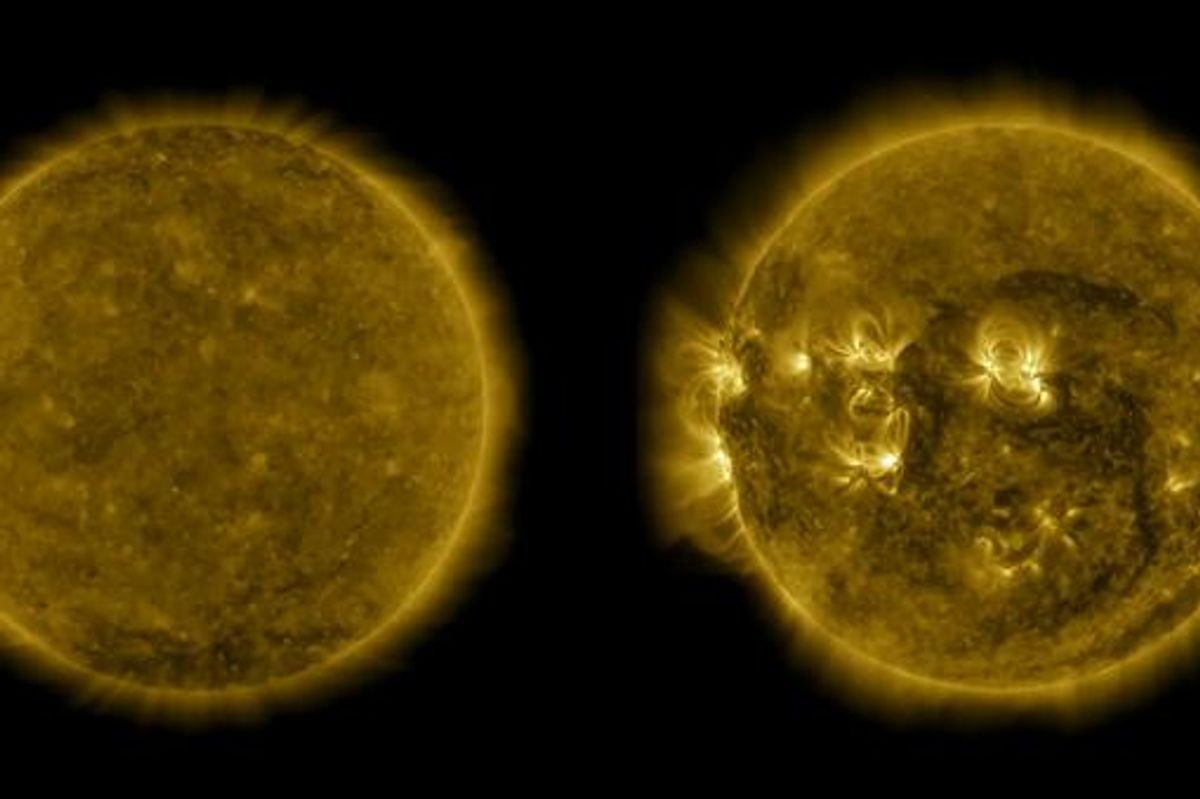
About every 11 years, the Sun moves through a familiar rhythm. Sunspots spread across its surface, flares snap into view, and then activity tapers off into a quieter phase known as solar minimum — when the star looks calmer, and its magnetic grip loosens.
The solar minimum between 2008 and 2009 lasted longer and ran quieter than most in recent decades. When astronomers lined it up against three other quiet periods spanning more than 40 years, the Sun’s outer layers didn’t match. Sound waves traveled faster through parts of the star, and a helium-related signal was stronger than in the other minima. Together, those clues point to shifts in temperature, pressure, and magnetic strength beneath the surface.
Those internal differences may influence how the next cycle gathers momentum, shaping the space weather that can ripple outward toward Earth and affect modern infrastructure. The findings appear in Monthly Notices of the Royal Astronomical Society.
“For the first time, we’ve been able to clearly quantify how the Sun’s internal structure shifts from one cycle minimum to the next,” said Bill Chaplin, from the University of Birmingham, in a press release. “Deep quiet minima can leave a measurable internal fingerprint.”
Probing the Sun’s Interior With Sound Waves
To track those shifts, researchers turned to helioseismology, the study of vibrations caused by sound waves trapped inside the Sun. Those waves make the star oscillate gently, and their patterns show what’s happening beneath the surface.
The data came from the Birmingham Solar-Oscillations Network, or BiSON, a global set of ground-based telescopes that has monitored the Sun’s vibrations continuously for more than 40 years. That long record allowed researchers to compare four successive solar minima side by side, the first time such an internal comparison has been made across multiple cycles.
One key signal, often referred to as the helium “glitch,” provided a sensitive marker of changes in the Sun’s outer layers. By tracking how that signal shifted from one minimum to the next, researchers could detect structural differences that would not be visible by looking at sunspots alone.
Read More: Planets With Two Suns Are Almost Impossible To Find — General Relativity May Be Why
How Quiet Solar Periods Shape Space Weather
Solar minimum may look uneventful, but it sets the stage for what follows. The Sun’s magnetic cycle drives space weather — bursts of radiation and charged particles that can interfere with radio communications, distort GPS signals, damage satellites, and strain electrical grids.
“Revealing how the Sun behaves beneath its surface during these quiet periods is significant because this behaviour has a strong bearing on how the activity levels build up in the cycles that follow,” said Sarbani Basu, from Yale University, in the press release.
If the starting conditions shift during especially deep minima, the strength and timing of the next cycle may shift as well.
Improving Solar Cycle Forecasts
This kind of insight only shows up with time. Without decades of continuous observations, the differences between these quiet periods would have been easy to miss.
The long record now offers something more than a historical snapshot; it provides a test. Solar models used to forecast future activity must be able to reproduce the structural shifts seen during the 2008 to 2009 minimum, as well as the relative stability of other cycles. If they cannot, it may mean the physics driving those changes is not yet fully captured.
The same technique could eventually be used on other stars. Missions such as the European Space Agency’s PLATO observatory will monitor Sun-like stars in similar ways, allowing astronomers to compare how magnetic cycles play out beyond our solar system, and how those changes might influence nearby planets.
Read More: Earth’s Magnetic Field Flips Regularly — Some Reversals Last 70,000 Years
Article Sources
Our writers at Discovermagazine.com use peer-reviewed studies and high-quality sources for our articles, and our editors review for scientific accuracy and editorial standards. Review the sources used below for this article:
This article references information from a recent study published in Monthly Notices of the Royal Astronomical Society: The seismic diversity of four successive solar cycle minima as observed by the Birmingham Solar-Oscillations Network (BiSON)